|

May I suggest that you navigate the site via the
index on page 001. PRIOR PAGE / NEXT PAGE PRIOR PAGE / NEXT PAGE
Do you want to make a comment? A site guestbook is here. Copyright?
Test.
On this page ...
Old Sunderland,
Early Sunderland in words and images,
The Sunderland Flying Boat.
To search for specific text on this page, just press 'CTRL +
F' & then enter your search term. A general site search facility is here.
I sincerely thank Brian Wharmby
of Leicestershire, U.K., for providing the fine work that appears on this page.
A sepia etching of the River Wear in
Sunderland, 50 cm x 35 cm in size.
Only one of the two
'Wharmby' works
(the other is here) is titled, specifically the image on this page. It is entitled 'Old Sunderland'
& is marked 'From a
Painting
by Tom M Hemy and Etched by the Artist', as indeed you can see below. It was published by Hills and Co, Printsellers,
of Sunderland, on Nov. 1, 1888.
The work has not been removed from its frame, so
it is possible that more data is recorded on the rear of the print. Brian
acquired both prints at a Newcastle upon Tyne auction in May 1974. Both were, I understand, framed by J. Burnham, Gilder and Picture Frame Maker, of 1 Derwent Street,
Stockton Road, Sunderland.
OLD SUNDERLAND


Now a work similar to the above is located in the Tyne and Wear Museums - indeed the image can be seen
& enlarged in sections
here at the Tyne and Wear Museums' Collection On Line. It
may well be the original work depicted in the above print, because it is entitled
also 'Old Sunderland' and while not identical is most similar. It would be good
to be able to show the Museum painting on this page in full size. I do show,
however, the large thumbnail of it which appears on the Museum site. And trust
that the use of that thumbnail image on this non-profit & informational site
is in order.
The original work in the Tyne and Wear Museum is very large indeed. And most impressive. Almost 8 ft wide in
fact. Far more impressive than
I can impart via this page. Shauna Gregg, of Tyne & Wear Museums, advises that
it is dated 1885. These are the words with which the Museum describes their work,
which is
an oil on canvas of 232.7 cm by 154.0 cm (about 92 x 61 inches):
 |
'The busy River Wear at Ettrick's Quay, Sunderland is pictured
in this scene. Huge anchors with their chains lie in heaps on the quay, and the
keel (barge) at the front of the picture is also filled with anchors. Smoking
chimneys add a haze to the subdued evening light. The area shown here was
cleared in 1932 for the construction of Corporation Quay. Thomas Hemy lived in
Sunderland for some years, before moving to London in about 1885. This is one of
his most important pictures.'
|
|
The two works are different, witness the
angles of the ships' masts at the right edge of the images. So is the painting
in the Museum truly the original? The webmaster does not pretend to be an expert
on such matters, but suspects that it IS indeed the original.
At right is a Raphael Tuck & Sons 'Oilette' postcard view of what also looks to be Ettrick's Quay, Sunderland. A card by artist Parsons-Norman, mailed, the eBay vendor advised, in
Oct. 1905. It sold for GBP 10.62 or US $16.56 on Jan. 11, 2010.
Now Ettrick's Quay was, Andy Dennis advised having consulted an early map, at
the mouth of the river. Where the looming building is at left in the painting
would seem to have been the Custom House, on 'Custom House Quay' in 1897 (and
Corporation Quay today). So the painting must be of the 1888 view from the south
bank looking inland & westward (maybe south westward considering the course of
the river there). The two chimneys in the background of the image are from a
brewery, I understand. But we are not yet sure which brewery it was. It probably
was of 'Sunderland or
Robertson's Brewery' however. Does anyone
know for sure?
But maybe the chimneys are
not from a brewery at all. 'Nemo', a Sunderland resident, has written in to say that he believes they,
in fact, belong to an old power station. Thanks, Nemo!
| |
 |
Hemy's etching would
not have been produced by a mechanical process. Lines in an etching are
eaten into the plate by the action of an acid rather than being gouged into the
plate with a tool. One can imagine the artist
working in his studio on the etching plate & looking up constantly to the
original painting perhaps sitting on an easel beside him. He would look at the painting
& incise the wax coating or ground on the plate. And look again & incise
again. When sufficiently advanced, the plate would be submerged in an acid bath
& the acid would eat into the metal plate where the wax had been removed.
Lines cut as deeply as required would be coated with stopping-out varnish, &
the process would be repeated to incise other areas or more deeply incise
existing lines to the depth thought desirable. There would
have been multiple dippings of the plate into the acid as the etching advanced to finality.
And then there would be multiple proofs, with the plate being cleaned, ink
applied & an impression taken. And the plate recoated & incised again. A
lengthy process I suspect & truly a labour of love. Who is to say that when
Thomas Hemy worked on the area with the ships' masts at the
extreme right of the image, he did not think that the masts looked better at an
angle. And changed that detail.
There are many WWW sites which define what an 'etching' is, & should you have an interest in
pursuing that matter you should
best read them all.
The word is applied, I read, to both the image etched onto the plate & to an impression
from the plate. I was interested to read, but only in the Wikipedia description,
that 'the process is believed to have been
invented by Daniel Hopfer (circa
1470 - 1536) of Augsburg, Germany, who decorated armour in this
way, and applied the method to printmaking.' To me that sounds rather suspect. I would
truly be surprised if an armourer skilled in the forge would himself apply that process to the most
different discipline of printmaking. But if he didn't, certainly others did.
We sincerely thank Brian Wharmby for images of both of
his etchings, i.e. the one on this page & also the one on page 002. If YOU
could add more information, do please
contact the webmaster.
EARLY SUNDERLAND
IN WORDS AND IMAGES
The webmaster hopes that in the near future more material can be
presented on this page & site of early industrial Sunderland. The contrast between what the River Wear looked like through to the
mid 20th century, & what it looks like today is truly astonishing. The past - the docks
& warehouses,
the shipping, the dingy plants, the
coal loading facilities & their railway lines, the shipbuilding yards, the glass works, the rope factories,
the dirt, the grime, etc. etc. are all
long gone,
& only through old photographs & the work of artists such as Thomas Hemy can one envisage what it
once looked like. Is it
important to know? I think it is else I would not provide this page. And perhaps
you also may think it is important since you have found your way to this very
page.
The few Sunderland scenes that the webmaster has so far seen are
reminiscent of the sights of the east end of London of the mid-fifties & of
the then dirty Thames river & its industrial bleakness. I recall as a young
man the dock area of east London & the dingy rows of slum houses stretching
into the distance in every direction, every one of them belching smoke from its
chimney stack (just maybe burning coal that came from Sunderland!). There
has indeed been giant progress. But that does not mean we should forget the past.
So bear with me as
data re Sunderland is located by the webmaster. But the webmaster is not a
researcher. He lives far away in Canada & has no access to local image archives or museums. So if you, a visitor
to this page, can provide material, it would be most welcome. And would help
advance, I believe, a page or pages that deserve to be written.
My inclination is that over time, this page or maybe
in time many pages,
will evolve into sections specifically directed a) to the shipbuilding history
of Sunderland b) to the coal mining industry of the Sunderland area & c) to other areas
of activity. We now, in fact, have extensive data about shipbuilding, a few
pages about the potteries. More, I trust, in the future.
Before advancing to the images which follow, I should advise you of a WWW site that
features 400 or so postcard images of Sunderland, the postcard collection, I learn, of former Sunderland Fire Officer Tom Marshall.
That collection can be seen here on the
site of James Bryce (of the Southwick History And Preservation Society), whose front door is here. Do drop by!
The sources of the images which
follow? Just 27 images at this moment. I present the best versions of the images I can today. If you have a better image of
any item, do
please consider providing it to the webmaster for inclusion here.
Hold your mouse over each image item to see
the image number coding. The images will surely, with time, not end up numerically sequential. As
re-sequencing is required. Some descriptive words re each can be read below the
many images.
approx. 1300 AD

1870 / 1890
1890 / 1900
An e-Bay item
in Jul. 2022, offered for sale what the vendor noted is
an antique book illustration, taken from 'The Rivers of Great Britain', published by Cassell and Company, Limited, London,
in 1901. i.e. the same illustration as above. The caption below the image
apparently states 'Looking up the River, Sunderland'. Of 5.5 x 8.75 inches or 14.0 x 22.0cm,
in size. With a browner colour to it - most attractive. Do drop by to see it for
yourself! Offered at GBP 14.99 or U.S. $17.91.
Available at the same time
& by the same vendor was an 1895 photograph, clearly the photograph from which the illustration above was created. From a photo by Poulton & Son
published in 1895 in 'Round The Coast' by Geo. Newnes. Ltd., London.
Of 7 x 9.75 inches or 18.0 x 25.0 cm. in size. Offered at GBP 8.00 ot U.S. $10.74.
1900 / 1910


1910 / 1920
1925

1930s

1940s

1960s
1980s

1990s
Items 1), 2)
and 12) are from expired eBay items. Item 2 may be a postcard 'by GD & DL as part of their Star Series.'
Item 3) was from a 'www.british-towns.net' website
where usage for
educational purposes is permitted. But I cannot find the page again! The image itself would seem to date from 1897
(that site says 1900). The original photographer's name? Don't know. The image
was republished in the 1970s by 'Pamlin' of Croydon in the form of a postcard
which postcard refers to the
beached vessel being the 'Lady Katherine'. But are there not two beached vessels
in the image? Perhaps the vessel at centre is the 'Lady Katherine'. I somewhat darkened the pale image which
was available on that page
for a slightly better presentation here, & resized it. And I added it in a larger size, scanned from an actual postcard, though I
can see the result has less detail than the smaller image.
Item 4) is from an expired eBay
item which did not sell.
Item 5) I don't know today. I found it somewhere on the WWW, most probably on eBay, but I do not know where exactly.
Item 6) An image by C. J. Kenyon dating from 1966. It appears low on this interesting railway history
page about the
Lambton Railway & appeared originally
in the Mar. 1991 issue, # 124, of the 'Industrial Railway Record'. Should C. J. Kenyon or 'The Industrial Railway Record' prefer
that the image be removed from this page, I will of course, do so. You can obtain a copy of that issue at the address at the foot of
that linked page. I lightened the image somewhat for use on this page. It was quite dark in the original.
Item 7) is from an expired 'Delcampe' item. A postcard that dates I believe from 1966, since
it was postmarked 'World Cup Sunderland Jul 13 - 23'. The postmarked date was not perfectly clear but I believe read 1966, when 3 preliminary World Cup matches were in fact played in Roker Park, Sunderland.
A couple of copies of it were available on eBay in Sep. 2006.
Item 8) An image by Peter Proud dating from Oct. 1966. It
used to appear
in full size, on the fine
site of the
Lambton Locomotives Trust Limited - a group of enthusiasts whose purpose is to ensure that the Lambton locomotives are
preserved in perpetuity - a great purpose indeed! Site now gone it would seem.
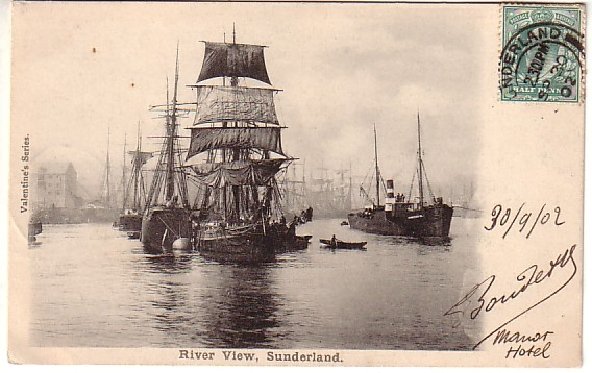
Item 9) is from a 'Valentine's Series' postcard entitled 'River-View,
Sunderland.', which postcard sold on eBay in early Oct. 2006 for GBP 2.99 or approximately U.S. $5.99. I say 'from' because I was not pleased with my earlier
efforts in resizing the card for presentation on this
page. And, since the prime purpose is to show early images here, I have now essentially used
only the image portion of the card, after removing some black marks. The postcard,
as it was listed, can be seen here.
A beautiful card, indeed - posted in Sep. 1902. The image also was published
by Valentine's in colour, it would seem,
this example being posted in 1904.
Item 10) is from an eBay
item that sold in early Oct. 2006 for GBP 0.99, approximately U.S.
$1.85. Most similar to image # 4 beside it, but showing the south side of the river better.
Item 11) is from a now gone
eBay item that sold in mid Oct. 2006 for GBP 4.99, or approximately U.S.
$5.65. Stated to be a page of 8.25 x 10.5 inches from 'The World: its Cities and
Peoples, edited by W. W. Birdsall' Dating from 1892. Entitled 'Looking up the river, Sunderland.'
A later eBay item stated that the image itself is of 6 x 9 in. in size. Most similar to the item a
row or so below it today. Except for the coal hopper cars, all of which are horse drawn.
Item 13) is image # 9 in a number of images provided by the BBC available here
(#9). We thank
the photographer whose name, however, seems not to be stated.
Item 14) is from an eBay item that sold in early Dec. 2006 for GBP 7.52, approximately U.S. $14.73. Of the Toll House of the 1796 Iron Bridge
photographed in 1870. Taken
in the evening or early morning (length of shadows) & maybe on the north bank looking east?
Maybe not, however. A few words in Chapter X of 'The Dress
Lodger' by Sheri
Holman refer to the tollhouse being rather on the south bank.
Item 15) is from an eBay item that sold in mid Feb. 2007 for GBP 7.49, approximately U.S. $14.60. An interesting
1903 image, that I would love to present
here in a better quality.
Item 16) is from an eBay item that sold in mid Feb. 2007 for GBP 11.61, approximately U.S. $22.64. A beautiful card indeed. 'Parsons
Norman' seems to be, in full, George Parsons Norman (1840-1914). Another
copy of the postcard was sold on Dec. 19, 2008. For GBP 16.01 or approximately
U.S. $24.18, after no less than 11 bids. Somebody should start a little website
about the artist whose works are most charming. It would seem that his other
postcard images, & there are many of them, do not seem to command the same value
as does this Sunderland card. Another such card was sold in Jan. 2010 for GBP 3.29 or US $5.25.
And another in Apl. 2010 for GBP 3.50. And yet another,
in Oct. 2011, for GBP 5.60 or U.S. $8.78.
Item 17) is from another eBay item that sold in mid Jan. 2007 for GBP 7.30, approximately U.S. $14.23
Item 18) is a wonderful image of Paddle Tug-Boat Roker, which
seems to date from 1904. Taken at Methil, Stephen Swinhoe advises. A magnificent image in the original. I show part of it only. It sold in late Feb. 2007 for GBP 2.20.
Item 19) The Winter Gardens in 1905. The significant part of a postcard image. It sold in a group of 6 postcards in Apl. 2008. Not a shipping or industrial image, but too beautiful to ignore!
Item 20) The ancient dugout canoe, which is on public display at
Sunderland Museum & Winter Gardens. In an image ex Where Ships Are Born.
The canoe was discovered in 1888, along with some human remains it would seem, in the River Wear river
bed a little downstream of Toby Gill. Toby Gill, itself, is just upstream of Hylton,
I am advised. Keith Cockerill indicates that the canoe was given a coating of creosote-type fluid in the early days in order to preserve it. A process which
had a commendable objective but is surely now regretted - since as a result the wood cannot be carbon dated.
Now the canoe has always been thought to be truly ancient - 'Where Ships Were
Born' suggested it might be 4000 years old. But Keith advises that based upon recent work in other parts of England, presumably on
similar sorts of vessels, this type of
canoe may not be as old as was first thought. Perhaps 700 years
old.
I learn that the boat was found by Harry Watts, as you can read here. The text
is from a book entitled 'Life of Harry Watts', published in 1911 by Halls &
Company at Sunderland & written by Alfred Spencer. A 'www.archive.org'
volume that is available
here.
The text follows, provided so that search engines can
find it.
In the Museum in Borough Road is a Prehistoric Canoe found in the bed of the
River Wear by Mr. Watts when engaged in diving operations. The account of it
given in the 1910 Spring issue of the Sunderland Public Library Circular, is
as follows :-
"This is one of the most important additions ever made to the antiquities department of the Museum.
This ancient dug-out canoe was found in the bed of the River Wear at Hylton,
near Sunderland, about 25 years ago, and was recently presented to the
Corporation by the River Wear Commissioners. As may be seen, it was hewn out
of an oak tree trunk ; it is upwards of 2,000 years old, and may even date back
to the stone age. It may, indeed, be claimed to be Sunderland's earliest boat,
and the forerunner of the many noble vessels which have for centuries been
launched on the Wear, and have made Sunderland's reputation as the largest
shipbuilding town in the world.
"The details of its discovery are as follows
:-
It was discovered by Mr. Harry Watts, the well-known Sunderland diver and
life-saver, when employed by the Commissioners to remove the 'Brixons,' large
stones forming the remains of a bridge which spanned the river at Hylton. The
canoe lay at the river bottom, covered with alluvial mud and shingle, and
contained human bones, which, unfortunately, were not secured. Its size is
about eleven feet long by two feet broad, by one and a half feet deep. Stone
implements shaped like chisels were also found in the bed of the stream near
the same spot, together with deer horns, relics of the times when ancient
Britons, clad in skins, and armed with stone axes, hunted the red deer in the
primeval forests of the county of Durham. Proof of the existence of such forests in times of
yore is not wanting, in the shape of huge trees found water-logged in the bed
of the stream ; and it was doubtless from the trunk of a similar giant of the
forest that the canoe itself was made, probably carved out by stone axes,
assisted by fire."
Item 21) A black & white postcard image of the 'Corner of China Saloon' of the C. W. Wilson & Sons, Glass Manufacturers & Merchants, of 86 & 87 High Street, Sunderland. An eBay
item in Oct. 2011. Image modified for better presentation here
- original.
Item 22) A postcard, mailed Sep. 11, 1903, of Fawcett Street in Sunderland. An eBay
item in Apl. 2012
-
the original image is here
- original.
Items 23
& 24) Views of the River Wear, looking eastward from the road bridge & from
underneath the bridges. In the early
1900s perhaps? Both images are widely available, most often, I believe, as
postcards.
Item 25) A postcard image of a mass demonstration outside the Sunderland Police Station & Magistrate's Court - believed to be in
Feb. 1908. At a time of great unemployment & social unrest in the city. The
original postcard image, in sepia, was kindly provided to the webmaster by Jim
Rice. Such image, in sepia, can be seen here &
can be see here in black
& white, as modified by the webmaster. A stunning image of the faces of the
unemployed in 1908. Jim's scan was even bigger!
Item 26) A photograph of the Winter Gardens. Ex an eBay item
in Aug. 2012.
Item 27) A photograph of one of the onion sellers from France that sold their onions on the streets of Sunderland indeed
on the streets of all the cities of England. We thank the person who supplied the image to the webmaster.
It may possibly have originated with 'The Sunderland Antiquarian Society'
here or
maybe with 'oldsunderland.co.uk'
or with 'readytogo.net'
or with 'opentopia.com'- we thank whoever.
Item 28) The major portion of a tucks 'Oilette' postcard of an artwork
'Sunderland Bridges' by Parsons-Norman in full, George Parsons Norman
(1840-1914). The card is frequently offered for sale on eBay.
Item 29) Sunderland City Hall by moonlight. A postcard published in 1905 by D. F. & Co. of York. Ex a long expired eBay item,
shown much enlarged.
Item 30) Sunderland City Hall. A postcard published, I believe, in the early 1900s. The original eBay image was in sepia. It has been enlarged for inclusion on this page. Ex a long expired eBay item.
Item 31) Sunderland Museum & Free Library. A postcard published, I believe, in 1903. The original eBay image was in sepia. It has been enlarged for inclusion on this page. Ex a long expired eBay item.
Item 32) I seem to have lost track of where this fine
image originated.
Item 33) Ex eBay. A Sunderland Police cap badge stated to
date from the 1930s.
Item 34) Ex eBay. Fawcett Street in Sunderland on Christmas Eve 1987.
The image, by a photographer whose name is unknown to the webmaster, was modified by the webmaster.
Item 35) Ex eBay. A postcard image dating from
1925. Of the River Wear scene, taken from the bridge.
Converted to a black & white by the webmaster from its original sepia.
THE SUNDERLAND
FLYING BOAT
As I add this next item and image, I must confess that I am not sure that it
should even be on this page. I think it
IS a neat image & I like it. And I hope that you do also.
In searching for items re 'Sunderland' there are lots of references to the
'Sunderland' or 'Short Sunderland'. Related to the flying boat of that name. The word 'Short' does not refer
to the aircraft's size but rather to 'Short Brothers', a pioneer British aircraft manufacturer with major experience in marine aircraft design. The company would seem to have been
then based at Rochester, on
the River Medway,
in Kent, about 30 miles E. of London. With the name of 'Short Bros (Rochester
& Bedford) Ltd.' But in the pages I have checked, quite a lot of them
in fact, & at my library, I can see no reference as to why the aircraft
came to be named the 'Sunderland'. There may or likely may not be an association with
the city, however. There was a shipbuilding company in Sunderland of
the very same name.
Can anybody tell us, definitively, whether the two businesses were in fact related
& why the aircraft was called the 'Sunderland'? So far as I can see, the
businesses were not related. Nor have I read anywhere why the aircraft name was
chosen.
But John Appleby advises (thanks!) that since the aircraft, a seaplane,
could land on runways or on water it was decided to name it after a
seaport - hence it was named 'Sunderland' after the city of Sunderland.
Especially so, since it was customary for Short Brothers to name their aircraft with geographical place names beginning with
the letter 'S', such as Sandringham & Stranraer.
Alan Dicey has
kindly been in touch and clarifies many matters about the Sunderland aircraft. Here are his words:-
The name Sunderland was attached to the Short S.25 in accordance with Air Ministry naming convention, which for bombers was a city or town, with flying boats to be named after coastal or port towns. No greater significance
than that. Manufacturers liked to be alliterative where possible, so a lot of Shorts military aircraft had location names beginning with S - Singapore, Seaford, Shetland, Solent, Sunderland, Stirling.
The Sunderland is indeed a seaplane,
but that just means an aircraft that can land on water. It is not an amphibian, which is the term for an aircraft that is fitted with an undercarriage as well as a boat hull or floats, some well-known examples of these being the Grumman
Goose and the Consolidated Catalina, or the Supermarine Walrus, all of WW2 vintage. The Sunderland is a flying boat, with its single boat hull. So no, it could not land on runways, only on water. it could be fitted with wheeled beaching gear
while in the water to allow it to be hauled up a slipway.
There is no connection between Short Brothers the aircraft manufacturer (initially established in London and registered in 1908) and Short Brothers Limited, the shipbuilder, established
as a limited company in 1900. Shorts (then of Rochester) had been building land planes, floatplanes and flying boats since the first World War, culminating in 1936 with the S.23 Empire class, for Imperial airways. The Empire boats were
the basis for the S.25 Sunderland. Sunderlands were built in a separate factory on the River Medway and launched into the river.
The Sunderland performed maritime patrol, convoy escort and anti-submarine duties during the whole of WW2, being fitted with radar as soon as air-to-surface sets were available. It served in all theaters,
with great distinction.
The various coloured pictures:
Sunderlands carried many different camouflage schemes during their time in service.
- Pre-war, overall silver was standard for RAF flying boats - a painted finish, not natural
metal. - The green/brown/black scheme was probably applied very early on, when supplies of the proper colours were short. The official scheme (Temperate Sea Scheme) was Extra Dark Sea Grey/Dark Slate Grey (which is greenish) with Sky
undersides. There isn't any documentary evidence of green and brown being applied, but it is possible, and a few reference books have drawings of Sunderlands in such a scheme. Monochrome photos can't really show the difference.
- The
aircraft coded D-AG shows the Temperate Sea Scheme, right for 1940-41. In 1942, Sunderlands had white undersurfaces and sides, camouflage restricted to the very top surfaces. In 1943 the top surface colour changed to plain grey. Australian-based Sunderlands
were green. I think the artist has used the Shorts promotional photo as his reference, and later given it the colour scheme of the day.
He's made a small mistake, too - his reference for the camouflage scheme is probably one of a set, all from the
port side, taken by a photographer from 'The Aeroplane' magazine, who was in a second Sunderland, part of a convoy escort operation in May 1940 (they appear in many reference books). The proper code is DA-G, consisting of DA for 210 Squadron and G to
identify the individual aircraft. On the starboard side it would be rendered either with two letters aft of the roundel (DA-G) or as G-DA, but the artist has kept the letter order and spacing from the port side. AG were the code letters for 197
Squadron, a fighter-bomber unit formed in 1942 and flying the single-seat Hawker Typhoon.
The Short Brothers photo is from the manufacturers publicity department, and appears in contemporary aero magazines - I found a copy in 'Flight' for
April 20th 1939. The archives of Flight magazine are available online, which is very useful in this sort of search.
Fun stuff for the modeller.
In Dec. 2008, a 2 fold
(6 panel) leaflet was offered for sale on eBay. Published by Short Brothers and
Harland Ltd., of Belfast, & entitled 'Three-quarters of a Century in Aerospace,
Shorts 1901-1976’. It commemorated 75 years of 'Shorts' aircraft, from
Oswald and Eustace making balloons in Hove in 1901 to the Seacat, Tigercat & Blowpipe guided missiles
from Belfast. 'It’s a time for looking back with pride to the achievements
which have established Shorts among the great names of the industry – and for
looking forward to our next 75 years and the achievements that lie ahead’.
'Shorts', the vendor advised, was bought by Bombardier Aerospace in 1989. No
association whatsoever with the City of Sunderland, or none that I can see. But
I leave the following image on the page regardless - because I like it.
Should
you be interested there are a great many WWW pages about the aircraft, a great many books
& a great many photographs, as is
befitting such a brilliant & successful aircraft. A search via Google or on eBay,
or a visit to your local library, will produce a wealth of information.
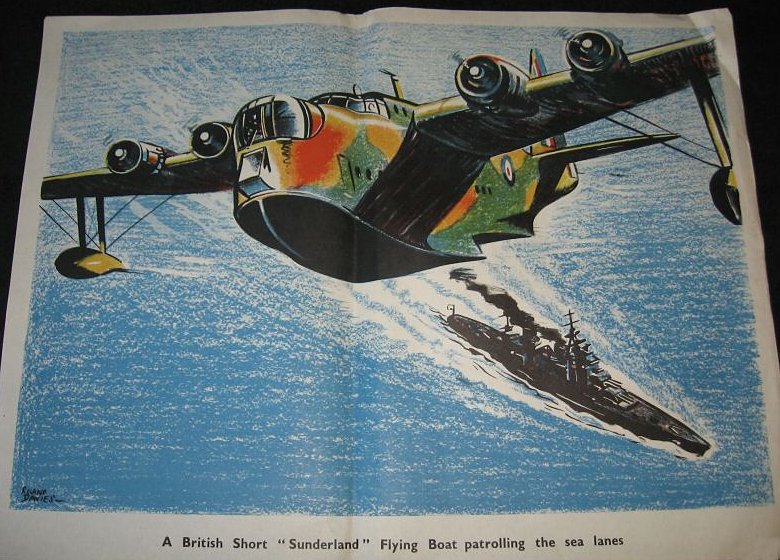
My conclusions may prove to be quite wrong. But the image that follows is most attractive. It is from a 1940's poster,
sold on eBay
in Sep. 2006 for just U.S. $0.99 - a 15 x 20 inch print by artist P. E. Davies.
The poster sells, I believe, on
eBay with some frequency.
Next a postcard image of the 'Short Sunderland' as published by
J. Salmon Ltd., & numbered 4844. Featuring the artwork of A. F. D. Bannister, a
prolific artist indeed. The postcard was sold on eBay with an even larger listing image than I show
below.
There is a puzzle re this card - I have seen other cards of identical
publisher name & card number that show the plane in white or silver, as you can
see here. Winston Churchill's words as Prime Minister are recorded on the card's
back - 'This is a time for everyone to stand together, and hold
firm!'.

A 1939 advertisement for the aircraft, from a long gone source.


DATA SOUGHT
A listing of items that would, if available, add to my
presently limited
body of knowledge of Sunderland. I do not really
want the following, per se. Just to read them in order to see whatever new data that they might prove to contain. If you could help in any way,
drop me a line.
There are many more I should add to the lists - there are a lot of books
published about Sunderland.
Sunderland history generally
| 1 |
'Sunderland
Through Time' by Keith Cockerill.
|
96 pages, soft cover, illustrated with 180 photographs. Published, in 2009, by
Amberley Publishing. ISBN 1848685769 |
Shipbuilding and shipping
| 1 |
'Port of Sunderland 1950'.
|
120 pages, illustrated with photographs & maps. Published by the Port of Sunderland, it would
seem. |
|
2 |
'Sunderland Shipyards'. By Andrew Clark. |
128 pages illustrated. Published 1998 in the 'People's History Series'.
|
|
3 |
'Sunderland - The Biggest Shipbuilding Town in the World' by
Alan Brett and Andrew Clark. |
Published 2005.
|
The bridges and the river
|
1 |
'Bridges of the River Wear' by Keith Cockerill. |
128 pages illustrated. Published 2005 in the 'People's History Series'.
ISBN 1902527348. |
|
2 |
'Sunderland - A River of Life'. By Jack Curtis. |
96 pages illustrated. Published 2003 in the 'People's History Series'.
|
The coal mines
|
1 |
'A Wearside Mining Story, including
an account of the sinking of Wearmouth Pit, Co. Durham, and the birth of the
Durham Miners' Association at that Colliery' by John Elliot McCutcheon. |
Published
in 1960 by the author at 2, Ambleside Avenue, Seaham,
Co. Durham. 101 pages with over 30 photographs. |
|
2 |
'Sacrifice , Achievement , Gratitude (Images of The Great Northern Coalfield in Decline)' by Aidan Doyle. |
116 pages illustrated. Published 1997. Publisher name presently unknown.
|
|
3 |
'Adventures in Coal'. The beginnings of the
coal mining firm of Henry Briggs, Son & Co. in Yorkshire c. 1826 to
1890. By John Goodchild. |
96 pages.
A monograph of 'Northern Mine
Research Society', published Aug. 2000. British Mining No. 66.
|
The railways
|
1 |
'Railways in England, 1826 & 1827' - by C. von Oeynhauser & H. von Dechen. |
98 pages illustrated. Observations collected, I read, during a study of the railways at Darlington, Sunderland,
Liverpool/Manchester, Bolton-le-Moors/Leigh, etc. Published by the Newcomen Society by W. Heffer & Sons Ltd. of
Cambridge. |
May I suggest that you navigate the site via the
index on page 001.PRIOR PAGE / NEXT PAGE
Thomas M. M. Hemy Data Pages
01,
02
&
03 are now on site. Plus all
of the other image pages, accessible though the index on page
05.
To MV Danmark
Slider Puzzle Page
&
to the
Special Pages Index.
| A SITE SEARCH FACILITY
THE GUEST BOOK - GO
HERE
|
|
|