|

May I suggest that you navigate the site via the
index on page 001. PRIOR PAGE / NEXT PAGE PRIOR PAGE / NEXT PAGE
Do you want to make a comment? A site guestbook is here.
On this page ...
Short Brothers
Copyright?
(84 = 84) Test.
 Miramar,
Plimsoll, images, mariners-l.co.uk
(none), Excel DP, MNL, eBay, Delcampe, Mar. 18, 2021 Miramar,
Plimsoll, images, mariners-l.co.uk
(none), Excel DP, MNL, eBay, Delcampe, Mar. 18, 2021
Corrections in any of the material which follows, however tiny,
would be most
welcome. And
additions, of course!
To search for specific text on this page, just press 'CTRL +
F' & then enter your search term. A general site search facility is here.
SHORT BROTHERS
SHORT BROTHERS LIMITED
SHORTS' SHIPBUILDERS
This is the second 'Short' page, made necessary by the increasing number of listings re
'Short' built vessels.
The first page, with the first 100 vessels, is available
here.
Names of just a few more of the vessels constructed by Short
Brothers of Sunderland - as I happen to spot references to them. In a table in
build date sequence. And alphabetic within a year. But just a start! Clearly in business a very long time indeed.
Miramar lists,
17 pages, (highest hull number
on page). It used to be
that you could click on the links that follow & get to the relevant Miramar
page. But no longer! The new procedure must be to go to Miramar (here) & log in (you
must be registered to view any page). And once you are logged in, return to this page & all the
following links should work for you:-
70,
99,
131,
162,
193,
225,
257,
286,
316,
346,
377,
410,
426,
456,
500,
517,
548.
(548)
| 103 |


|
Sandgate Castle
4725/7634 (N/G) tons
Hull 408
146633 |
1922 |
A cargo
ship, with some limited passenger accommodation.
First registered in Sep. 1922. Per
1 (Board of Trade Wreck
Report),
2 &
3
(Sandgate Castle),
4 (Empire State Building, 1st item),
5 (Lloyd's Register data, 1930/31 thru 1937/38),
6 (Lloyd's Weekly Casualty Reports, 1937 data re
Sandgate Castle),
7
(Miramar, link, you now must be registered to access). 425.5 ft. (about 135 metres) long, speed of 12 or 12 1/2 knots,
signal letters KMTL later GJBQ, 642 NHP steam turbine engines by North Eastern Marine Engineering Co. Ltd. of Newcastle. A
sister to Sandown Castle. Built for 'Union-Castle Mail Steamship Company, Limited',
noted for its lavender hulled liners with black & red funnels. Launched on Dec. 23, 1920 & delivered in Sep. 1922. She 'spent some lying idle in the
London Docks before commencing service'. In 1924, as did her sister, she carried live cattle from South Africa to the U.K. In
1925, was engaged on the U.S.A. to South Africa service. I read that on one occasion she carried sand as ballast from Durban, South Africa, to New York &
that such sand, which normally would be dumped at sea, was instead off-loaded at New York & used in the construction of the Empire State Building. On May 24, 1937,
the vessel left Hull for Philadelphia after overhaul & repairs. At Philadelphia she was partially loaded with lubricating oil, kerosene & 'gasolene', and proceeded
to New York where she completed her loading - of a varied cargo which included paint, motor cars, breakfast cereal, refrigerators & folding chairs.
On Jun. 23,
1937, under the command of Captain Hans C. (Charles) Bergen, she left New York for Cape Town, South Africa. When 350 miles NE of Bermuda, at 36.51N/60.05W, she caught fire at or about 10:00 a.m. on Jun. 26, 1937 & at
about noon that day she was abandoned. The crew were rescued from lifeboats by President Pierce. Vessel was seen afloat on Jun. 30, 1937 by Conte
de Savoia & is believed to have sunk soon thereafter. I refer you to the Board of Trade Report for the detail but the fire would seem to have been caused
by an engineer, unaware of the ship's design, whose actions resulted in the spilling of oil which then caught fire. That fire was extinguished, but soon fire broke out in
the cargo holds. The Court suggested that the vessel may well not have sunk had the fire been fought properly, held Capt. Bergen responsible for the loss & censured
him severely. Anything to add?
|
| 104 |


|
Carlton
4750/5162 (N/G) tons
Hull 415
148059 |
1924 |
A cargo ship. Per
1 (Chapman and Willan, Ltd., flags & data),
2 ('convoyweb.org', WW2 convoy duty),
3 (23 Octobre 1940),
4 ('Southampton City Council/Plimsoll', Lloyd's Register data, 1930/31 thru 1940/1941),
5 (Miramar, Pietro Calvi, link, you now must be registered to access),
6
(Miramar, Carlton, link, you now must be registered to access).
390.0 ft.
long (118.87 metres) perpendicular to perpendicular, 402.0 ft. long (122.53
metres) overall, signal letters KQJP later GKPQ, 368 NHP engines by John
Dickinson & Sons Ltd. of Sunderland.
Built for R. Chapman & Son, ('Chapman'), of Newcastle. Over time, Chapman
owned 6 vessels of the identical name, including another Carlton
built by 'Short' in 1964. Just a few references to WW2 convoy duty (for this Carlton). On Dec. 20, 1940, while en route from
Newport, Wales, to Buenos Aires, Argentina, & part of convoy OB 260 (started from Liverpool), Carlton attacked Italian submarine Calvi
'con una grossa mitragliera' i.e. with a large machine gun. Lorenzo Colombo advised, at a website no longer available, (thanks Lorenzo!) that he had read that Carlton in
fact tried to ram the submarine - also that Carlton would almost certainly have used her guns rather than her machine guns, Calvi
being well armed (two 120 mm guns & two 13.2 mm. machine guns in addition to eight 533 mm torpedo tubes). Lorenzo does not believe that Calvi
would have been forced to submerge by just machine guns. Carlton was soon sunk by a
Calvi torpedo. About 550 miles W. of Ireland. At 54.30N/18.30W. 31 lives were lost (30 crew & a gunner), & only 4 survived. I have been advised
that the 4 were picked up by Antiope (4545/1930) on Jan. 7, 1941, when 200 miles SW of Iceland, presumably after 18 days in a lifeboat. Of note, even though links above
(& the text) reference Calvi, it would seem that the submarine was properly named Pietro Calvi. Lorenzo
further
advised that the submarine was named after Pietro F. (Fortunato) Calvi, a hero (1) of the
First Italian
War of Independence (1848/49), & that ships named after a
person are often referred to by just that person's surname. Lorenzo Colombo adds.
Anything you can add?
|
| 105 |


|
Kafiristan
5193 tons
Hull 417
148088 |
1924 |
A cargo ship.
Per
1 (Jun. 16, 1935 accident - the missing image is 2nd at left),
2 ('uboat.net'
page, with image),
3 (Common Brothers history
60% down).
390 ft. (about 126 metres) long, speed 10 knots. Built for 'Hindustan
Steam Ship Co. Ltd.', of Newcastle, owned by 'Common Brothers Ltd.' (the ship's managers). On Jun. 16, 1935, the vessel, described as a collier, collided with
Canadian Pacific ('CP') liner Empress of Britain in thick fog, near the Magdalen
Islands in the Gulf of St. Lawrence. Part of Kafiristan's bow was completely sheared away & sank. 3 of the crew, working on
the forecastle, were killed & several others injured. Empress of Britain suffered minor damage, & continued on her way to Britain after mounting rescue
operations. Beaverford, another CP ship, took Kafiristan in tow. Franklin, a tug it would seem, arrived some time later, took up the tow,
'built a cofferdam in the casualty to stop the incoming water, and delivered the ship safely to Sydney, NS'. On Sep. 17, 1939, under the command of
John Busby & with a crew of 34, vessel was en route, unescorted, from Jucaro, Cuba to Liverpool with a cargo of sugar. It was attacked by U-53 (Korvettenkapitän Ernst-Günter Heinicke),
at 50.16N/16.55W, 300/350 miles west of Cape Clear/Fastnet, SW tip of Ireland. The first torpedo missed, the second did not. The Karifistan crew
abandoned ship, but the 1st lifeboat, launched while Karifistan was still moving, capsized with the loss of 6 lives. It should be mentioned that Heinicke offered
i) to tow the other lifeboats towards land, & ii) send an SOS message, but U-53 submerged when attacked on the surface by a British bomber with machine-gun fire & 2 bombs. The 29 survivors were picked up by
west-bound American Farmer & landed at New York.
Can you add
anything? |
| 106 |


|
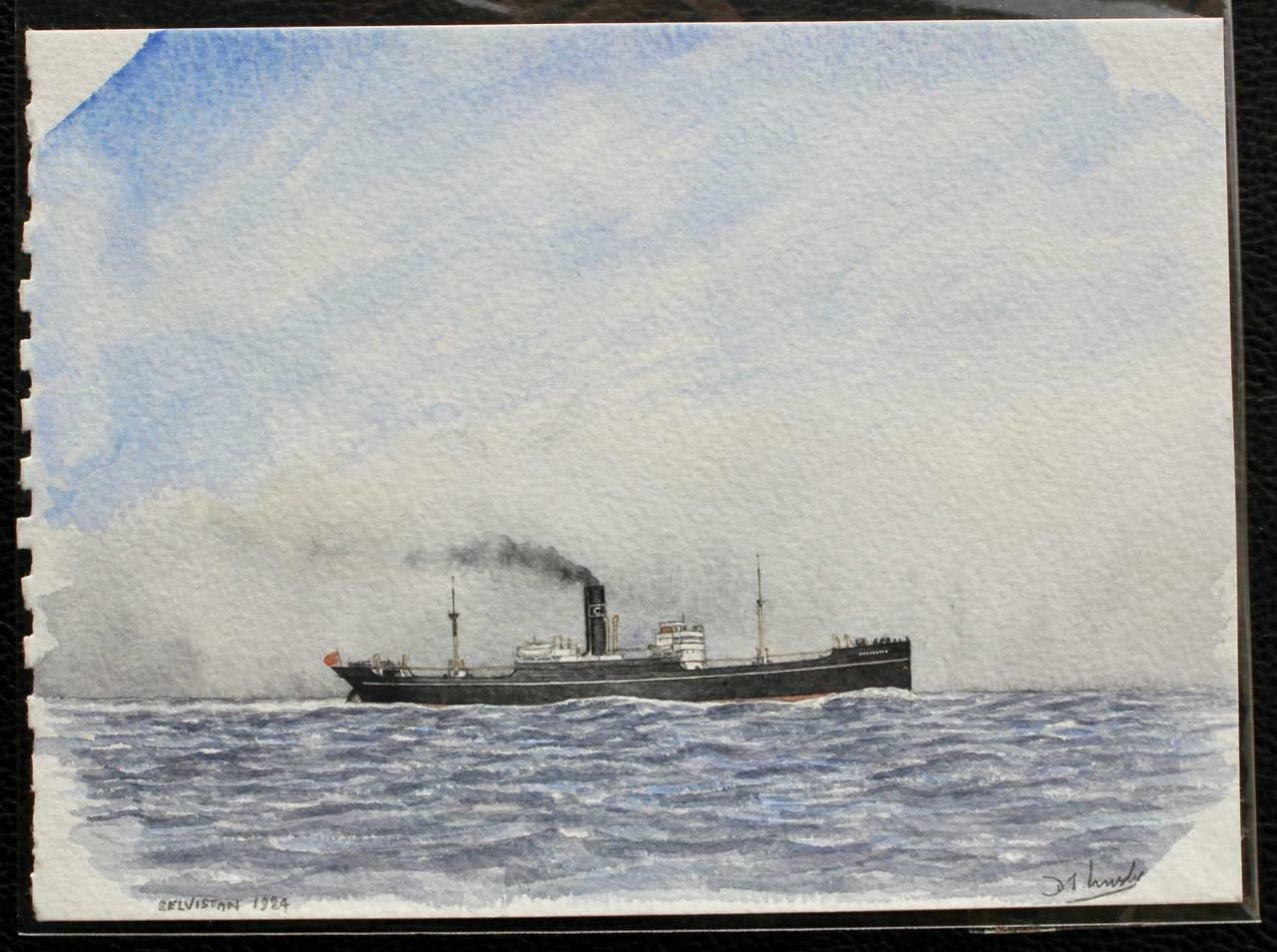
Selvistan
5136 tons
Hull 416
148070 |
1924
|
A cargo ship.
Per
1 ('uboat.net'
page, with image),
2 (Common Brothers history 60% down),
3 ('convoyweb.org', WW2
convoy duty, Selvistan),
4 (Convoy ONS-5),
5 (extensive
'Ahoy' data re ONS-5),
6 (Selvistan
ref.).
390 ft. (about 126 metres) long, speed of 10 knots. Built for 'Hindustan
Steam Ship Co. Ltd.', of Newcastle, owned by 'Common Brothers Ltd.' (the ship's
managers). On Oct. 10, 1941, while in convoy ON-23 from the Tyne to
Halifax, Canada, vessel was in collision with Warkworth, 4941
tons, which sank with the loss of 13 lives. At 58.24N/22.28W,
500 miles SSW of Iceland. Does anybody know the circumstances? Late on May 5, 1943, while part of Convoy ONS-5 bound from
Liverpool to Halifax, Selvistan, in ballast, was hit on
the port side by 2 torpedoes,
fired by U-266 (Kapitänleutnant Ralf von Jessen), & sank,
stern first, within 2 minutes. At
53.10N/44.40W, (S. of Cape Farewell, Greenland, & NE of Newfoundland). Six aboard Selvistan, 5 gunners & a crew
member, lost their lives. 40 survivors, including the Master [George E. (Edward)
Miles], were picked up by HMS Tay & landed at St. John's,
Newfoundland. In fact, two other convoy vessels, Gharinda & Bonde, were also
sunk in the same attack, even though it would seem that U-266 only
fired 4 torpedoes. And 13 of the 46 merchant ships in the convoy were sunk.
Can you add
anything? |
| 107 |


|
Waziristan
3191/5135 (N/G) tons
Hull 414
148048 |
1924 |
A cargo ship. Per
1 (Common Brothers history 2/3rd down),
2 (Southampton City Council/Plimsoll, Lloyd's Registers of 1930/31 thru 1944/45),
3 ('convoyweb.org', WW2
convoy duty, Waziristan),
4 (Convoy
PQ.7A),
5
(Miramar, link, you now must be registered to access). 390.0 ft (118.87 metres) long
perpendicular to perpendicular, signal letters KQBH later GCZV, speed of 10 knots,
363 NHP engines by John Dickinson & Sons Ltd., of Sunderland. Built for
'Hindustan Steam Ship Co. Ltd.', of Newcastle, owned by 'Common Brothers Ltd.' (the ship's managers). 30 convoy references in WW2 including 6 voyages across
the N. Atlantic, generally carrying scrap metal or grain, & coastal voyages. On Nov. 23, 1941, under the command of Ronald Tate,
Waziristan left New York for Sydney, Cape Breton, Nova Scotia, Canada, with a cargo of
3,700 tons of military supplies including, I read, 1,000 tons of copper & 410 Ford trucks, for the war effort of
Soviet Russia. The first British vessel, in fact, to carry war supplies directly to Russia from the U.S.A.
At Sydney, she joined E. bound convoy SC-57 & safely
arrived at Iceland. On Dec. 26, 1941, she left Hvalfjord, (Reykjavik), Iceland, with just one other cargo ship (Cold Harbor) & 2 minesweepers bound for Murmansk,
Russia. In convoy PQ.7A. Bad weather was encountered, & in a fierce easterly gale & thick ice, the vessels became separated. Cold Harbor last saw
Waziristan at 4 p.m. on Jan. 1, 1942. Waziristan was torpedoed on Jan. 2, 1942, by U-134 [Kapitänleutnant Rudolf Schendel ('Schendel')]. The
first 2 torpedoes apparently missed but the 3rd hit home. U-134 saw the crew abandon ship - a complement of 47 which included 10 gunners -
before the vessel broke in two & sank. All 47 lost their lives. At 74.09N/19.10E, said to be about 300 miles NW of
Jan Mayen Island, but that seems not to be so. In the Norwegian or Barents Sea. It is interesting to note that on the immediately prior U-134 patrol, Schendel had sunk a single ship, on Dec. 9, 1941 off
Tanafiord, Norway - a ship that proved to be a German ship - the 2184/5 ton Steinbek.
It would seem not to be known if there was any loss of life. Waziristan? A mountainous region of NW Pakistan, bordering Afghanistan. Perhaps where Osama
Bin Laden was hiding at one time - before he was killed in his Pakistan compound
at Abbottabad, Pakistan, on May 2,
2011. Can you add
anything?
|
| 108 |


|
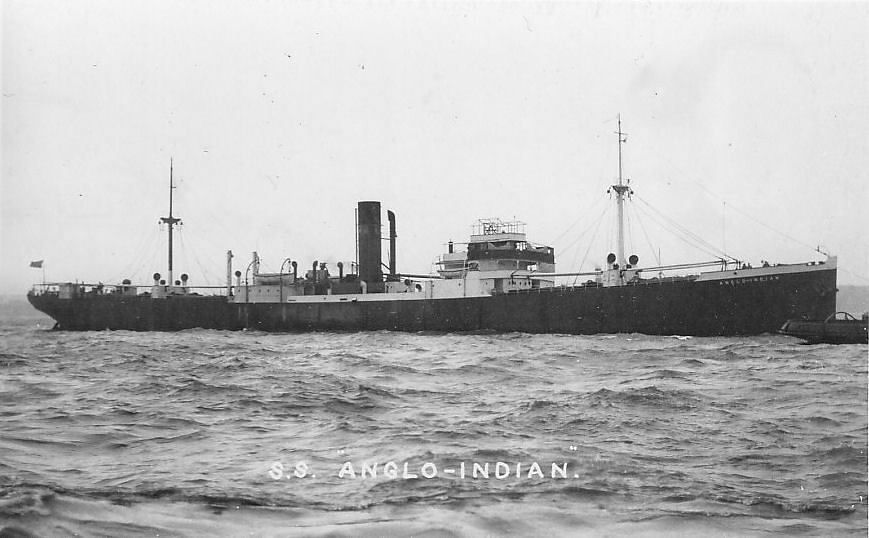
Anglo-Indian
3401/5531 (N/G) tons
Hull 421
148665
Baxtergate
Artygia
Domina
Lily
Michalos |
1925 |
A cargo ship which was launched on Jul. 07, 1925.
Per
1 (Turnbull
Scott history near page top),
2 (Southampton City Council/Plimsoll, Lloyd's Registers of 1937/38 thru 1945/46),
3 ('convoyweb.org', WW2
convoy duty, Baxtergate),
4 (1951 collision with Steel
Flyer),
5 (Miramar, link,
you now must be registered to access).
426.0 ft. (129.845 metres) long perpendicular to perpendicular, 439.6 ft. long
overall, speed of 11 knot, signal letters GLNW, 453 NHP engines by North Eastern Marine Engineering
Co. Ltd., of Newcastle.
A corrugated ship. Built for 'Nitrate
Producers' Steamship Co., Ltd.', (Anglo Line), Lawther, Latta & Co. Ltd. of
London, the managers. Visited Auckland, New Zealand, a couple of times.
In 1937,
the vessel was sold to Turnbull Scott & Co., of London, for
£50,000, & renamed
Baxtergate. 'She was kept on the Pacific phosphate and
nitrate trading of her
previous owner.'
111 WW2 convoy references, including at least 9 voyages
across the N. Atlantic, service in the Mediterranean, to W. Africa (Freetown,
Takoradi) & to South Africa & lots of local U.K. voyages. Many independent voyages
also. With varied
cargoes such as wheat, phosphates, lumber & steel.
In 1947, the vessel was sold to 'Panamanian Tramp Shipping Co.',
(Stathatos &
Co., of London, the managers), & renamed
Artygia. In 1948, the vessel was sold again, to 'Compania de Navegacion Cebaco, S.A.', of Panama, with C. Michalos & Co.
the managers, & renamed Domina.
On Mar. 28, 1951, while en route to Baltimore with a cargo of iron ore, the vessel
collided with Steel Flyer in Chesapeake Bay.
The vessels were on
crossing courses. Steel Flyer was guilty of gross negligence but
Domina was negligent also. Did not spot the extent to which either
ship was damaged. There may be later WWW court data
that I have not read.
In 1955, the vessel was sold or transferred to Michalos Bros, of Piraeus, Greece, & renamed Lily Michalos.
On
Aug. 21, 1959, she arrived at Hong Kong to be broken
up.
Anything to add?
|
| 109 |

|
Newbrough
5342 tons
Hull 419
148124 |
1925 |
A cargo ship. Per
1 (Sea Gallantry Awards),
2 ('Canberra
Times', Australia,
1933 newspaper article, 4th item),
3 (Common Brothers history 60% down,
no ref. to Newbrough),
4 (NY
Times article available, with ref. to ship being abandoned),
5
(Miramar, link, you now must be registered to access). About 126 metres long, speed of 12 knots, maybe. Built for
'Northumbrian Shipping Co. Ltd.', of Newcastle, owned by 'Common Brothers Ltd.'
(the ship's managers). On Dec. 24, 1932, Newbrough was stranded in
heavy weather on a reef off Morant Cay,
60 miles from Kingston, Jamaica. What happened is confusing
indeed. i) 2 says that the entire crew were rescued by Norseman by breeches buoy.
ii) However, two prestigious 'Sea Gallantry Medals' were awarded re the disaster & the story as to
why they were awarded is very different. 1 states that the first Newbrough lifeboat made it to the
South-East Morant Cay. And the 2nd
lifeboat eventually did also. Thanks to the bravery of both Ernest H. Halliday & Antonio M. Viana, respectively Chief Officer & Boatswain of
Newbrough,
who swam in the pounding surf & found openings in the reef. Both received 'Sea
Gallantry Medals' for their bravery. The entire Newbrough crew of
31 was saved & taken off the Cay by Norseman, an 1844 ton
cable ship owned by Western Telegraph Co.
Can anybody clarify exactly what did happen that day? Can you possibly add
anything?
|
| 110 |

|
Simonburn
3242/5213 (N/G) tons
Hull 420
148140 |
1925 |
A cargo ship. Per
1 ('convoyweb.org', WW2 convoy duty, Simonburn),
2 (Common Brothers history 1/3rd down,
no ref. to this Simonburn),
3 (convoy WN.27),
4 (convoy SC.6),
5 (Oct. 1940 lifeboat rescue),
6 ('Southampton
City Council/Plimsoll', Lloyd's
Register data,
Simonburn, 1930/31 thru
1940/41),
7
(Miramar, link, you now must be registered to access). 390.0 ft. (118.87 metres) long, speed of 10 knots,
signal letters KTHJ, later GLXR, 368 HP engines by John Dickinson Ltd. of Sunderland. Built for
'Northumbrian Shipping Co. Ltd.', of Newcastle, owned by 'Common Brothers Ltd.' (probably the ship's managers). 13 convoy references early in WW2 including 3 voyages
across the N. Atlantic & coastal U.K. trips. On Sep. 27, 1940, Simonburn,
left Sydney, Cape Breton, Canada, in convoy SC.6, with a cargo of wheat from
Montreal, intended for delivery at London. On Oct. 27, 1940, she left the Clyde
for Methil (Firth of Forth), in convoy WN.27, of 11 merchant ships, with,
presumably, that same cargo of wheat. WN.27 ran into a major storm & high seas & suffered major losses. On Oct. 30, 1940,
Simonburn was driven ashore in severe weather conditions at Rattray
(Aberdeenshire, NE tip of Scotland), drifted off & sank 4 miles off Rattray Head.
Alcora & Lisbon were also driven ashore that day at Rattray, while
Baron Minto
suffered a number of air attacks & was driven ashore at nearby Strathbeg
Bay (but not, it would seem, wrecked there because she was later bombed & sunk on Feb. 14, 1941). Eros arrived at
Methil damaged. I read that Patia was also driven ashore at Rattray that day,
which is a puzzle & I think in error (read Patia data via 1). 93 in total are said to
have been
rescued that day from the 4 ships. Simonburn had 39 aboard. All were
rescued by the Peterhead lifeboat Julia Park Barry of Glasgow. In
two trips, & landed at Fraserburgh. The lifeboat was at sea in appalling
conditions for over 9 hours
that day & the heroic crew rescued an amazing total of 93 persons. Can you
add
anything? Another image perhaps? |
| 111 |


|
Anglo-Peruvian
5457 tons
Hull 423
149698 |
1926 |
A cargo ship.
Per
1 (wreck),
2 ('convoyweb.org', WW2 convoy duty, Anglo Peruvian),
3 (Convoy OB-288),
4 (sinking),
5 (Miramar, link,
you now must be registered to access).
426 ft. (about 135 or so metres) long, speed of 11 knots. Built for
'Nitrate Producers' Steamship Co., Ltd.', (Anglo Line), Lawther,
Latta & Co. Ltd. of London, managers. Presumably for the South American nitrate
trade. 16 convoy ref. in early WW2 including 2 voyages across N Atlantic & U.K.
coastal voyages. Vessel left Liverpool on Feb. 8, 1941, as part of convoy OB-288, bound
for Boston, Massachusetts, with a cargo of coal. At 9 p.m. on Feb. 23, 1941, when dispersed from the convoy &
located S. of Iceland, was twice torpedoed by U-96. Vessel broke in two &
sank within 3 minutes. At 59.30N/21.00W. 29 were lost
including Cyril M. (Mervyn) Quick, the Master. 17 survivors were picked up from a
life-raft by
Harberton & were landed at Halifax, Nova Scotia. Anything to add?
An image?
|
| 112 |

|
Demeterton
5251 tons
Hull 422
149406 |
1926 |
A cargo ship. Per
1 (Chapman
and Willan, Ltd., flags & data),
2 (Birkenhead
drydock 55% down),
3 (Saturday, 15 March),
4 ('convoyweb.org', WW2 convoy duty, Demeterton),
5
(Miramar, link, you now must be registered to access). 410 ft. (about 126 metres) long, speed of 10 knots. Built for R.
Chapman & Son, ('Chapman'), of Newcastle. Or maybe by
'The Carlton Steamship Company Ltd.', which was related to the owners of Chapman. Over time, Chapman owned 3 vessels of the identical
name.
In Dec. 1940,
when in drydock at Birkenhead, the vessel was hit by a 100 lb. bomb which exploded in
the lower hold with no loss of life. Many references to convoy duty in WW2 - mainly
North Atlantic but also in Mar. 1940 (HN 22) Ålesund, Norway, to Methil
(Firth of Forth)
with iron ore bound for Cardiff. On Mar. 15, 1941, while in convoy HX 42
& en route from the U.S. to Falmouth, U.K. with a cargo of grain, the vessel was attacked by
battleship Scharnhorst during operation 'Berlin',
the entire crew being taken prisoner. The vessel was sunk on Mar. 16, 1941 at
45.58N/44.00W, SE of St. John's, Newfoundland. On that single day, Scharnhorst & Gneisenau
together
sank 16 ships in the North Atlantic. Data about Chapman companies is modest indeed. A 1965 volume, entitled 'CHAPMAN OF NEWCASTLE - The Story of
a Tyneside Tramp Shipping Company' by John Lingwood & Harold Appleyard,
presumably covers the company & its fleet. Anything to
add?
|
| 113 |


|
Anglo-Australian
3332/5456 (N/G) tons
Hull 424
149817 |
1927 |
A steel steamship.
Per 1 (data),
2 (Board
of Trade Loss Inquiry report).
Anglo-Australian was built for 'Nitrate Producers' Steamship Co.,
Ltd.', (Anglo Line), Lawther,
Latta & Co. Ltd. of London, managers. The vessel was launched, I read, on
Mar. 21, 1937 & first registered, at London, on Apl. 27, 1927. Lloyd's Register
Foundation kindly make available 70 Survey related documents re the vessel incl. this
May 04, 1927 Survey.
426.0 ft. long, 453 NHP engines by North Eastern Engineering Co. Ltd. of
Newcastle, signal letters GMXW, speed of 10 1/2 knots, crew lists are available
via this page.
On Mar. 08, 1938, Anglo-Australian left Cardiff, Wales, in ballast, for British Columbia,
via the Panama Canal, to pick up a cargo of lumber.
On Mar. 14, 1938 she passed Fayal, Azores, & was never heard from again.
The vessel is believed to have
foundered in severe gale conditions approx. 60/70 miles NW of Fayal. All 38 aboard
were lost. This contemporary news report relates.
Anglo-Australian's then captain was Frederick Parslow, who won the Distinguished Service
Cross for his actions on
Jul. 04, 1915 re the Anglo-Californian (1,
2). Actions in which his
father died & was posthumously awarded the Victoria Cross.
The Board of Trade, at its Oct. 1928 Inquiry, concluded that the most probable
cause of the loss of Anglo-Australian was the buckling of its shelter deck with subsequent complete
fracture from deck to keel. The vessel had had a history of cracks in the
structure of the shelter deck. Which cracks had been routinely repaired.
Anything to
add?
|
| 114 |

|
Holystone
5462 tons
Hull 427
149450 |
1927 |
A cargo ship.
Per 1 (data),
2 ('convoyweb.org', WW2 convoy duty, Holystone),
3 (Common Bros history 40% down, but no ref. to Holystone),
4
& 5 (convoy OB.284),
6 (insert 101 & then Holystone),
7 (data & image),
8 (Miramar, link,
you now must be registered to access).
397 ft. (about 126 metres) long, speed of 10 or 11 knots. Built for 'Northumbrian Shipping Co. Ltd.',
of Newcastle, which company was a ship owning arm of Common Brothers Ltd. 16
convoy references early in WW2 including 3 voyages across N Atlantic & coastal UK trips. On
Feb. 10, 1941, under the command of Capt. John S. (Stewart) Bain, vessel left Oban,
Scotland, in ballast for Halifax, Canada (voyage originated at Hull). Vessel joined convoy OB.284 which left Liverpool
on Feb. 9, 1941. Last heard from on Feb. 14, 1941, on which day vessel was
torpedoed & sunk by U.101 (Korvettenkapitän Ernst Mengersen). At or about 54.10N/18.50W
(or 53N/18W), W. of
Ireland. All aboard were lost - 40 lives including 2 passengers. Can you add
anything?
|
| 115 |


|
Irene S. Embiricos
4164 tons
Hull 426
Xmas |
1927 |
A cargo ship.
Per
1 ('convoyweb.org', WW2 convoy duty, Irene S. Embiricos),
2 (image, Irene S. Embiricos),
3 (Miramar, link,
you now must be registered to access).
119.8 metres long, perpendicular to perpendicular, 409 ft. 6 in., speed of 9 or
9 1/2 knots. Built for 'S. G. Embiricos Ltd.',
of Athens, Greece), & managed by Embiricos
Ltd., of London. In Apl. 1942, the vessel carried grain from Bahia Blanca to
Genoa, Italy. Just 11
convoy references in WW2 in the period of Dec. 1942 to May 1944, mostly 'shorter
convoy series' in the Indian Ocean (Aden, Durban, S. Africa, Mombasa, Kenya (Kilindini),
Mozambique (Lourenco Marques now Maputo), Vizagpatnam (SE India), Colombo
(Ceylon now Sri Lanka). Surely independent voyages also, but I am not permitted
access. In 1960, the vessel was sold to 'H. Sienmin & Sons',
described as Hong
Kong trading buyers. And renamed Xmas. On Apl. 19, 1961, the vessel
arrived at Koyagishima, Nagasaki, Japan, to be broken up. At the facilities of
Kawanami Heavy Industries?? The WWW record for this ship is modest. Can you add
anything?
|
| 116 |

|
Laristan
6401 (later
6417?) tons
Hull 425
149446
Empire Gulf
Laristan
Cherrywood
Irene M.
Semira |
1927 |
A tanker.
Per 1 (Gulf),
2 &
3 (WW2 convoy duty, Laristan & Empire Gulf),
4
[data 55% down Laristan (3)],
5 (Convoy ON.57),
6 ('Southampton City Council/Plimsoll', Lloyd's
Register data,
Laristan, 1930/31 thru
1942/43),
7 ('Southampton City Council/Plimsoll', Lloyd's
Register data,
Empire Gulf, 1942/43 thru
1945/46),
8 (Common Brothers 'Blue Peter' article,
SECOND SHIP, ex 9 &
10),
11 (Miramar, link,
you now must be registered to access).
420.0 ft. long (128.02 metres) perpendicular to perpendicular, about 133 metres
long overall, speed of 10 1/2 knots, signal letters KWQS & GFMK. Built for
Hindustan Steam Shipping Co. Ltd., the main ship owning arm of 'Common Brothers Ltd.'
('Common'),
of Newcastle. I
read that the vessel was badly damaged in 1929 during storms in the N. Atlantic while en route from Philadelphia to France under the command of Captain B. E.
Marshall. Ownership was taken over by the Ministry of War Transport at the outbreak of WW2. As Laristan, the vessel made 5 voyages across the N. Atlantic & coastal
U.K. trips in early WW2. On Jan. 15, 1942, when part of convoy ON.57 ex Liverpool, the vessel was stranded on Tiree Island,
an island in the Inner Hebrides. The vessel was seriously damaged & was declared a total loss. But on Jan. 7, 1943 it was refloated &, presumably repaired, became Empire Gulf, operated by the Ministry
of War Transport. As Empire Gulf, the vessel made another 6 voyages across
the Atlantic, & shorter voyages also. In 1946, vessel was repurchased by Common & renamed Laristan.
Owned by Home Line Ltd. with Common the managers. The vessel was sold in 1949 to John I. Jacobs & Co. Ltd., of London, & renamed Cherrywood.
And in 1953, the vessel was sold to Marcou & Sons, of London, & renamed Irene M. (Costa Rica
flag). In 1954, she was sold to Muzaffer Emin Zorlu, of Canakkale, Turkey, & renamed Semira.
The vessel was scrapped at Kalafatyeri, Turkey, in Q4 of 1960. Can you add
anything?
|
| 117 |


|
Amberton
5377 tons
Hull 431
149474 |
1928 |
A cargo ship. Per
1 (Chapman
and Willan, Ltd., flags & data),
2 ('convoyweb.org', WW2 convoy duty, click on 'SHIP SEARCH' then insert Amberton),
3
(Miramar, link, you now must be registered to access). About 130 metres long, speed of 10 knots. Built for Carlton Steamship Co. Ltd.
of Newcastle. 139 WW2 convoy references, including at least 11 N. Atlantic crossings,
almost always carrying wheat or flour but one voyage carrying sugar, service
into Mediterranean (Algiers, Augusta, Naples), to Freetown, Sierra Leone, & many
eastern North America & U.K. coastal trips. On Jul. 23, 1947, the vessel was wrecked at Western Head,
Cape Pine, on the Avalon Peninsula of Newfoundland. Specifically near the Wester
Head of St. Shotts Bight. No data
about the circumstances. Any loss of life? In Apl. 2011, Joseph Dale kindly advised
(thanks!) that he was aboard at the time & that there was, in fact, no loss of life. Foundation Franklin came
to Amberton's assistance, & later Foundation Josephine also, both
tugs owned by 'Foundation Maritime' of Halifax, Nova Scotia, (images of both tugs are on this page). Their
efforts at pulling the vessel free risked breaking her up. Freeing her was
not successful & the Amberton crew was transferred to USCG
Spencer & in due course flown to Halifax. The vessel's cargo was
presumably timber since I read that timber from the ship was used to build at
least a dozen buildings & many more outbuildings at St. Shotts. WWW data about Amberton seems
to be modest. Anything to
add?
|
| 118 |


|
Anglo-Canadian
5268 (or 5288) tons
Hull 430
160529 |
1928 |
A cargo ship.
Per
1 (Japanese attack in 1942),
2 (data),
3 (data & image),
4 ('convoyweb.org', WW2 convoy duty, click on 'SHIP SEARCH' then insert Anglo Canadian),
5 (Miramar, link,
you now must be registered to access).
426 ft. long, speed of 10 1/2 (or maybe 11) knots. Built for 'Nitrate Producers' Steamship Co.,
Ltd.', (Anglo Line), Lawther,
Latta & Co. Ltd., of London, managers. 16 WW2 convoy references including 2
voyages across N. Atlantic, service to W. Africa (Freetown) & service also in
eastern Mediterranean. In first 6 months of 1942 served in the Suez/Aden/Colombo/ Bombay/Kenya
area. At Visagapatam Roads, Andhra Pradesh, India,
on Apl. 16, 1942, the vessel,
'sailing alone', was
targeted by planes from Ryujo, a Japanese aircraft carrier. Was
attacked for 2 hours, hit by a bomb (later carried ashore & exploded!) & set on fire. Captain D.
J. Williams later awarded OBE for his conduct & two others honoured also. On Jun. 25, 1942, while en route,
unescorted & in ballast, from Visagapatam
to Baltimore, via Capetown & Ascension Island, vessel was torpedoed & sunk by U-153 in
western N. Atlantic. At
25.12N/55.31W. About 800 miles northeast of Antigua. One life lost. Captain Williams & 48 aboard survived
& were landed at St. Kitts, Windward Islands. Some references I saw stated,
incorrectly I believe, that this
vessel was, in fact, built by 'Doxford'. Anything to add?
|
| 119 |

|
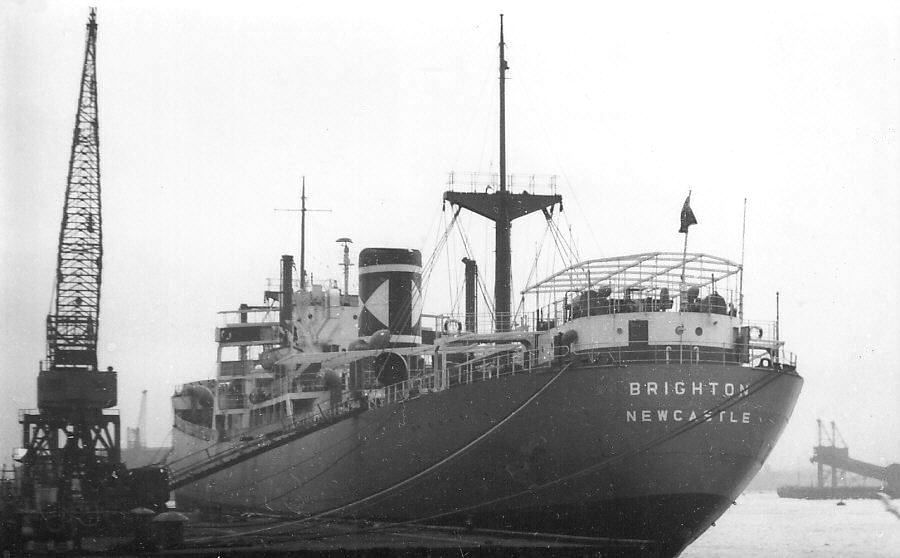
Brighton
5359 tons
Hull 428
149452 |
1928 |
A cargo ship. Per
1 (sinking,
6th May 1940),
2 (Chapman
and Willan, Ltd., flags & data),
3 (wreck location),
4 (French page, 20% down),
5
(Miramar, link, you now must be registered to access). About 130 metres long, speed of 10 knots. Built for 'The Carlton Steamship Company Ltd.' which was related to
R. Chapman & Son of Newcastle. On May 6, 1940, while en route from the Humber to
Dunkirk, France, with a cargo of coal, vessel hit a mine & sank approaching
Dunkirk. At 51.03.06N/2.08.40E. Wreck appears, however, to in fact be at
51.03.07N/2.10.59E, lying E-W in 3 pieces. The 34 crew members were rescued. Data about Brighton seems
to be non-existent & data about Chapman companies is modest indeed. A 1965 volume, entitled 'CHAPMAN OF NEWCASTLE - The Story of
a Tyneside Tramp Shipping Company' by John Lingwood & Harold Appleyard,
presumably covers the company & its fleet. Anything to
add?
|
| 120 |
|
Kurdistan
5844 tons
Hull 433
149487 |
1928 |
A cargo ship. Per
1 (sinking),
2 ('convoyweb.org', WW2 convoy duty, click on 'SHIP SEARCH' then insert Kurdistan),
3
(convoy SC.57),
4 (Hindustan
history & Kurdistan (4) 45% down),
5 ('uboat.net'
page, with image),
6
(Miramar, link, you now must be registered to access). 434 (or 420) ft. (about 133 metres) long, speed of 10 knots. Built for Hindustan Steam
Shipping Co. Ltd., the main ship owning arm of Common Brothers Ltd. A site
visitor's father was aboard the vessel in 1931 & 1932 voyages to Buenos Aires &
to Canada. 29 convoy references early in WW2 including 5 voyages across N.
Atlantic, service to the Indian Ocean (Bombay) & to W. Africa (Freetown), also coastal UK
trips. Vessel was at New York in Nov. 1941 & travelled to Sydney, Cape Breton,
Canada, to join an E. bound convoy. Convoy SC.57 left Sydney on Nov. 28, 1941
for Liverpool. The convoy
included Kurdistan, bound for Manchester & carrying a general cargo (foodstuffs, base metals &
textiles). A minute or so before midnight on Dec. 10, 1941, vessel was both torpedoed by
U-130 & attacked by a German aircraft. And sank, at
56.51N/16.36W, (or 56.57N), about 300 miles W. of the Hebrides. Kurdistan
was the ship of the Convoy Commodore (R. Gill). 10 lives lost (7 crew, a gunner
& 2 convoy commodore's staff). 56 survivors, including the commodore &
Captain William F. (Fearon) McMillan, were picked up by HMS Kingcup
(K 33) & landed at Londonderry. A now dead page referred to a German aircraft. Anything to
add?
An image?
|
| 121 |


|
Riverton
5378 tons
Hull 429
149458 |
1928 |
A cargo ship. Per
1 ('convoyweb.org', WW2 convoy duty, click on 'SHIP SEARCH' then insert Riverton Beware re the correct ship!),
2 (Chapman
and Willan, Ltd., flags & data),
3 (image, ex Photoship),
4 (data,
about 35% down, 2 paragraphs above 'ALLIED SUBMARINE OPERATIONS'),
5 (data,
'Wednesday, 24 April' para 10, 30% down),
6 (Lloyd's Register data, 1930/31 thru 1938/39, ex 'Southampton
City Council/Plimsoll'),
7
(Miramar, link, you now must be registered to access). About 130 metres long
(409.6 ft.), speed of 10 knots, signal letters LBKV later GNRY. Built for 'The
Carlton Steamship Company Ltd.', of Newcastle, with R. Chapman & Son,
('Chapman') the vessel's managers & owners. On Mar. 22, 1940, Riverton (have not read what her cargo was) left Methil
(Firth of Forth) as part of convoy
ON.22 bound for Norway. On Apl. 9, 1940, Riverton
was one of a number of British steamers seized by German forces as part of their invasion of Norway, which invasion, in part at least, was to secure
German control over iron ore mined in the region. Riverton was
seized at Narvik, in the Arctic Circle, 700 miles N. of Bergen. Her crew members were taken prisoner & placed aboard
Jan Wellem, a German tanker. While I have read that Riverton was
scuttled on Apl. 22, 1940,
she would seem to have been rather sunk by British Light Cruiser Effingham, on Apl. 24, 1940,
while moored
along an outlying pier. The wreck, I have read, was removed in the 1940s. Can
anybody, in a few words, better set the stage for those 1940 events? WWW data about Riverton seems
to be non-existent. 'DRIVER5966' has kindly added some data related to the battle at Narvik as you can read
here. Anything to
add?
|
| 122 |


|
Anglo-African
5601 tons
Hull 439
161339
New Westminster City
Lord Codrington
Tozai Maru No. 7
Risshun Maru No. 3 |
1929 |
A cargo ship. Per
1 (ref. 5% down),
2 (William Reardon Smith),
3 ('convoyweb.org', WW2 convoy duty, click on 'SHIP SEARCH' then insert Anglo African),
4 (Mediterranean convoys 1942/43),
5 (WW2 voyages),
6 (Miramar, link,
you now must be registered to access). 129.8 metres long,
(426 ft.) speed of 11 knots. Built for 'Nitrate Producers' Steamship Co., Ltd.', (Anglo Line), Lawther,
Latta & Co. Ltd. of London, managers. It would seem that Anglo Line's vessels were sold to Sir
William Reardon Smith & Co. ('Reardon') in 1943. It must have been early that year in view of the interesting WW2 account by Kenneth Clatworthy at
1. The vessel he refers to would seem to be
this Anglo-African, even though he states his Anglo-African was built in 1912.
Now Reardon was noted as being tight-fisted. Hence Kenneth's comment that the 'Anglo-African had a big "S" on the funnel, the insignia of the Sir
William Rearden Smith Line, but the crew said it stood for starvation.' And his comment that the ship carried, in a cargo of war supplies, 493 tons of
high octane fuel. Only 493 tons because if a merchant ship carried over 500 tons they would have had to pay the crew an extra £1 - per month! He refers to the ship
carrying supplies to Tangiers & S. America & possibly to Russia. 70 convoy references early in WW2, including at least 5 voyages across N. Atlantic,
voyages to Mediterranean (Naples, Augusta, Port Said), also to Freetown, Sierra Leone, Suez, Aden & coastal U.K. trips. In 1948, renamed New Westminster City. Sold in 1949 to 'Sojozita Shipping
Company, Ltd.', 'Ships Finance & Management Co. Ltd.' the managers, & renamed Lord Codrington. Sold in 1952 to 'Tozai Kisen Co.',
of Japan, &
renamed Tozai Maru No. 7. Sold in 1956 to 'Kusakabe Kisen K.K.', of Amagasaki, Japan, &
renamed Risshun Maru No. 3. Broken up in Japan in 1965. Anything to add?
Or
correct? |
| 123 |


|
Anglo-Saxon
3401/5596 (N/G) tons
Hull 437
161279 |
1929 |
A cargo ship. Per
1 (sinking & image),
2 (Wikipedia vessel data),
3 (survivors machine-gunned & related story),
4 (image at N. Vancouver),
5 (Southampton City Council/Plimsoll Lloyd's Registers from 1930 thru 1940),
6 (Miramar, link, you now must be registered to access).
426.0 ft. (129.845 metres) long, speed of 11 knots, 458 NHP engines by North
Eastern Marine Engineering Co. Ltd. of Newcastle. Built for 'Nitrate
Producers' Steamship Co., Ltd.', (Anglo Line), Lawther, Latta & Co. Ltd. of London, managers. On
Aug. 21, 1940, while en route with a cargo of coal from Newport, Wales, to Bahia
Blanca, Argentina, the vessel, unaccompanied & lightly armed, was surprise attacked & sunk off the coast of Africa with gunfire &
torpedo by Widder, a German raider. At 26.10N/34.09W. 2 small boats
got away but only one of them was heard from again. 7 of the crew of 41 escaped in an 18 ft. jolly boat & 2 of the 7 landed on Eleuthera
Island, Bahamas, on Oct. 30, 1940, after 70 harrowing days at sea (including a hurricane)
& after drifting some 2,700 miles. En route, 1 of the 7 went insane & 3 committed
suicide. 39 lives were
accordingly lost including Philip R. L. Flynn, the captain. Robert G. Taggert & Wilbert Roy Widdicombe (19 & 21 years
respectively) were the 2
survivors, but Widdicombe was later lost when aboard Siamese Prince, torpedoed
by U-69 on Feb. 17, 1941. The jolly boat was auctioned off in Dec.
1940, but is now on display in the Imperial War Museum in London. Hellmuth von Ruckteschell,
the Widder captain, did not attempt rescue of
survivors & per an Imperial War Museum 'package'
which alas is no longer available, machine gunned two life rafts. He was later tried for War Crimes.
Taggart died at age 43. Whole story covered in 'All Brave Sailors: The Sinking
of the 'Anglo Saxon', August 21, 1940', by J. (James) Revell Carr (1939-), 1st published 2004. Anything to
add?
|
| 124 |

|
Goolistan
5851 tons
Hull 435
161512 |
1929 |
A cargo ship.
Per
1 (data
incl. 42 names of the lost),
2 ('convoyweb.org', WW2 convoy duty, click on 'SHIP SEARCH' then insert Goolistan),
3 (convoy QP.15),
4 (Goolistan
with image),
5 (insert 625, U-625),
6 (QP.15 report),
7
(Miramar, link, you now must be registered to access). 440 ft. (about 139 metres) long, speed of 10 knots. Built for 'Hindustan Steam Ship Co.
Ltd.', of Newcastle, owned by 'Common Brothers Ltd.' (the ship's managers). 34 convoy references
early in WW2, including at least 5 voyages across N. Atlantic carrying
grain or flour, voyages to Archangel, Russia, W. Africa (Freetown, Sierra
Leone) & coastal
U.K. trips. On Nov. 17, 1942, under the command of Master William Thomson,
the vessel left Archangel, Russia, for Loch Ewe, Scotland, & Manchester in
ballast (or per one ref. carrying timber & a general cargo). At Kola Inlet (Murmansk,
Russia), she joined convoy QP.15 for Loch Ewe. Weather conditions were bad, with
high seas, gale force winds & poor visibility. In the early hours of Nov. 23,
1942, the vessel was hit by a torpedo fired by U-625 at
75.50N/15.45E (or maybe 75.50N/16.45E or 75.30N/8.00E), W. of Bear Island in the Barents Sea. The entire crew was lost, either 42 or (per
Miramar) 50 lives. Can you add
anything? |
| 125 |


|
Grainton
6341 (or 6365) tons
Hull 434
149489
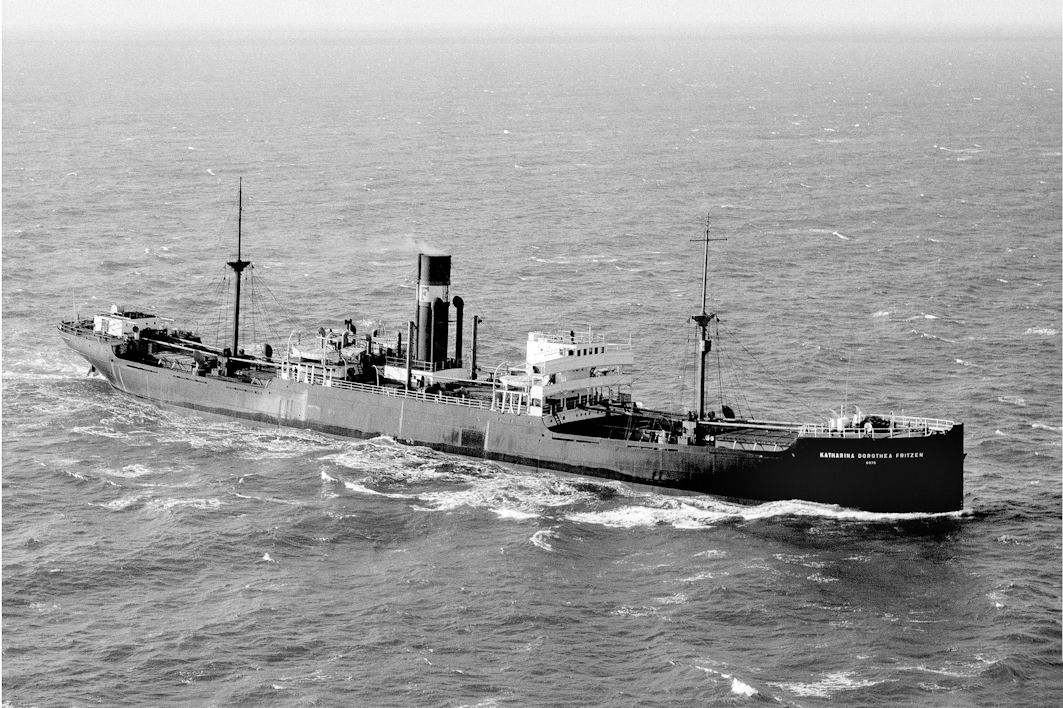
Katharina Dorothea Fritzen (that's all one name) |
1929 |
A cargo ship. Per
1 (Chapman
and Willan, Ltd., flags & data),
2 ('Fritzen'
& Katharina Dorothea Fritzen),
3 ('convoyweb.org', WW2 convoy duty, click on 'SHIP SEARCH' then insert Grainton),
4 (Saturday, 2 December Fowey),
5
(Miramar, link, you now must be registered to access). 128.9 metres long,
perpendicular to perpendicular, speed of 10 knots. Built for Carlton Steamship
Co. Ltd. of Newcastle. Extensive convoy duty in WW2
- 83 convoy references -
list includes
many U.K. coastal trips but also 8 voyages across the N. Atlantic & voyages to
Freetown, Sierra Leone. Most frequently carrying grain. On Dec. 2, 1939, while
part of convoy SL 11 (a convoy not listed at 3), the vessel collided with escorting sloop Fowey at 8.51N/14.37W,
off Freetown. The vessel was sold, in 1950, to 'Johs. Fritzen & Sohn', of Emden, Germany, & renamed Katharina Dorothea Fritzen.
The vessel arrived at Yokosuka, Japan, in Apl. 1961, to be broken up. All said & done,
I can locate only minimal WWW data about this vessel.
Can you
add
anything?
|
| 126 |


|
Nurtureton
6272 tons
Hull 436
161525
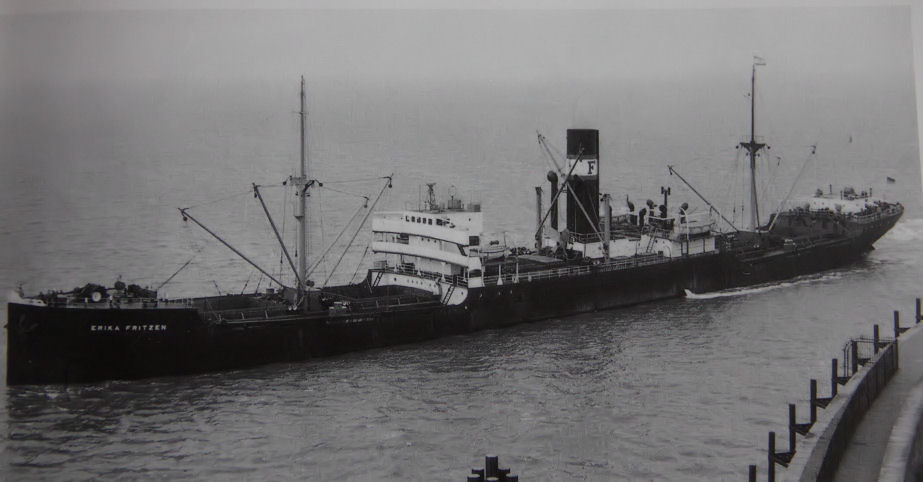
Erika Fritzen
Mongkok |
1929 |
A cargo ship. Per
1 (Chapman
and Willan, Ltd., flags & data),
2 (image,
Erika Fritzen),
3 ('convoyweb.org', WW2 convoy duty, click on 'SHIP SEARCH' then insert Nurtureton),
4 (Lloyd's Register data, 1930/31 thru 1945/46, ex 'Southampton City Council/Plimsoll'),
5
(Miramar, link, you now must be registered to access). 128.9 metres long
perpendicular to perpendicular (423.0 ft.), speed of 12 knots, signal letters
LDKG later GSWV. Built for 'The Carlton
Steamship Company Ltd.' which was related to the owners of 'R. Chapman & Son', of Newcastle,
the vessel's managers.
An eBay item advised me that on Jan. 5, 1931, she was stranded in thick fog
near Dungeness, Kent. She was re-floated, in two halves, which halves were
towed by tug to Rotterdam to be joined together. In 1941/42 the vessel became
owned by The Carlton Steamship Company Ltd. & Cambay Steamship Co. Ltd. 65 WW2 convoy references. List includes
many U.K. coastal trips but also 10 voyages across N. Atlantic & voyages to
Freetown, Sierra Leone. Most frequently carrying grain. The vessel was sold, in 1953, to 'Johs. Fritzen & Sohn', of Emden, Germany, & renamed
Erika Fritzen. And sold, in May 1960, to Oriental Steel &
Rolling Mills Co., of Hong Kong, probably to be broken up, & renamed
Mongkok. The vessel arrived at Hong Kong, on Aug. 2, 1960, to be broken up. All said & done,
I can locate minimal WWW data about the vessel.
Can you
add
anything? Some detail about the
interesting Dungeness grounding, perhaps?.
|
| 127 |


|
Pukkastan
5809 tons
Hull 438
161540 |
1929 |
A cargo ship. Per
1 ('uboat.net', data about sinking, with image),
2 ('wrecksite.eu', wreck
detail),
3 (the
ship's bell),
4 (Hindustan/Common Brothers history
45% down),
5 (Pukkastan data, low on page),
6
(Miramar, link, you now must be registered to access). 134.4 metres long,
perpendicular to perpendicular, 440.5 ft., speed? Built for 'Hindustan
Steam Ship Co. Ltd.', of Newcastle, owned by 'Common Brothers Ltd.' (the ship's
managers). On Sep. 7, 1939, under the command of
John S. (Strachan) Thomson, the vessel was en route, unescorted, from Cape Town,
South Africa, to Rotterdam via Devonport, with a cargo of maize (have read mutton
as well). She was
stopped by 2 shots across her bow fired by U-34, Fregattenkapitän Wilhelm Rollmann in command. The crew
were ordered to abandon ship, the vessel was sunk by torpedo & possibly by gunfire also, & the entire crew
of 35 was rescued by Bilderdijk. At 49.23N/07.49W, SW of Bishop Rock, 70 miles off
Land's End. Can you add
anything?
|
| 128 |


|
Frumenton
6675 tons
Hull 440
161547 |
1930 |
A cargo ship. Per
1 (Chapman
and Willan, Ltd., flags & data),
2 ('convoyweb.org', WW2 convoy duty, click on 'SHIP SEARCH' then insert Frumenton, but beware the correct vessel),
3 (Saturday, 7 September),
4
(Miramar, link, you now must be registered to access). About 138 metres long. Built for R. Chapman & Son, ('Chapman'), of Newcastle. Or maybe that
might correctly be 'The Carlton Steamship Company Ltd.' which was related to the
owners of Chapman. Many references to WW2 convoy duty, mainly carrying grain. On Sep. 7, 1940 & also on Sep. 8 & 9, 1940 was bombed by enemy
aircraft & damaged. Have not read where. On Mar. 3, 1942, vessel hit a mine & sank. At 52.21N/01.58E.
Off the coast of Norfolk, U.K. Can locate minimal WWW data about the vessel & no
data about the 1942 circumstances. Loss of life when mined? Arie de Lange advises (thanks!),
per a link in German, that the mine was laid by the 2nd S-flotilla, KKpt Feldt in command. Data about Chapman companies is modest indeed. A 1965 volume, entitled 'CHAPMAN OF NEWCASTLE - The Story of
a Tyneside Tramp Shipping Company' by John Lingwood & Harold Appleyard,
presumably covers the company & its fleet. Anything to
add?
|
| 129 |


|
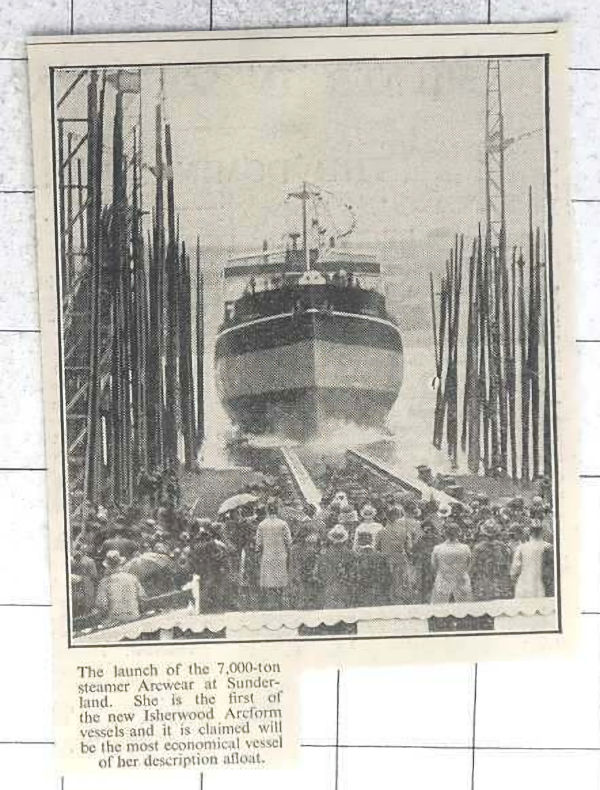
Arcwear
4157 (or 4163) tons
Hull 443
163432
Lord Cochrane
Frieden
Martha
Boston L.
Helene |
1934 |
An 'arcform' cargo ship.
Per
1 (data,
Arcwear),
2 (data,
1933 & 1934),
3 ('convoyweb.org', WW2 convoy duty, click on 'SHIP SEARCH' then insert Lord Cochrane).
About 115 metres (377.4 ft.) long, speed of 11 (have also read
10) knots. Vessel was built using the
curved 'arcform' design
of Sir Joseph Isherwood. Its 'loaded' sea trials took place on Jan. 22, 1934,
over the Polperro measured mile off the Cornish coast, after which the vessel
left on its maiden voyage to Buenos Aires, with a cargo of coal. On its maiden voyage, 'the ship
suffered with heavy rolling in heavy weather, and jerky motion in calm weather.
This resulted in seawater halfway up her hatches and the whole foredeck
submerged under water.' The design improved fuel consumption, I
understand. Built for Arcwear Shipping Co. Ltd. or
maybe Arcwear Steamship Co. (Isherwood Arcform Ships Ltd., the managers?), of London.
The vessel was sold, in 1936,
to Norwich Steamship Co. Ltd., (Ships Finance & Management Co. Ltd., the
managers), renamed Lord Cochrane & registered at London. 89
WW2 convoy references including at least 11 N. Atlantic crossings, service to W.
Africa (Freetown, Takoradi) & S. America, along with many U.K. coastal
voyages. The vessel was sold in
1950 to 'Aug. Bolten Wm. Miller's Nachfolger (GmbH & Co.) KG', of Hamburg, Germany, & renamed Frieden.
And sold in 1958 to N. D. Koufos
& renamed Martha. And sold again, in 1964, to M. Scufalos, of Piræus, Greece, & renamed Boston L.
And sold yet again, in 1966, to Ferrando & Massone ('Ferrando'), of Genoa, Italy, & renamed Helene.
But Ferrando may have been the manager rather than the owner. Since on Jul. 25, 1968, when owned by 'Concordia Enterprise, Inc.' of Panama, & en route from Constantza,
Rumania, Black Sea, to Jeddah, Saudi Arabia, the vessel was stranded off Inhaca Island, near Laurenco Marques, Mozambique.
At 25.58S/32.59E. The vessel's cargo was mainly timber but with some cement
also. I have not read the circumstances. It was re-floated with the assistance
of Jacob, a Dutch salvage tug, towed into Laurenço Marques & 5
weeks later to Durban, South Africa, where she arrived on Sep. 15, 1968. Upon
examination, her damage was found to be severe, & she was broken up at Durban. Can someone remind my why a 1968 voyage from
the Black Sea to Saudi Arabia would not have used the Suez Canal? The canal must
have been closed, likely related to then hostilities between Israel & Egypt. Yes?
Not a lot of WWW
data, all said & done. Can you help with more? An image?
|
| 130 |


|
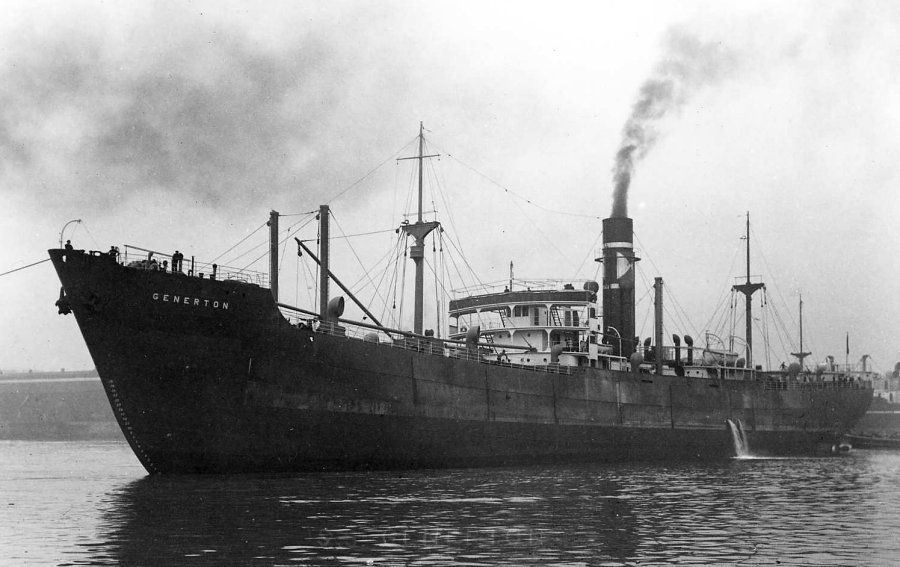
Generton
4797 (or 4801) tons
Hull 448
161600
Imatra
Capella
Bucentaur
Bangkok Trader |
1936 |
A cargo ship. Per
1 (Chapman
and Willan, Ltd., flags & data),
2 (bombing,
'Thursday, 18 July'),
3 (watercolour
by Laurence T. Dunn),
4 ('convoyweb.org', WW2 convoy duty, click on 'SHIP SEARCH' then insert Generton),
5
(Miramar, link, you now must be registered to access). About 135 metres long,
439 ft. 2 in., speed of 10 or 10 1/2 knots. Built for 'Carlton Steamship Company
Ltd.' with R. Chapman & Son, ('Chapman'), as the managers, both of Newcastle. Extensive convoy duty (114 voyages) in WW2. Duty included a great many voyages to &
from North America,
also into the Mediterranean (Port Said), to W. Africa (Freetown), plus many U.K. coastal
trips. The vessel would appear to have left convoy HX 55, (Liverpool ex Halifax), on Jul. 16,
1940, when NW of Ireland, for its onward trip to Middlesbrough
with scrap iron & steel plate. It was bombed on Jul. 18, 1940, in the North
Sea. Said to have been damaged but presumably lightly so. Since the vessel left Methil, Firth of Forth,
Scotland, for Southend,
Essex, (but surely, in fact, for Middlesbrough) on Jul. 19, 1940. Re Convoy
SC.174, which left Halifax on Apl. 28, 1945 for Liverpool, the vessel, carrying
lumber, is described as having been a straggler for 7 days. In 1955, the vessel was sold to 'Paulins Rederi Ab. Modesta', (Frank Skibdahl, Turku,
Kanavaniemi), of Finland, & renamed Imatra. In 1960, the ship
was sold to 'Wallem
& Co.', (of Hong Kong?), & renamed Capella. And sold again, in
1966, to 'Teh Hu Steamship Co.' ('Teh'), of Hong Kong, who may rather have been
the managers, &
renamed Bucentaur. The vessel was sold again, in 1968, to 'Cia.
Nav. Pearl', of Panama, Teh the managers?, & renamed Bangkok Trader.
On Oct. 1, 1968, the vessel developed 'leaks' during a typhoon while en route from Bangkok, Thailand,
to Osaka, Japan. They must have been rather large 'leaks' because the vessel was
abandoned at 22.30N/117.30E, off the coast of China, but soon was towed E. to Kaohsiung, Taiwan, where it arrived
on Oct. 4, 1968. The vessel was subsequently heavily damaged by fire at
Kaohsiung on Oct. 16, 1968, & was sold to Taiwanese
ship breakers in (June?) 1969 & broken up at Kaohsiung. Anything to
add?
|
| 131 |


|
Springwood
1177 tons
Hull 446
164679
Highwood
Spanker |
1936 |
A cargo ship/collier which was launched on Jun. 18, 1936. Per
1 & 2 (short
videos of Spanker at Hook of Holland in 1954),
3 (Lloyd's Register ('LR') listing, 1937 re Springwood,
ex Southampton City Council/ Plimsoll), 4 (LR data re Highwood,
ex Southampton City Council/ Plimsoll, 1937 thru 1945),
5 ('convoyweb.org', WW2 convoy duty, click on 'SHIP SEARCH' then insert Highwood),
6 (image,
Spanker, near page bottom),
7 (Miramar, link,
you now must be registered to access).
221.3 ft. long, 67.4 metres long perpendicular to perpendicular, speed of 8 knots,
signal letters MLQQ, 119 HP. Built for Springwell Shipping Co. Ltd. ('Springwell'), of London. In 1937,
the vessel, renamed Highwood, became owned by Highwood Shipping Co. Ltd., also of London, with Springwell the managers. A couple of changes in manager - in 1939/40
& in 1945/46 respectively, Culliford &
Clark Ltd. & E. R. Newbigin Ltd.
became her managers. WW2 convoy duty, 36 voyages from Sep. 1939 thru Apl. 1944 -
mainly U.K. coastal but including two voyages to Gibraltar ex Milford Sound &
Liverpool in 1940, both returning to Liverpool with either pit props or minerals. In 1954, the vessel was sold to Granta Steamship Co. Ltd.
of Newcastle & was renamed Spanker. With Witherington &
Everett, also of Newcastle, as her managers. On Aug. 7, 1954, while under the command of Jim Cleugh & en route from
Rotterdam to London in ballast, the ship stranded on the northern pier at the Hook of
Holland (Hoek van Holland). During a fierce storm with gale force winds, I
understand. The vessel had earlier delivered a cargo of coal. What a scene! See the dramatic image at left. I
understand that the vessel was badly holed & had to be broken up in situ, with great
difficulty due to limited access to the site, but have so far been unable to read
full detail as to the
circumstances of her stranding. An extensive Dutch newspaper article is,
however, available here, which
article refers, I understand, to the bad weather conditions at the time. I tried
to translate a part of the article. Can anybody summarise what it truly says? It would seem
that there was no loss of life. Can you add
anything? #1930 |
| 132 |


|
Corinda
3376 tons
Hull 449
156014
5118553
Silver Gulf
Fortune Wind |
1937 |
A cargo/passenger ship.
Per
1 ('Flotilla
Australia', data, image, Corinda),
2 ('Australasian
United', data Corinda),
3 ('convoyweb.org', WW2 convoy duty, click on 'SHIP SEARCH' then insert Corinda),
4 (5 images, Corinda).
356 ft. 10 in. long (overall I think), 105.3 metres long perpendicular to perpendicular, 345 ft. 6 in., speed of 12 knots.
Corinda? A suburb of Brisbane, Australia.
Built for 'Australasian United Steam
Navigation Company Ltd.' ('Australasian'), of London & Sydney, New South Wales,
Australia (have also read Brisbane & Melbourne). Their 50th fleet vessel. Its
maiden voyage was on Jul. 16, 1937 (I suspect that is the arrival date in
Australia). 50 WW2 convoy references, almost all of which were in Australian
waters (Brisbane/Caloundra, Newcastle, Sydney, Melbourne), except for service
in the Indian Ocean in Apl/Sep 1944 (Colombo, Calcutta). And then briefly
independent into the eastern Mediterranean (Alexandria, Haifa). Later on, the company ran into financial difficulties & sold all of
its ships - Corinda was, in fact, the last
fleet vessel to be sold. In Mar. 1961,
the
vessel was sold to 'Power Navigation Co.', of Hong Kong, & renamed Silver Gulf.
And later that same year (i.e. 1961) the vessel was sold to 'Continental Navigation &
Enterprises Ltd.' ('Continental'), also of Hong Kong, (Miramar states 'Chan Hoon Ho',
who was, it would seem, the President of Continental), & renamed Fortune Wind.
In Oct. 1970, the vessel was sold again, to 'Sincere Navigation Co.', of Taiwan
perhaps, with
no change of vessel name. On Jun.
11, 1971, the vessel arrived at Hsinkang, China, to be broken up.
There is not a lot of WWW
available
data about the vessel. Can you help
with more? |
| 133 |
 |
Springdale
1579 (or 1636) tons
Hull 452
165564
Eastdale
Springdale |
1937 |
A small cargo ship. A coaster. Per
1 (Reoch
15% down),
2
(Lloyd's Register data, 1937/38 to 1940/41, ex 'Southampton City Council/Plimsoll'),
3 (Miramar, link,
you now must be registered to access).
76.5 metres (251.4 ft.) long perpendicular to perpendicular, 259.9 ft. overall, speed of 10 knots,
signal letters MMLT. Built for Springwell Shipping Co. Ltd.
('Springwell').
David Freeman has advised (thanks!) of a voyage ex Newcastle on Feb. 17, 1953
returning to Swansea, Wales. In 1953, presumably later in the year therefore, the
vessel was chartered by Reoch Steamship Company Limited, of Montreal, Quebec, Canada, for the
shipment of grain on the Great Lakes. Sold (later that year, I presume), to 'Eastboard Shipping' & renamed Eastdale. In 1955,
the
name reverted to Springdale. On Jun.
18, 1959, while en route from Munksund, Sweden, to London, with a cargo of timber,
the vessel capsized
when the cargo shifted. The vessel sank at 63.02N/19.39E, about 17 miles off Cape Skag, Gulf
of Bothnia, off the E. coast of Sweden, near Örnsköldsvik. It was then owned by Springwell, so maybe they re-acquired it in 1955,
but, an expired eBay item stated the owner, when it sank, to be 'East Board Shipping'. Not a lot of WWW
data. Can you help with more?
|
| 134 |


|
Springtide
1579 (later or 1638, 1589, 1594 & 1588) tons
Hull 451
165530
Eastide
Sullberg
Granny Marigo
Guiseppe Riccardi |
1937 |
A small cargo ship. A coaster. Per
1 (extensive data, insert Springtide
& click on link),
2 (Reoch
15% down),
3
(Lloyd's Register data, 1937/38 to 1940/41, ex 'Southampton City Council/Plimsoll'),
4 (Miramar, link,
you now must be registered to access).
76.6 metres long perpendicular to perpendicular, 259.9 ft. long overall, 251.4 ft.
between perpendiculars, speed of 10 or 10 1/2 knots, signal letters MMLJ. The
vessel was built for 'Springwell Shipping Co. Ltd.' ('Springwell'), of London, a company noted for the carriage of timber. During WW2, from 1940 to 1947, the vessel was employed as a
'mine destructor vessel' by the Royal Navy, to combat German magnetic mines. It
may have been registered in the name of the Royal Navy. Was it in fact so
registered? The
ship was equipped with a large electro-magnet in its hold. Which did not work
too well & was superseded by 'the much lighter & highly efficient LL-sweep'.
The vessel was later converted into a 'deperming' vessel. Saw service with the Eastern Fleet,
based at Colombo, Ceylon, now Sri Lanka. 'Petroc', who kindly provided the 1960
image of Granny Marigo at left, advises that 'Sea Breezes' had an
article in its Sep. 1982 issue about the vessel's WW2 history. Can anybody provide that
article? In 1947, the vessel reverted to Springwell. It 'christened' a
new harbour, likely on the Thames, & discharged a cargo of timber ex Oulu,
Finland. Was chartered for a period by Newfoundland-Great Lakes Steamship Co.
Was in collision with Hampshire Coast in the
River Ribble, Lancashire, on Mar. 6, 1952. Have not read enough detail to
summarise what happened. In 1953, the vessel was sold to 'Eastboard Shipping Ltd.',
of London, 'Federal
Commerce & Navigation Co. Ltd.' the managers, & renamed Eastide.
During the 1954 season, the vessel was chartered by 'Reoch Steamship Company
Limited', of Montreal, Canada, for the shipment of grain on the Great Lakes. It
was sold,
in 1956, to 'August Bolten Wm. Miller’s
Nachfolger (GmbH &
Co.)', of Hamburg, Germany, & renamed Sullberg. And sold again,
in 1960, to 'Compagnia Maritima Angelikana S.A.', of Panama, 'D. J. Papadimitriou'
the manager (which may mean
D. J. Papadimitriou Sons,
a shipping company earlier headquartered in Alexandria, Egypt.) Was then renamed Granny Marigo
& registered at Monrovia, Liberia. But ... the 1960 image at left of Granny
Marigo indicates that the vessel was then registered at Beirut (Beyrouth), Lebanon.
The vessel was sold, in
1961, to 'S.A.N.A.' (i.e. 'Societá Abruzzese di Navigazione per Azioni', of Venice,
Italy, & renamed Guiseppe Riccardi. In Q1 of 1972,
the vessel was broken up at La Spezia, Italy. Link 1 indicates that the initial
gross tonnage was 1627, otherwise the vessel must have been modified in 1956, to
become 1638 tons. Other more modest tonnage changes, in subsequent years. Can you add anything more or clarify the above?
Another image? |
| 135 |


|
Anglo Indian or Anglo-Indian
5609 (later 5622) tons
Hull 453
166338
Tacoma City
Inchcastle
Lucky |
1938 |
A cargo ship.
Per A (e-Bay image, Lucky,
it would be good, someday, to have a copy of this fine image on site without the
logo!),
1 (Inch Steamship,
Inchcastle),
2 (70% down 'CAPILANO'),
3 (New
Zealand),
4 (Miramar, link,
you now must be registered to access).
About 137 metres long, speed of 10 knots. Built for 'Nitrate
Producers' Steamship Co., Ltd.', (Anglo Line), Lawther, Latta & Co. Ltd. of
London, managers. In mid
Jun. 1938, the chartered vessel, carrying a 36 man crew & a general cargo which included gold
concentrate & sulphur, was en route from Montreal, Quebec, to Vancouver, British
Columbia, both Canada, via Tacoma, Washington, when a fire broke out in her
holds. After the crew's 3 day battle against the flames, the fire was finally extinguished when
the vessel arrived at Los Angeles, California, & the fire was extinguished by
the harbour fireboats of San Pedro (Los Angeles). In 1943, the vessel was sold to Reardon Smith & Sons, 'Rearden Smith Line',
of Cardiff. Due to Government restrictions, the vessel could not be renamed until
1948 - when it was renamed Tacoma
City. In 1954, sold to Williamson & Co. ('Williamson') of Hong Kong (or
maybe to Inch Steamship Company Ltd., a subsidiary of Williamson), & renamed
Inchcastle. Visited Auckland, New Zealand, once, on Sep. 1, 1956. In 1966
the vessel was sold to Prosperity Steamship Co. (or to 'Wing On
Steamship Co. SA'), also of Hong Kong, & renamed
Lucky. Registered at Panama. On Nov. 8, 1969, Lucky arrived at Kaohsiung, Taiwan, to be broken
up. Anything to add? |
| 136 |


|
Hermiston
4813 (or 4795) tons
Hull 457
165773
Nego Trader
Kien An |
1939 |
A cargo ship. Per
1 (Chapman
and Willan, Ltd., flags & data),
2 (ref. Hermiston),
3
(Miramar, link, you now must be registered to access). 133.6 metres long overall, 439
ft. 2 in., speed of 10 knots. Built for The Carlton Steamship Company
Ltd. ('Carlton'), (R. Chapman & Son, the manager, related to the owners of
Carlton), of Newcastle. It would seem that Carlton & Cambay Steamship Co. Ltd.
became the owners in 1941. Hermiston was the second last ship out of Rangoon before that city was seized
by the Japanese (in 1942?). The vessel was sold, in 1960, to 'Pan Norse
Steamship Co.', of Panama, Wallem & Co.,
of Bergen, Norway, likely the managers, & renamed Nego Trader.
And sold, in
1966, to 'Kien An Steamship Co., S.A.', of Panama, 'C. W. Hsin' likely the agent, & renamed Kien An
(a name that seems to be associated with Vietnam). On Dec. 16, 1967, the vessel was
blown aground off Kikizaki, Naoetsu, Japan, in heavy weather. The vessel dragged
its anchors, when awaiting a berth at Naoetsu to unload her cargo of manganese
ore ex Thailand. At 37.17N/138.34E (an incorrect 'inland' reference). I read
that 38 members of the crew were rescued by Japanese Air Force helicopters. 5
crew members dived into the icy waters & made it to shore though one of the 5
later died. Four others, who also, it is presumed, dived from the ship, were
never found. So 5 lives were lost. The ship? It broke into two pieces in the heavy seas. WWW data about the vessel seems
to be non-existent. Anything to
add?
|
| 137 |


|
Scorton
4813 tons
Hull 458
165775
Fro
Winsome |
1939 |
A cargo ship which was launched on Oct. 30, 1939. Per
1 (U-229),
2 (U-633),
3 (image, Fro),
4 (Chapman
and Willan, Ltd., flags & data),
5 ('convoyweb.org', WW2 convoy duty, click on 'SHIP SEARCH' then insert Scorton),
6 (Montrose, about 50% down,
search for Winsome),
7 (sinking
of U-633),
8
('Southampton City Council/ Plimsoll' Lloyd's Register listings, 1939 thru 1945), 9
(Miramar, link, you now must be registered to access). 427.0 ft. long
perpendicular to perpendicular, 439.2 ft long (133.87 metres) overall, speed of 10 knots,
signal letters GMVL, 359 HP engines by George Clark (1938) Limited of Sunderland. Built for Carlton Steamship Company
Ltd. ('Carlton'), of Newcastle, (R. Chapman & Son, the manager, related to the
owners of Carlton), which ownership became, from 1941, Carlton Steamship Company
Limited & Cambay Steamship Company Limited. Extensive convoy duty (88
voyages) in WW2. Duty included a great many voyages to & from North America,
also to W. Africa (Freetown, Sierra Leone), plus many U.K. coastal trips. In
early Mar. 1943, the vessel, under the command of Terrot Glover (1905/1971), was en route in convoy SC.121 from New York City to Liverpool with a
cargo of sugar. On Mar. 10, 1943, at daybreak, the vessel was attacked by German
submarine U-229 which fired
2 torpedoes at Scorton - but both of them missed their target. A
little later that same day, two submarines
were spotted within the convoy & one of them came close to the surface right
under Scorton's bow. Scorton ran into/rammed what
proved to be U-633, & as a result
of the collision the
submarine sank with the loss of 43 lives - at 58.51N/19.55W in the N. Atlantic south of Iceland.
U-633 was commanded by Oberleutnant zur See Bernhard Müller.
Scorton suffered both bow & rudder damage from the collision & had to be towed into Greenock by tug Cherbourgeois III.
I should note that link 2
refers to U-633 being rather sunk by depth charges from U.S. Coast Guard cutter
Spencer. Such report seems likely to be incorrect, since
Scorton's
captain, Terrot Glover, (his image), was awarded the OBE (Member of the Order of the British
Empire) for his actions respecting the
sinking, as per these newspaper cuttings kindly provided by a friend of the site (1 & 2).
The vessel's 3rd Officer, William McDonald Nicolson received a Commendation
also. Scorton was soon repaired & back into service. On Sep. 8, 1943,
the vessel rammed
amidships &
seriously damaged Matapedia, a Canadian Flower Class corvette, in thick fog off Sambro
Lightship (approaches to Halifax harbour, Nova Scotia, Canada). Scorton was sold in 1955 to
A/S D/S Ask, A. Kjerland &
Co. A/S of Bergen, Norway, the managers & renamed
Fro. And sold again in
1965 to Winsen Steamship Co. S.A. of Panama, Winley Shipping Co., of Hong Kong
the managers, & renamed Winsome. On Jun. 10, 1967,
the vessel, en route from Kaohsiung, Taiwan, to Da Nang, Vietnam, in ballast,
caught fire at
16.30N/115.13E, in the S. China Sea, NW of Manila, Philippines. It sank the next day at 16.45N/116.45E.
USS Montrose came to
her rescue but Winsome had sunk by the time she arrived on the scene. The
crew was rescued by a Russian ship (unnamed), I read. I have seen nothing yet about the
circumstances. WWW data about the vessel is, despite all of the above, modest. Anything to
add?
|
| 138 |
 |
Barnby
4813 tons
Hull 459
161029 |
1940 |
A cargo ship.
Per
1 (Barnby 75% down - convoy HX126),
2,
3 &
4 (all May 22),
5 (page in German),
6
(Miramar, link, you now must be registered to access).
A very short life! 439 ft. (130.2 metres) long. Built for 'Rowland & Marwood's Steamship Co. Ltd.', ('Headlam & Son' managers), of Whitby. On
May 10, 1941, Barnby left Halifax, Nova Scotia, destination Hull, as part of convoy
HX126 (started as 29 ships), with a cargo of bagged flour from Saint John,
New Brunswick. On May 20, a
submarine was sighted & the convoy scattered. Barnby was
hit by 2 torpedoes fired by U-111 & sank at 1340 on May 22, 1941, SW of Iceland, at 60.30N/34.12W.
But a long expired eBay item said that the cargo of flour kept her afloat after the crew abandoned
ship & that it is not known where exactly she later sank. 2 lives lost
(some sites say 1 only). 44 survivors,
including the master, were adrift for 9 days, rescued by British light cruiser
Aurora on May 30th, & landed 9 days later at Reykjavik, Iceland.
A splendid builder's model of the vessel,
146 cm long, was listed on eBay but is long expired. The vendor is no longer
on eBay. Is it possible that you have anything to
add? Your contribution of knowledge would be most welcome.
|
| 139 |


|
Hindustan
5245 tons
Hull 460
165784
Almen
Sas |
1940 |
A cargo ship. Per
1 [data about
45% down, Hindustan (6)],
2 ('convoyweb.org', WW2 convoy duty, click on 'SHIP SEARCH' then insert Hindustan),
3 (George Sigalas),
4
(Miramar, link, you now must be registered to access). 137.2 metres long, speed of 10 1/2 knots. Built for
'Hindustan
Steam Shipping Co. Ltd.', of Newcastle, owned by 'Common Brothers Ltd.' (the ship's
managers). The 6th 'Common Brothers' vessel of the name (they had 8 over the
years). Extensive convoy duty (71 voyages) in WW2. Duty included 5 voyages to &
from North America, service in Indian Ocean & Middle East (Bombay, Calcutta,
Colombo, Suez), & many U.K. coastal trips. In 1954, vessel was sold to Rederi A/B Atos, of Sweden, (Allan Borjesson,
the manager), & renamed Almen. In 1963, vessel was sold to T. Stafilopatis et al
('Stafilopatis'), of Greece, & renamed Sas. It seems likely, however (3), that George T. Sigalas ('Sigalas') was in fact the
owner & Stafilopatis maybe was the manager. On May 29, 1967, the vessel,
chartered to 'Raznoeksport', left Novorossiisk (Black Sea coast of Russia) for the Persian Gulf with a cargo of cement. An engine defect arose on Jun. 1, 1967,
& the vessel proceeded to Piraeus, Greece, to effect necessary repairs. By the
time she was ready to proceed, 14 days later, the Suez canal was closed due to
the then Israeli-Arab six-day war. The cement was then delivered to the Persian
Gulf (via Cape of Good Hope) & Sigalas claimed, unsuccessfully, for compensation for extra incurred
expenses. Vessel was sold again in 1972. To whom? No name change.
Vessel was
laid up in 1977 & on Jul. 23, 1979, arrived at Santander, Spain,
to be broken up. Can you add
anything?
|
| 140 |


|
Empire Summer
6949 (or 6950) tons
Hull 464
168670
5154636
Stonegate
Hastedt
Ho Ping 52
Zhan Dou 52
& maybe
Hoping Wu Shi Er |
1941 |
A cargo ship.
Per
1 (Turnbull Scott
history, 50% down),
2 ('convoyweb.org', WW2 convoy duty, click on 'SHIP SEARCH' then insert Empire Summer),
3 (image
Stonegate, but you must be registered to see it),
4 (Miramar, link,
you now must be registered to access). 134.1 metres long overall, 130.5 metres
perpendicular to perpendicular, 428 ft., speed of 10
knots. The vessel was suilt for the Ministry of War Transport
(initially managed by 'Haldin & Phillips Ltd.' & then by 'Turnbull, Scott & Co.',
both of
London). 79 WW2 convoy references including at least 5 N. Atlantic crossings,
extensive service into the Mediterranean (Port Said, Alexandria, Augusta, Naples,
Bone), to W. Africa (Freetown), & many U.K. local. The vessel was sold in 1945,
to Turnbull Scott Shipping Company Ltd., a tramp ship company, of London, &
in 1946 was renamed
Stonegate.
In 1955,
the vessel was sold to 'Partenreederei Hastedt', ('Carl Meentzen Schiffahrt und Handel GmbH',
the managers), both of Bremen, Germany, & renamed
Hastedt. The vessel was sold, in 1959, for £130,000, to the Government of the
People's Republic of China, & renamed Ho
Ping 52 (per Miramar) & Hoping Wu Shi Er, per 1 (maybe
'Err' at the end). Was renamed Zhan Dou 52 in 1967.
Transferred to (or registered under) China Ocean Shipping Co, of Peking, China, in 1973. Per 1, may have been renamed Ho Ping 52 in 1979.
Reportedly broken up in China, in 1985. Certainly deleted from Lloyd's Register
in 1984/85. Is it possible that you have anything to
add?
Or can correct the above? |
| 141 |


|
Newbrough
5255 tons
Hull 463
165807
5130446?
Avisbay
Giannis |
1941 |
A cargo ship.
Per
1 ('convoyweb.org', WW2 convoy duty, click on 'SHIP SEARCH' then insert Newbrough),
2
(Miramar, link, you now must be registered to access). 137.2 metres long, speed? Built for 'Northumbrian
Shipping Corporation Ltd.', of Newcastle, which company was related to both 'Hindustan Steam Ship Co.
Ltd.', & 'Common Brothers Ltd.' (the last were the ship's managers). 52
WW2 convoy references including 5 voyages across the N. Atlantic, generally carrying
grains, voyages to the Mediterranean, Caribbean, Iran, West Africa (Freetown, Sierra
Leone), & coastal
U.K. trips. The vessel was sold, in 1955, to 'The Aviation & Shipping Co.
Ltd.', of London, 'Purvis Shipping Co. Ltd.', also of London, the managers & renamed Avisbay. In 1962,
the vessel was
sold to 'Aegean Nav. Co. Inc.', of Beirut, Lebanon, 'L. Nimicos' the manager, & renamed Giannis.
In Sep. 1969 the vessel had engine trouble, & went to 'Fuji Marden & Co. Ltd.'
('Fuji'), of Hong Kong. In Oct. 1969,
the break up of the vessel commenced at Fuji. Can you add
anything?
|
| 142 |


|
Empire Envoy
7046 (or 7047) tons
Hull 473
169107
Cheltenham
La Orilla
Stallberg
Verna
Paulin |
1942
|
A cargo ship. Per
1 ('Southampton
City Council/Plimsoll',
Lloyd's Register listings, Empire Envoy, 1942/43 thru 1945/46),
2 (1965 image Verna Paulin),
3 (50% down, image La Orilla but I think not
the correct vessel),
4 (Miramar, link,
you now must be registered to access). 431.0 ft. long perpendicular to
perpendicular, 446.5 ft. long overall, signal letters BFDF. Built for Ministry of War Transport, managed
by Hugh Roberts & Son. Involved in convoy work in 1943 & probably
later also. The vessel was sold in 1946
to Thompson Steamshipping Co. Ltd., of London, & renamed Cheltenham.
The vessel visited Auckland, New Zealand, 4 times between Oct. 1951 & Feb. 1952. In 1952 (or maybe
in 1951) the vessel was sold to Buries Markes
Limited ('Buries'), grain & coal shippers, & renamed La Orilla.
It was transferred, in 1954, to Louis
Dreyfus & Co. Ltd., of France, (owners of Buries). In 1955 the vessel was sold to 'Stallbergs Grufve Rederi',
of Stockholm, Sweden, & renamed Stallberg. And sold to other Swedish
owners in 1957 & 1960 - to 'Rederi A/B Stellvik' & to 'Stallbergs Grufve
Rederi', respectively, both of Stockholm. In 1962, Stallberg was sold to 'Paulins Rederi A/B', of Abo (Turku),
Finland & renamed Verna Paulin. The vessel arrived
at Bruges, Belgium, in Jul. 1969, to be broken up. is it possible that you have anything to add? |
| 143 |


|
Empire Keats
7035 tons
Hull 470
169019
Ionion
Ioannis Chandris
Ioannis
Inglessis
Thai Long |
1942 |
A cargo ship.
Per
1 ('convoyweb.org', WW2 convoy duty, click on 'SHIP SEARCH' then insert Empire Keats),
2 ('convoyweb.org', WW2 convoy duty,
Ionion),
3 (Miramar, link,
you now must be registered to access). 431 ft. long. Built for the Ministry of War Transport.
17 WW2 convoy references thru 1943 as Empire Keats, including a N. Atlantic
crossing & service to W. Africa & Caribbean. Sold or transferred to the Greek Government in 1943 & renamed
Ionion.
(1 states Ionian). 21 WW2 convoy references as Ionion,
including 2 N. Atlantic crossings & service to South Africa. In 1944/45,
many independent voyages in Indian Ocean & to New Zealand & Australia. In 1947, sold to
'Mrs. Evegenisa J. Chandris', of Greece, & renamed Ioannis Chandris,
(Chandris Lines, perhaps?). Sold
in 1955 to 'Navigation de Samos' (Samos Steamship Co.), also of Greece,
(D. Inglessi Sons the managers?), & renamed Ioannis Inglessis. Sold
in 1965 to either a) Welfare Marine Corp., of Liberia, or b) Thai Chong Nav. Co.,
possibly of Taipei, & renamed Thai Long.
In Oct. 1966, arrived
at Keelung, Taiwan, to be broken up. Is it possible that you have anything to
add?
An image perhaps?
|
| 144 |


|
Empire Newton
7037 tons
Hull 468
169006
Artisan |
1942 |
A cargo ship.
Per
1 (T.
& J. Harrison, Artisan),
2 ('convoyweb.org', WW2 convoy duty, click on 'SHIP SEARCH' then insert Empire Newton),
3
& 4 ('shipsnostalgia', data & images, Artisan, but you must be registered to see either of them),
5 (Miramar, link,
you now must be registered to access). 136.1 metres long overall, 129.5 metres
perpendicular to perpendicular, 431 ft., speed of 11 knots. Built for Ministry of War Transport,
managed initially by W. H. Cockerline & Co. Ltd., of Hull, & later, in
1944, by T. & J. Harrison Ltd., of Liverpool.
52 WW2 convoy references as Empire Newton, including 5 N.
Atlantic crossings (3 of the return voyages were independent - 4 of the W. bound crossings were
independent also), service into the Mediterranean (Malta, Augusta, Bari, etc.).
Also 6 voyages to Juno and Gold beaches, Seine Bay, France, in Jun/Jul 1944 re the Normandy landings. From Oct.
1944, the vessel was mainly independent, either in the Indian Ocean (Cape Town,
Durban, Mombasa, Colombo, Calcutta, Visakhapatnam in India), or in S. American
waters (Buenos Aires, Rosario, Montevideo). Also U.K. coastal voyages. The ship
suffered damage to her port quarter on Jul. 14, 1945 when at Calcutta, India -
hit by Rose, a tug. The vessel was sold,
on Jan. 29, 1946, for £139,398, to Charente Steamship Co. Ltd., owned & managed
by T. & J. Harrison Ltd.,
both of Liverpool, & renamed Artisan. I read that on Sep. 23, 1949,
the vessel put into Dakar, Senegal, with a serious fire in her coal bunkers,
while en route from Beira, Mozambique, to Avonmouth. The vessel was sold to
British Iron and Steel Corporation to be scrapped & on Aug. 21, 1959, the
vessel arrived
at the Grays, Essex, ship breaking facilities of T. W. Ward Ltd., to be broken up. Is it possible that you have anything to
add?
An image perhaps?
|
| 145 |


|
Empire Southey
7041 tons
Hull 471
169023
Hollybank
Stad Rotterdam
Ocean Unity |
1942 |
A cargo ship.
Per
1 ('convoyweb.org', WW2 convoy duty, click on 'SHIP SEARCH' then insert Empire Southey),
2 [Bank Line,
Hollybank (1)],
3 (Halcyon-Lijn, 5 images, Stad Rotterdam),
4 (Rio Atuel case),
5 (Miramar, link,
you now must be registered to access). 431 ft. long,
136.07 metres, speed of 9 1/2 (or 10 1/2) knots. Built for Ministry of War Transport. Initially managed by
W. Runciman & Co., but in 1944, Andrew Weir & Co. Ltd. took over that role. 61 WW2 convoy references including at least 6 N. Atlantic
crossings, extensive service in the Mediterranean (Alexandria, Port Said, Augusta, Bari), Caribbean, also Capetown, S. Africa & French coast. Am not permitted to access the ship's 'convoyweb.org' independent voyages.
On Mar. 13, 1944, the vessel damaged Empire Addison at Naples, Italy. Have not read any detail. Collisions with ice on one N. Atlantic crossing to Halifax. In 1946,
the vessel was sold to Bank Line Limited, managed by Andrew Weir & Co. Ltd., & renamed Hollybank.
On Oct. 31, 1947, Hollybank ran aground to avoid a collision with Rio Atuel, an
Argentine steamship. In Hog Island Channel of Cape Cod Canal.
Rio Atuel, which suddenly veered into the course of Hollybank
as a result of a language misunderstanding of her pilot's instruction, was held to be at fault. Sold in 1953, for £250,000, to 'Halcyon-Lijn N.V.' of Rotterdam, the Netherlands, & renamed Stad Rotterdam.
Was sold again, in 1963 to Ocean Shipping & Enterprises (Panama) S.A., of Panama, 'Great East Asia Shipping & Trading Corporation', of Hong Kong, the managers, & renamed Ocean Unity.
Liberian flag. On Mar. 8, 1967, the vessel arrived at Kaohsiung, Taiwan, to be broken up. Is it possible that you have anything to
add? An image as Empire Southey, perhaps?
|
| 146 |
|
Empire Webster
7043 tons
Hull 472
169029 |
1942 |
A cargo ship, which had a very short life. Per
1 ('uboat.net',
sinking),
2 ('convoyweb.org', WW2 convoy duty, click on 'SHIP SEARCH' then insert Empire Webster),
3 (data,
with image of Otto Hartmann),
4 (Hartmann),
5 (U-77),
6 (Lloyd's
List, 1943/44),
7
(Miramar, link, you now must be registered to access). Likely 131.7 metres long
overall, & 125.0 metres perpendicular to perpendicular, (431 ft.), speed of 10
knots. Built for Ministry of War Transport & managed by Hall Brothers, of
Newcastle. Just 5 WW2 convoy references, including U.K. coastal & a
Nov. 1942 voyage from the Clyde to Bône, N. Africa, returning from Philipeville,
Algeria. On Jan. 21, 1943, the vessel, under the command of
Alexander R. (Roderick) Duncan, with a total of 63 aboard including 8 military passengers & 1 gunner,
(have also read 61 total only), left Glasgow, River Clyde, for Bône, Algeria, in convoy KMS-8 (a convoy of 60 merchant ships &
17 escorts). Carrying 3,000 tons of
coal & military
stores - have also read included trucks & tanks. At 2:00 a.m. on Feb. 7, 1943, the
convoy was attacked by air & by submarine. Empire Webster was hit by one of 4 torpedoes
fired at the convoy by U-77,
Kapitänleutnant Otto Hartmann in command. At
36.47N/01.37E, near Ténès, Algeria, W. of Algiers in the Mediterranean. U-77 broke
off her attack when
HMCS Camrose ('Camrose') (K154) detected her presence &
vigorously counter attacked. As did an allied aircraft, it would appear. Empire
Banner
(built at Sunderland by Bartram)
was hit by another of the 4 torpedoes. Empire Webster did not sink
immediately. It would seem that the vessel may have been hit by 2 torpedoes - a
second, also by U-77, a few hours after the first (per a Google 'snippet'
reference, here, to 'U-boat Operations of the Second World War' by Kenneth G. Wynn.
Indeed the volume seems to state 'Empire Webster was sunk
by gunfire from an Allied naval vessel'.) Is that what, in fact, happened? Four Empire Webster lives
were lost as a result of the
attack, the gunner & three crew members. 59 Empire Webster survivors were picked up by Camrose & landed at Algiers.
Harry R. (Richard) Phillips, an apprentice, was awarded the 'Lloyd's War Medal for Bravery
at Sea' & also the 'British Empire Medal' for his rescue of two injured members
of the crew, trapped in their quarters when the ship was hit. U-77 was later sunk, on Mar. 28,
1943, when attacked E. of Cartagena, Spain. Would welcome
any corrections to the above, or additional data. An image?
|
| 147 |


|
Empire Bardolph
7017 (or 7063) tons
Hull 474
169109
Memling
Vancouver Star
Memling |
1943 |
A cargo ship.
Per
1 (data & images),
2 ('Southampton
City Council/Plimsoll',
Lloyd's Register listings, Empire Bardolph, 1942/43 thru 1945/46),
3 ('convoyweb. org', WW2 convoy duty, click on 'SHIP SEARCH' then insert Empire Bardolph),
4 (Miramar, link,
you now must be registered to access). 431.0 ft. long (131.37 metres)
perpendicular to perpendicular. 446.5 ft. long (136.09 metres) overall, signal
letters BFDP. Built for Ministry of War Transport,
& managed by 'Donaldson Bros & Black' & then by 'Lamport & Holt Line'.
26 WW2 convoy references, including at least 2 N. Atlantic crossings, to
Freetown, W. Africa, many times, & U.K. coastal. The vessel was sold, in 1945,
to Lamport & Holt Line Ltd., of Liverpool, & renamed, in 1946, Memling (the 3rd fleet vessel of that name).
The vessel was sold again, in 1953, to
Blue Star Line Ltd., & renamed Vancouver Star. Transferred, in 1957,
to Lamport & Holt Line Ltd., of London, & again named Memling.
The vessel was sold for £44,000, in Sep. 1959, to 'N.V. Simon's
Metaalhandel'. It arrived at Rotterdam, on Oct. 19, 1959, to be scrapped, Scrapping
commenced on Oct. 23, 1959 at the ship-breaking facilities there of N.V. Simon's
Metaalhandel. Anything to add?
|
| 148 |


|
Empire Camp
7046 (or 7052) tons
Hull 480
169124
5395486
Valacia
New York City
Loch Morar
Yelkenci |
1943 |
A
refrigerated cargo ship.
Per
1 (Wikipedia, Yelkenci),
2
[Cunard,
Valacia (2)],
3 [Bristol City Line,
New York City (4)],
4 ('Southampton
City Council/Plimsoll',
Lloyd's Register listings, Empire Camp),
5 ('convoyweb.org', WW2 convoy duty, click on 'SHIP SEARCH' then insert Empire Camp),
6 (Bristol City Line),
7 (3 images, Yelkenci).
136.1 metres long overall, 129.5 metres perpendicular to perpendicular, 431 ft., speed of 10
1/2 or 11 knots, signal letters BFKR.
Built as Empire Camp
for The Ministry of War Transport, managed by 'Blue Star Line Ltd.', of London.
31 WW2
convoy references including at least 6 (& maybe 7) N. Atlantic crossings,
service to Freetown, W. Africa, & U.K. coastal.
In 1946, the vessel was sold to
'Cunard White Star Line Co. Ltd.', & renamed
Valacia. The second vessel of the name in the Cunard fleet.
In 1949, the vessel was transferred to Cunard Steamship Co.
Ltd. with no change of vessel name. In 1951, the vessel was sold to 'Bristol City Line of
Steamships Limited' i.e. 'Bristol City Line', of
Bristol, 'Charles Hill & Sons' the managers, & renamed New York City.
In 1955,
the vessel was sold to 'Glasgow United Shipping Company Limited' ('United'),
'Maclay & McIntyre Ltd.' ('Maclay'), of Glasgow, the managers, & renamed
Loch Morar.
Miramar used to indicate that 'SS Induna Co. Ltd.' ('Induna') became her owners in 1955 &
not United, Induna being however, I read, a company managed by Maclay.
In 1959,
'Steamship Induna Co. Ltd.', sold
the vessel for £80,000 to 'Lufti Yelkenci Evlatlari Donatma Istiraki', of
Istanbul, Turkey, Lufti Yelkenci the manager, & renamed Yelkenci.
Became Turkish flag, U.K. flag all prior periods.
There was labour unrest re the unloading
of bulk cotton seed at Hull, in Feb. 1959.
On
Feb. 20, 1971, the vessel arrived at the Halic, Istanbul ship breaking
facilities of 'Imdat
Gundogdu ve Zaven Eseyan' to be broken up.
Can you
add
anything? Another image perhaps? |
| 149 |


|
Empire Duchess
7067 tons
Hull 478
180051
Braemar
Castle
King James
Tyne Breeze
Cathay Trader
Pearl Light
Habib Marikar |
1943 |
A cargo ship. Per
1
[Union-Castle Line,
Braemar Castle (2)],
2 ('convoyweb.org', WW2 convoy duty, click on 'SHIP SEARCH' then insert Empire Duchess),
3 (Ghent),
4
[Union-Castle, Braemar Castle (2), 50% down],
5 [King Line, King James (2)],
6 (Navarro, November 4),
8 (Miramar, link,
you now must be registered to access).
466 ft. 6 in. (or 431 ft.) long, speed of 12 knots. Built as Empire Duchess
for the Ministry of War Transport, managed by 'Hugh Hogarth & Sons', of
Glasgow. 33 WW2
convoy references, (seems to be a small number), including at least 1 voyage across
the N. Atlantic, (ONS.27 & UGS.37) service to
West Africa (Freetown, Takoradi) & Mediterranean (Port Said) & local. Independent as far E. as Rangoon. In
Feb. 1944, the vessel went aground & suffered collision damage near Boston, Cape Cod Canal
maybe. On
Dec. 21, 1944, a collision with, I think, Chemong. Off the coast
of Norfolk, at 52.59.15N/01.49.30E. Empire Duchess was repaired at Grimsby. An
explosion & fire in No. 2 hold at Ghent, Belgium, on Feb. 18, 1945. On Aug. 7, 1946,
the vessel became managed by Union-Castle Mail Steamship Company Limited ('Union-Castle'). In 1949,
Union-Castle became the owner, & the ship was renamed Braemar Castle.
In 1950, the vessel was transferred to
King Line Ltd., then Union-Castle owned, & renamed
King James. John Nicholson, who served aboard the ship from Jun. to Dec.
1955, has an ongoing interest in the
ship. He indicates that when they were in the Red Sea, the ship had to
heave to for the replacement of a main bearing. And that in heavy weather in the
N. Atlantic the ship suffered 'serious fuel oil pollution and lost way this combined
with Radio/RDF failure'. In 1958, the vessel was sold to 'Cambray Prince Steamship Co.', of Hong Kong,
(John Manners & Co., the managers) & renamed Tyne Breeze.
And in 1963, she was sold to
Cathay Trader Steam Ship Co., of Hong Kong, & renamed Cathay Trader. In 1964,
the vessel was sold again, to
'Pacific Pearl Navigation Co.', also of Hong Kong, & renamed
Pearl Light.
And in 1966, was sold to 'Marikar Navigation & Agencies Ltd.', of Hong Kong, &
renamed Habib Marikar. On Nov. 4, 1967,
while en route from Hong Kong to Chittagong, Bangladesh with a cargo of cement, the vessel suffered an engine
failure during Typhoon 'Emma', went ashore & was wrecked on a reef at Lincoln Island, 400 miles SSW of Hong Kong,
in the Tonkin Gulf. A constructive total loss. At
16.30N/112.50E. Two landing craft manned with volunteers from USS Navarro
(APA-215) Captain Whitmore in command, rescued, with very great difficulty, 43 of the
crew of Habib Marikar. Two crew members were in the water & Mick
Ferl, Electronic Technician 3 & a Navy Rescue Swimmer, saved one of them &
received a Commendation for his fine conduct. So one life was lost. Vernon
Jackson of the 'USS Navarro (APA-215) Association', via John Nicholson,
has kindly provided images re the Navarro rescue in 1967 (last 3
images at left). The bulk of the Habib Marikar crew, those that
did not require the medical facilities aboard Navarro, were later
transferred to Bengalis, a Dutch cargo ship, & landed at Hong
Kong. John seeks
such data as the name of the Habib Marikar master, its crew list & a manifest to help
identify those in the images. Can you
add
anything? |
| 150 |


|
Empire Friendship
7058 tons
Hull 475
169114
Matelots Pillien et Peyrat (all one name!) |
1943 |
A cargo ship. Per
1 (image,
Matelots Pillien et Peyrat),
2
[Compagnie de Navigation Mixte, (Matelots Pillien et Peyrat)],
3 ('convoyweb.org', WW2 convoy duty, click on 'SHIP SEARCH' then insert Empire Friendship),
4
('pdf', French, meaning of French name),
5 (Miramar, link,
you now must be registered to access).
431.0 ft. long perpendicular to perpendicular, 446 ft. 5 in. overall, speed of 12 knots, maybe,
signal letters BFJB. Built as Empire
Friendship
for the Ministry of War Transport, managed by 'Sir Robert Ropner & Co. Ltd.' of
West Hartlepool. 28 WW2
convoy references, including at least 2 voyages across N. Atlantic, service to
E. & S. Africa
[Cape Town, Durban, Kilindini (Kenya), Aden], in Mediterranean & U.K. coastal. In 1945,
the vessel was sold to
the French Government, managed by 'Compagnie de Navigation Mixte', & renamed
Matelots Pillien et Peyrat. No WW2 convoy references, at 'convoyweb.org'
under the new name. That new name, I read, relates to 2 young sailors
(matelots) shot in
Algeria in 1942 after failing in an
attempt to escape from their ship, the 'Gabriel Guist'hau' while crossing the
Straits of Gibraltar. In 1948, the vessel was transferred to 'Compagnie Havraise de Navigation E. Corblet & Cie.',
which company was restyled as 'Compagnie Havraise
de Navigation à Vapeur', of Le Havre, & Paris perhaps? The vessel was laid up late in its life at Port-de-Bouc,
Bouches-du-Rhone, near Marseilles, France. On Oct. 29, 1962, in high 'mistral'
winds, she dragged her anchors,
broke free from her moorings & was driven onto a breakwater at the entrance of
the 'Canal de Marseille au Rhône'. The vessel was re-floated, on Nov. 3, 1962,
but was declared a constructive total loss. And arrived at La Seyne-sur-Mer,
Toulon, France, later in Nov. 1962, to be scrapped. Can you
add
to or correct the above? Particularly re the proper identification of the
vessel's French owners & managers. An image perhaps? |
| 151 |

|
Empire Cromer
7058 tons
Hull 480
180133
Corrientes
Inchmay
Kaukhali |
1944 |
A refrigerated cargo ship. Per
1
[data 50% down, '8th November 2007',
Inchmay (2)],
2 [Inch Steamship,
Inchmay (2)],
3 ('Ron
Mapplebeck' addl. data),
4
[Blue Star Line, Corrientes (2)],
5 ('convoyweb.org', WW2 convoy duty, click on 'SHIP SEARCH' then insert Empire Cromer),
6 (Miramar, link,
you now must be registered to access).
136.1 metres long overall, 129.5 metres perpendicular to perpendicular, 431 ft.,
speed of 10 or 10 1/2 knots. Built as Empire Cromer
for the Ministry of War Transport, managed by 'Blue Star Line'. 15 WW2 convoy
references thru Jun. 1945, incl. 3 N. Atlantic crossings, in fact 4 with an
independent return voyage. Likely carried meat. Including service to Buenos Aires, Argentina.
Additional independent crossings after Jun. 1945. On Mar. 20, 1946, the vessel was sold to
Donaldson Line Ltd., of Glasgow, & renamed
Corrientes. In Mar. 1954, it was sold again, to 'Blue Star Line' of
London, with the intention of renaming her 'Oakland Star', however the vessel was
surplus to Blue Star requirements & sold before the name could be changed. In
Jan. 1955, the vessel was sold to Williamson &
Co. ('Williamson') of Hong Kong (or maybe to 'Inch Steamship Company Ltd.', a
subsidiary of Williamson), & renamed Inchmay. And in 1966, the
vessel was sold to
'National Shipping Corp. of Pakistan' (or 'Pakistan National Shipping Co.'), & renamed
Kaukhali.
On Apl. 2, 1968,
the vessel arrived at Karachi, Pakistan, to be a) laid up or b) broken up. The sale to
ship-breakers was only, I read, effected in Oct. 1968 & break up only commenced in May
1969, at the ship breaking facilities of 'Eastern Steel Co.'. Can you
add
anything? An image perhaps? |
| 152 |


|
Empire Pendennis
7058 or 7053 tons
Hull 481
180136
Vasconia
Fresno Star
Millais
Grosvenor Navigator |
1944 |
A cargo ship. Per
1 (data,
Empire Pendennis),
2 (Miramar, link,
you now must be registered to access). 136.1 metres long overall (446.5 ft.),
129.5 metres perpendicular to perpendicular (431.0 ft.), speed of 10 knots,
signal letters MQJY. Built
for the Ministry of War Transport, with Ellerman & Bucknall Steamship Co.
Ltd. the managers. The vessel became
Vasconia, when bought, in 1946, by Cunard White Star Line Ltd.
It was sold, in 1951, to
Blue Star Line Ltd. & renamed Fresno Star. In 1957, the
vessel was transferred
to Lamport & Holt Line Ltd. & renamed Millais (the
3rd fleet vessel of that name). The vessel was sold
for £102,500, in 1960, to Grosvenor Shipping Co. Ltd. of London, Mollers Ltd. of Hong Kong
the managers, & renamed
Grosvenor
Navigator. The vessel was hit by Ocean Glory on Sep.
2, 1962, at Hong Kong, apparently during a typhoon. Ocean Glory (Sunderland built as
Empire Trail) had broken free of her moorings
in typhoon Wanda. Grosvenor Navigator clearly survived the hit because 4 years later, on Sep. 9, 1966,
the vessel arrived at the Kaohsiung, Taiwan, facilities of 'Sing Chien
Yung Steel & Ironworks Co.', to be scrapped. Anything to
add?
|
| 153 |


|
Empire Nairobi
7295 tons
Hull 484
180154
Dover Hill
Basil
Ravenshoe
Plate Shipper
Umran
Tan 2 |
1945 |
A cargo ship.
Per
1 ('convoyweb.org', WW2 convoy duty, click on 'SHIP SEARCH' then insert Empire Nairobi),
2 (image
& data, Dover Hill).
136.7 metres long overall, 129.5 metres
perpendicular to perpendicular, speed of 10 1/2 knots. Built
for Ministry of War Transport, managed by Lyle Shipping Co. Ltd., of
Glasgow. Just 3 WW2
convoy references, two of which are re a N. Atlantic crossing westbound in Apl.
1945, returning in May 1945 (UGS.95). The vessel became
Dover Hill, when bought, in 1946, by Dover Hill Steamship Co.
Ltd., of Sunderland, managed & likely owned by 'Counties Ship Management Co. Ltd.', of London. The vessel
was sold, in 1951, to
'Compagnia Naviera (or Navigazione?) Castellana SA', of Panama City, Panama, & renamed
Basil. In 1954, the vessel was sold again, to British Steamship (or
Steam Shipping) Co.
Ltd., of Cardiff, John Cory & Sons Ltd., of Newport, the managers, & renamed
Ravenshoe. It would seem that the vessel was transferred, in 1957,
to 'British Steam Shipping Co. Ltd. & Orders & Handford Steamship Co. Ltd.',
also of Cardiff, with no change of vessel name. The vessel was sold,
in 1960, to 'Plate Shipping Co. S.A.', of Piraeus, Greece, (or of Panama), managed
by P. B. Pandelis Ltd., of London, & renamed
Plate Shipper. The vessel was Greek registered. In 1961, the vessel was sold to 'Riza ve Aslan Sadikoglu
ve
Ortagi Adi Komandit Sirketi', of Istanbul, Turkey, & renamed Umran.
The vessel was sold for the last time, in 1966, to 'Lutfi Yelkenci Evlatlari
Donatma Istiraki', also of Istanbul, & renamed Tan 2. On Sep. 7, 1968,
the vessel arrived at the Halic, Turkey, ship breaking facilities of 'Ali Tirali ve Onder
KS', to be broken up. There are many references to the ship being of 7290 gross
tons. I wonder why? 7295 tons seems to be correct.
Anything to
add?
|
| 154 |


|
Loksang
1851/3318 (N/G) tons
Hull 489
180835
5120099
Frankford |
1946 |
A cargo ship.
Per
1 (Jardine
Matheson, Loksang),
2 (image,
Loksang).
Launched on Nov. 17, 1945 & first registered, at London, on Mar. 19, 1946 (scroll to #180835).
328.0 ft.
long (99.97 metres) overall, 315.0 ft. (96.01 metres) perpendicular to perpendicular, speed of 12 knots, capacity for 12 first class & 200 deck passengers,
sister to Taksang,
signal letters VRJZ.
Fergie Pearce
advised (at 'shipsnostalgia' many years ago)
that the vessel was fitted with lightweight high
speed triple expansion 'North Eastern Marine' engines with poppet valves on HP
and LP cylinders, with 3 Scotch boilers & capable of 13/14 knots at 95 RPM.
But Lloyds' Register ('LR') of 1952/53 lists her then engines as being 582 MN
engines by George Clark (1938) Ltd. of Sunderland. Registered at Hong Kong. 2300
ihp engines per LR of 1968/69.
Built
for 'Indo-China Steam Navigation Co. Ltd.', (a subsidiary of 'Jardine,
Matheson & Co.'), of Hong Kong & London. Loksang (&
Taksang also), was known as a SEAC (South East Asia Command) coaster, &
provided passenger & cargo service between Japan & India. Have read no
specifics as to her service except that on
May 26, 1949, Loksang left
Yokohama, Japan, for Hong Kong, carrying to that port the first post WW2
shipment of Japanese made beer. The vessel had arrived with bananas from Formosa. The vessel was sold, in 1961, to
'Ocean Tramping Co. Ltd.' ('Ocean'), also of Hong Kong,
& renamed
Frankford. I read that Ocean was a company 'associated with the
People’s Republic of China', though the exact meaning of those words is unclear. On Oct. 14, 1971, the vessel arrived at Guangzhou
(or Kwangchow), China (formerly Canton), to be broken up. There is
very little data WWW available about this vessel.
Anything you can
add?
Rebecca Jones has kindly been in touch, (thanks!) with a pair of images of 1959
paintings by her great aunt Elva Blacker (1908/1984). Of the then crew of Loksang
(A & B). Elva Blacker was a travelling artist who went,
with her motorbike, to Bombay (now Mumbai), India, in 1957 & went on to
Singapore & other places further east. It seems likely that she sailed on Loksang from Hong Kong
to Japan in 1959. No crew lists seem to be available for the vessel. #1890
|
| 155 |


|
Rio Gualeguay
5382 tons
Hull 493
Argolikos
Francesca |
1946 |
A refrigerated cargo ship.
Per
1 (data
& images, Portuguese page).
134.56 metres long, speed of 11 knots, crew of 42, accommodation for 5
passengers. Built
for 'Flota Mercante del Estado', of Buenos Aires, Argentina, i.e. the Argentine Government.
In 1961, the vessel was transferred to
'Empresa Líneas Marítimas Argentinas S.A.', of Argentina. And in 1963 was sold
again to
'Empros Shipping Co. Ltd.', of Piraeus, Greece, G. Dracopoulos (of Greece perhaps)
the managers, & renamed
Argolikos. And sold once more in 1969 to 'Providence SAL' of
Beirut, Lebanon, N. Guida the manager, &
renamed Francesca. The vessel was broken up at the Vado Ligure,
Savona, Italy,
ship breaking facilities of G. Riccardi, in 1.72 (which I think means Jan.
1972). Paolo Piccardo has kindly been in touch (thanks so much, Paolo!) to advise that the
scrapping of Francesca is in fact documented, in a video which is available here.
The 18 or so minute video, by Luigi Cassanello & entitled 'Lyberty Ships KJ1',
shows Francesca & other vessels being broken up at the Vado Ligure
facilities in 1972. Made available by 'Fondazione Ansaldo', it would seem.
Anything to
add?
|
| 156 |

|
Taksang
3318 tons
Hull 488
180794
5298171?
Rochford |
1946 |
A cargo ship. Per
1 (Jardine
Matheson, Taksang),
2 (Miramar,
link, you now must be registered to access).
100.0 metres long (328 ft.) overall, 94.5 metres perpendicular to perpendicular, speed of 12 knots,
but capable of 13/14 knots, capacity for 12 first class & 200 deck passengers,
sister to Loksang. Built
for 'Indo-China Steam Navigation Co. Ltd.', (a subsidiary of Jardine,
Matheson & Co.), of Hong Kong & London. Taksang (&
Loksang also), was known as a SEAC (South East Asia Command)
coaster, & provided passenger & cargo service between Japan & India. The vessel was sold, in 1962, to
Peninsular Shipping Co. Ltd., of Hong Kong,
K. T. (or KT) Wong, of Hong Kong, the managers, & renamed
Rochford. Have seen a reference to the vessel being sold, in
1972, to The People's Republic of China. I presume related to its being broken up.
Since the vessel would seem to have arrived at Whampoa,
(i.e. Huangpu, an outer port of
Guangzhou, China), in Sep. 1971, to be broken up. There is
very little data WWW available about this vessel. Anything you can
add?
|
| 157 |


|
Blankvann
5391 tons
Hull 496
191041 (later)
Safina-e-Barkat |
1947 |
A cargo ship. Per
1 (Miramar,
link, you now must be registered to access).
130.5 metres long, perpendicular to perpendicular, speed of 11 knots. Built
for 'D/S A/S Vard', of Oslo, Norway, 'Jacobsen and Salvesen', also of Oslo,
the managers. Sold in 1959 to
Pan-Islamic Steamship Company Limited, of Karachi, Pakistan, & renamed
Safina-e-Barkat. In 1960, while en route to Chittagong,
Bangladesh, from
Karachi, the vessel was driven ashore during a cyclone 6 miles from the river
mouth at Chittagong. The ship's cargo was unloaded & the ship was then able to be re-floated.
The vessel was broken up, in Apl. 1972, at the Gadani Beach, Pakistan,
facilities of Hardware (likely correctly Hardwar) Shipbreaking Corp. Anything to
add?
|
| 158 |


|
Rio Teuco
5381 tons
Hull 494
43247
South America |
1947 |
A refrigerated cargo ship. Per
1 (data & image, Portuguese page),
2 (Miramar,
link, you now must be registered to access).
134.65 metres long, crew of 42, accommodation for 5 passengers, speed
of 11 knots. Built
for the Argentine Government. Sold in 1964 to Lemuria Shipping Corp., renamed
South America & registered at Liberia. On Feb. 11, 1966, the vessel
caught fire in the North Sea. About 1/2 way between Harwich & The Hague. At 52.02N/2.20E.
Vessel was beached at Maasvlakte, nr. Rotterdam, The Netherlands. Anything to
add? |
| 159 |


|
Albistan
5516 tons
Hull 498
181919
5008825 |
1948 |
A cargo ship.
Per
1
(data & image), 4 (5 images, Albistan).
Miramar used to advise that Albistan was originally ordered
by Australasian United Steam Navigation Co. Ltd.
of Melbourne, Australia, but was taken over by Strick Line Ltd. with F.
C. Strick & Co. the managers, just before the
keel was laid.
She was a Strick's ship for 23 years until sold for scrap in 1971
to Lee Sing Co. of Hong Kong.
Can you add
anything? |
| 160 |


|
Coramba
3551 tons
Hull 497
177201
Koomilya
San Fernando
High Star
An Kuo |
1948 |
A cargo ship which carried passengers. Per
1
(data, Australasian United, Coramba),
2 (data 75% down,
Coramba, image),
3
[McIlwraith McEacharn, Koomilya (2)],
4 (Miramar, link,
you now must be registered to access).
116.2 metres long overall, 109.8 metres long perpendicular to perpendicular, 381 ft. 4 in. long, speed of 12 knots. Built for 'Australasian United Steam Navigation Co. Ltd.' of
London & Sydney, Australia, Macdonald Hamilton & Co. the managers. Bought for
the Australian coastal trade. She was an
'Australasian' ship for 13 years until they ceased to own ships. The vessel was sold in
Feb. 1961 to 'McIlwraith
McEacharn & Co.', of Melbourne, Australia, & later that year renamed Koomilya.
In 1963, the vessel was sold to 'Associated Steamships Pty. Ltd., of
Melbourne, with no change of vessel name. The vessel was sold
again, in Nov. 1966, to San Francisco Steamship Co., of Hong Kong, John Manners & Co.
the managers, & renamed San Fernando. And sold
again in 1970 to Haisen Navigation Ltd., of Panama, & renamed High Star. The
vessel was sold for the last time in 1974, to 'An Lee Navigation Co. S.A.', also of
Panama, (but have also read Shanghai, China), & renamed An
Kuo. The vessel arrived at the Kaohsiung, Taiwan, ship breaking
facilities of 'Lung Fa Steel Corp.' on Mar. 10,
1976 to be broken up. Can you add
anything? |
| 161 |


|
Oslo
1884/3435 (N/G) tons
Hull 505
5286714
Nuevo Dominicano
III
Fundacion
Puerto Plata
Java |
1949 |
A steamship which was launched on Jun. 09, 1949 & completed in
Sep. 1949.
Per
1
(extensive data in Spanish also images, Nuevo Dominicano
III), 2
(research data, Oslo, ex page 250 of the extensive Danish 'pdf' file available here).
314.3 ft. long perpendicular to perpendicular, 330.4 ft. long overall, later (certainly
per LR in 1968/69), 310 ft. 7 in. (94.67 metres) long perpendicular to
perpendicular, 330 ft. 5 in. (100.71 metres) long overall, speed of 13 knots, facilities for 10 passengers, signal letters OUZV
later HIXA & HOIW, 1950 ihp oil-fired engines by George
Clark (1938) Limited, of Sunderland.
The vessel was built for 'D/S Pacific A/S'
of Copenhagen, Denmark, with L. R. Smith
& Co. soon A. H. Basse & Co., serving as the vessel's managers. (D/S
means Dampskibsselskabet, I do believe).
On Dec. 19, 1952, the vessel was
sold to 'Flota Mercante Dominicana C. per A.' ('Flota') of Cuidad Trujillo, (now
Santo Domingo), Dominican Republic, a company owned by the Government of
Dominica. It was handed over at a Danish port early in 1953 & immediately was
renamed Nuevo Dominicano III.
Later
in that year they renamed her Fundacion.
Flota, later based at
Puerto Plata (also Dominican Republic), in 1961 renamed the vessel a second time as
Puerto Plata.
In 1970, the vessel was sold to Gold Sail Shipping Corporation, of
Panama (or maybe of Gibraltar, with M. Soulas
her manager) & renamed Java.
On Jul. 18, 1971 the vessel was
towed into Gibraltar needing boiler repairs.
I read that in 1972, Java was
auctioned off for scrap at Gibraltar, & sold to 'José Laborda González
S.L.', of San Pedro del Piñatar (SE Spain, near Cartagena), further that
in Apl. 1972 the demolition commenced. Miramar
referred (thanks!) to the date of Feb. 20, 1972, which seems likely to be either the date
the vessel was sold or, alternatively, the date it arrived, under tow, at the
breakers.
Can you add
anything? #2048 |
| 162 |


|
Stina Dan
2370 tons
Hull 503
5235131
Mildred Cord
Hakaniemi
Lion of Delos |
1949 |
A cargo ship. Per
1
(Danish page, crew experiences Stina Dan, image),
2 (link 1
translated),
3
(image, Stina Dan),
4 (Miramar, link,
you now must be registered to access).
100.7 metres long overall, 94.6 metres long perpendicular to perpendicular,
310.0 ft., speed of 12
or 12 1/2 knots,
signal letters OUJM, equipped for 4 passengers. Built for 'Rederiet Ocean A/S',
of Esbjerg, Denmark, J. Lauritzen ('Lauritzen'), of Copenhagen,
Denmark, the managing owners. The first link refers to some of the vessel's early service - carrying newsprint
from Finland to Gravesend or Rochester, U.K., salt from Spain to Iceland, sand
from Casablanca to Denmark, service in the Baltic & to France. The vessel was sold, in
1957, to 'Concord Line A/S', of Copenhagen, Denmark, & renamed Mildred Cord.
I wonder who Mildred Cord was? Can you tell us?
John Knudsen has kindly been in touch - it would seem that 'Cord' relates to 'Concord
Line A/S' & 'Mildred' to the wife of the owner. John advises 'The owner of Concord
Line i.e. Joergen Ditlev Lauritzen (son of Knud Lauritzen owner of J. Lauritzen
of Copenhagen) was
married to Miss Sylvia Mildred Cornwell who was
British but living in Chile where they met.' Thank you John!
On Feb. 21, 1957, while en route from Rauma to Kotka, both Finland, with a general cargo, the
vessel ran aground on the S. coast of Finland in ice conditions. It would appear
that it, in fact, ran aground quite close to a lighthouse. The vessel was freed & repaired at Helsinki,
Finland. The vessel was sold
again, in 1964, to 'Etela-Suomen Laiva Oy', of Helsinki, & renamed
Hakaniemi. And sold
again, in 1966, to 'Koumtekal Cia Naviera SA', of Piraeus, Greece, & renamed
Lion of Delos. On Jul. 25, 1974, the vessel arrived at the Split,
Yugoslavia, ship breaking facilities of 'Brodospas', to be broken up. Can you add
anything?
|
| 163 |


|
Vinga
2353 tons
Hull 502
9032
5414725
Vilma Dan
Maren Cord
Amra
Maldive Carrier |
1949 |
A cargo ship.
Per
1 (3 vessel images).
100.7 metres long overall, 94.7 metres perpendicular to perpendicular, speed of 12 1/2 knots.
Built for 'Rederi A/B Bifrost',
of Gothenburg, Sweden, J. R. Trapp likely the manager.
The vessel was sold in 1950 to
'Rederiet Ocean A/S', of Copenhagen, Denmark, 'J. Lauritzen'
likely the manager & renamed Vilma
Dan. And sold in 1957 to 'Concord Line A/S', also of Copenhagen, J. D. Lauritzen
likely the manager, & renamed Maren Cord.
The vessel was sold
again, in
1963, to 'Rederi Ab Asta', of Mariehamn, Finland, Lennart Karlsson likely the
manager, & renamed Amra. And sold in 1967 to Maldives Shipping
Ltd., of Male, the Maldives, & renamed
Maldive Carrier.
On Oct. 04, 1974, the vessel caught fire 35 miles SE of Ras Meydani,
or Ras-e Meydani, located at 25.33N/58.41E, Iran. In Dec. 1974, the vessel arrived at the Gadani Beach, Pakistan,
ship breaking facilities of 'Abbas Steel Industries', to be broken up.
I am unable to find WWW data re this vessel. Can
you correct the above data or otherwise help? |
| 164 |


|
Victoria
5752 tons
Hull 509
5033545
Baden
Natrader
Trader |
1950 |
A cargo ship.
Per
1 (many images as Nautilus Line
Baden).
141.7 metres long, speed of 12 1/2 knots. Built for 'Diana Cia.
Naviera S.A.', of Panama. Sold 1951 to Nautilus Soc. Anon. di Navigazione Marittima,
of Lugano, Switzerland & renamed Baden. On Nov. 24,
1952, went aground 10 miles downstream from Libreville, Gabon. No damage & re-floated
in early Dec. 1952. 1954 sold to Keller Shipping Ltd., also of Basle. Sep. 1973
sold to Tim Shipping Co. S.A., of Piraeus, & renamed Natrader. Sold
Nov. 1973 to Astro Atlantico Armadora
S.A., of Panama, who renamed her Trader in 1974. Sold for demolition
to Eckhardt & Co. GmbH., of Hamburg, but vessel was resold to Spanish breakers,
towed to Santander, Spain, & arrived there to be broken up in Mar. 1975.
Anything to
add? |
| 165 |


|
Stanhope
6034 tons
Hull 508
184517
Sovetskaya Arktika |
1951 |
A cargo ship. Per
1 (Miramar, link,
you now must be registered to access).
140.6 metres long, 461 ft., speed of 12 knots. Built for 'Stanhope Steamship Company,
Limited' ('Stanhope'),
of London, 'J. A. Billmeir & Company, Limited', the managers. Stanhope was,
I read, set up in 1934 & controlled by Jack Albert Billmeir (1900/1963), ship
broker, ship owner & the owner of Stanhope. The vessel was sold, in 1954, to the
Government of the Union of Soviet Socialist Republics (USSR), & renamed Sovetskaya Arktika, which name translates as 'Soviet Arctic'.
The vessel was converted
to a 'fish carrier' in or about 1969. And broken up in the USSR in 1985 or 1986.
There are many links to Stanhope but none that I can spot to the vessel of that
name. Nor any to the
vessel's later name. So I thank Miramar for their data. Where did the fishing
fleet operate? Can you
add
anything? |
| 166 |


|
Barrington Court
6033 tons
Hull 513
184603
5401144
Ashoka Jayanti
Yannis
Blue Pearl |
1952 |
A freighter.
Per
1 (NZ),
2 (modest image as
Barrington Court), 3 (4 vessel images).
144.1 metres long overall, 135.9 metres perpendicular to perpendicular, speed of 12 knots. Owned by Court Line Limited or maybe Court Line Shipping Company (Haldin & Co. Ltd.
were I believe the managers). The vessel was sold, in 1963, to Jayanti Shipping Co. Ltd. of
Bombay, India, & renamed Ashoka Jayanti. In 1970, the
vessel was sold to 'Tex Cocle Co, SA', of Piraeus, Greece, & renamed
Yannis. And in 1974, the vessel was sold to 'Shin Shin Nav Co.
SA', of Panama, & renamed Blue Pearl.
On May 1, 1975, the vessel arrived at Kaohsiung, Taiwan, to be broken up.
Do you
possibly have more detail? |
| 167 |


|
Burutu Palm
5411 tons
Hull 511
185445
Tyhi
Globe Star |
1952 |
A cargo ship. Per
1 (image,
Burutu Palm),
2 (Palm Line),
3 (image Tyhi),
4 ('wrecksite.eu', extensive 'Patience Kevin' coverage re wreck),
5 (Miramar, link,
you now must be registered to access).
137.7 metres long, speed of 11 knots. Miramar refers to 'csd 7744gt/11100dw'.
Can anyone explain the meaning of that reference? Built for Palm Line Limited, of
Liverpool, which line served about forty ports
along the African coast from Morocco to Angola. Carried palm oil in its tanks from West Africa to
U.K. for William Lever (Unilever). Do read the interesting words at 5 re the
vessel's navigation of tight turns in the rivers of West Africa - to Sapele,
Warri, Port Harcourt & Calabar. The vessel was sold, in 1967, to 'Astrocid Naviera',
of Piraeus, Greece, likely with 'I. & D. Caroussis',
of Panama, the managers, & renamed
Tyhi. On Jul. 27, 1970, while en route from Shanghai to Bangladesh,
she ran aground in port but was re-floated. I am not clear as to exactly where
that happened. Early in 1973, the vessel was sold to 'Globe Navigation Ltd.'
('Globe'), of Singapore, 'S. M. Maulabaksh International Trading Co.', of Hong Kong, likely the managers, & renamed
Globe Star. Early on Apl. 27, 1973, on her first voyage for Globe, carrying 10,000 tons of malt wheat from Iskenderun (on Mediterranean coast of Turkey) to Karachi, Pakistan,
the vessel
ran aground due to a navigational error & was wrecked at Leven Reef Reef, 8 miles N. of Mombasa, Kenya.
Or maybe at 'Nyali Reef'. At 4.04.5S/39.42.01E. The route seems to be a puzzle. If her destination was Karachi, why
was she as far south as Mombasa, even if she was there to replenish her water tanks
as
would appear to have been the case? Tugs attempted to tow her off without success & efforts were made
to off-load her cargo. A long sad story - salvage was abandoned in Jun. 1973 when
heavy seas split open the ship at hold No. 3. In Nov. 1973, 5 members of a salvage crew died in No. 3 hold - due to gas poisoning on the water surface, & as a result the wreck was off limits
for a number of years. In late 1978, 'Divecon International' or 'Divecon
Ltd.' essentially demolished the ship. The remains of the wreck lie in 7/10
metres of water, Kenya's best wreck dive today. Do you
possibly have more detail?
|
| 168 |


|
Africa Palm
5410 tons
Hull 512
185454
Savoydean
|
1953 |
A cargo ship. Per
1 [Palm Line,
Africa Palm (1)],
2 (Miramar, link,
you now must be registered to access).
137.7 metres long overall, 129.8 metres perpendicular to perpendicular, 452 ft., speed of
11 knots. Built for Palm Line Limited, of
Liverpool, which line served about forty ports along
the coast from Morocco to Angola. Carried palm oil from West Africa to
U.K. for William Lever (Unilever). The vessel was sold, in 1972, to 'Acromion Cia. Naviera
S.A.',
of Panama, & renamed
Savoydean. In Jul. 1975, the vessel was en route from Chittagong to
African ports with a cargo of jute & hessian. On Jul. 24, 1975, while loading
additional cargo at Calcutta, India, the vessel suffered a fire in No. 4 hold.
The fire quickly spread to other holds & to the
accommodation areas causing severe damage. Her holds & engine-room were flooded
during extinguishing operations, & the vessel settled to the bottom. It was re-floated but was declared a constructive total
loss. Efforts were made to sell it 'as is where is', & it later
was, by court order, sold to Indian Metal Traders
Ltd., of Bombay, India, who, in Apl. 1976, commenced break up of the
vessel. Do you
possibly have more detail? |
| 169 |


|
Pearlstone
5925 (or 5884) tons
Hull 515
185935
5207081
Leto
Costaflora
Pearl Delta |
1953 |
A cargo ship.
Per
1
(Alva, Pearlstone),
2 (image, Leto),
3 (Dutch, image & data,
Leto),
3 (10 vessel images).
141.7 metres long overall, 133.7 metres perpendicular to perpendicular, speed of 14 knots,
signal letters PFON. Certainly 5884 tons in 1957/58. I believe that the initial owner was Alva
Steamship Company, of London, the vessel being featured in the Sep. 1953 issue of
The Motor
Ship, which issue I have not seen (facts confirmed by 1).
Changed names a number of times. Became
Leto in 1954, owned by NV Mij Zeevaart of Rotterdam, Netherlands, Costaflora in 1967,
owned by Leduma Cia Maritima SA, of Piraeus, Greece, &
Pearl Delta in 1979, owned by 'Pearl Gulf Transportation Limited', also of Piraeus
or maybe of Panama. On Feb. 9,
1981, the vessel arrived at the Gadani Beach, Pakistan, ship breaking facilities
of Zulfiquar Metals Ltd., to be broken up.
Do you
possibly have more detail? |
| 170 |


|
Ripley
5843 tons
Hull 514
169244
5357850
Thames Breeze |
1953 |
A cargo ship.
Per
1
(data & image, Thames Breeze, but you must now be registered to access it),
3 (2 images, Ripley).
140.6 metres long overall, 443 ft., 133.2 metres perpendicular to perpendicular, 435 ft., speed of 12 knots.
Built for 'The Thomasson Shipping Company Ltd.', of Newcastle, 'Stephens, Sutton &
Co. Ltd.', also of Newcastle, the managers. The vessel visited Auckland twice - on
Nov. 29, 1955 & Jan. 18, 1957. In 1958 (or maybe in 1957), the vessel was
transferred to Avon
Steamship Co. Ltd., also of Newcastle, with no change of vessel name. 2 states
that the vessel was sold, in Feb. 1963, to Carrington Navigation, of Hong Kong,
with Manners the managers. It would seem that the vessel
was soon thereafter sold, in 1964, to 'Cambay
Prince Steamship Co. Ltd.' ('Cambay'), of
Hong Kong, which company was likely owned & certainly managed by
John Manners & Co. Ltd. ('Manners'), also of Hong
Kong, & renamed Thames Breeze. Cambay owned the vessel
later, in
1969, when it ran aground. In 1964, the shelter deck was enclosed. On Dec. 11, 1969, while en
route from Shanghai, China, to Colombo, Sri Lanka, with a cargo of rice, the vessel ran
aground & was wrecked on
Investigator Reef in the South China Sea. At 9.40N/113.01E. While I have read
few details as to the circumstances, I read i) that the crew
abandoned the ship on Mar. 13, 1970, & ii) that on Mar. 18, 1970, the vessel was
declared a constructive total loss.
Do you
possibly have more detail?
|
| 171 |


|
Arna
5826 tons
Hull 518
5233822
Sabre Purpose
Mica
Union |
1954 |
A cargo ship. Per
1
(Auckland),
2 (data & Mica image),
3 (Miramar, link,
you now must be registered to access).
142.0 metres long overall, 133.7 metres perpendicular to perpendicular, 465 ft.
10 in., speed of 14 knots. Built for 'D/S A/S Sverre', of Bergen, Norway, (S. M. Kuhnle & Son the managers?).
The vessel visited Auckland, New Zealand, 6 times between Jul. 1955 & Apr. 1958.
The vessel was renamed Sabre Purpose in 1961. Sold at that time? If so, the
purchaser may possibly have been Sabre Shipping Corporation (a court case re
Flint), with 'D/S A/S Flint' ('Flint') the manager, both of Bergen. In 1962, the
vessel was, I think, sold to 'D/S A/S Flint', (Willy Kubon, of Bergen, the manager), &
renamed Mica. Its name became
Union in 1970, when bought by Jumbo Shipping Co. Ltd., of
Famagusta, Cyprus. In Oct. 1971, the vessel was en route from Gdynia, Poland, to
Chittagong, Bangladesh, with a cargo of coal. On Oct. 10,
1971, the vessel suffered a fire in her engine room when off W. Africa, at 7.55N/14.57W.
The vessel was abandoned by her crew, &, burning furiously in 5 holds, drifted until it sank 6 days
later, at 8.24N/15.04W. Both off Freetown, Sierra Leone. I presume that the crew
made it safely to land. The ship would have been unable to transit the Suez
Canal due to the Egyptian blockade of 1967/1975, hence was at that location. Do you
possibly have more detail? |
| 172 |
 |
Espen
5967 (or
5977 or 5971 or 8254) tons
Hull 521
5426039
Agios Nikolas
Tong Hong
Cosmos Merchant |
1955 |
A freighter. Per
1 (bottom
- thanks Hilsen Arnes),
2 (Miramar, link,
you now must be registered to access).
147.8 metres long, 485.0 ft. long overall, speed of 14 1/2 knots, signal letters LATH. Built for I/S "Espen", Bj. Ruud-Pedersen the managers,
both of Oslo, Norway. The vessel was sold, in 1963, to Mareante Cia. Naviera S.A.,
of Piraeus, Greece, & renamed Agios Nikolas. It was sold again, in 1976, to
Tay Hock Gwan Enterprise Pte Ltd.,
of Singapore, & renamed Tong Hong. And sold in 1978 to 'Taiko (S) (Pte) Ltd.', of Singapore, & renamed
Cosmos Merchant. The vessel may have caught fire at Calcutta, India. It
was broken up
in 1983 at Calcutta. Do you
possibly have more detail?
|
| 173 |


|
Vigrafjord
6145 (or 6185) tons
Hull 520
5260758
Oceantramp
Oriental |
1955 |
A freighter. Per
1 (Norwegian, data,
image, Vigrafjord),
2
[Norwegian-America Line, Vigrafjord (1)],
3 (image,
Vigrafjord),
4 (Miramar, link,
you now must be registered to access).
147.8 metres long overall, 485.0 ft., 137.2 metres perpendicular to perpendicular,
462.4 ft., speed of 14 knots,
signal letters LASO. It would seem that the vessel's plans were published in the
Sep. 1955 edition of 'Motor Ship'. Built for 'Skibs A/S Malmtransport' ('Skibs'), of Oslo, Norway.
Skibs may have been owned by 'Den norske Amerikalinje A/S', i.e.
Norwegian-America Line, since there are many vessel references to that shipping
line. The vessel was sold, in Feb. 1960, to Ocean Tramping Corp. Ltd.
('Ocean'), of Glasgow, & renamed
Oceantramp. Ocean was apparently owned by Hong Kong interests & in 1963 the
vessel was transferred to 'Ocean Tramping Comp.', of
Hong Kong. While I have not read the detail, it would seem that in early
1970, the vessel ran aground in the Western Caribbean, & was towed to
Furness-Smiths Dock (Trinidad) Ltd. for repairs. In Sep. 1970, the vessel was
sold to Nan Yang Shipping Co. ('NanYang'), of Mogadishu, Somalia, 'Ocean Tramping Co.' possibly the managers, & renamed Oriental.
There also was a NanYang of Macau - the same or a related company? Perhaps the
vessel was only registered at Mogadishu? On Jun. 26,
1973, while en route from Whampoa (i.e. Huangpu, an outer port of Guangzhou,
China), to Karachi, Pakistan, with a cargo of steel billets & coils &
also general cargo, the vessel was
wrecked. At 24.34N/67.06E, or 24.36N/67.07E, 14 miles S. of
Karachi. The vessel broke in two, was abandoned by her crew of 43, & was declared a constructive total loss. Can
anybody provide details as to the circumstances? The wreck was sold to 'Taisei Kaihatsu K.K. & Nichimen K.K.'
Presumably the two halves were each re-floated since I read that the vessel was later sold to Taiwan
ship breakers to be
scrapped. Do you
possibly have more detail?
|
| 174 |

 |
Stamos
8789 tons
Hull 522
5337965
Dimitris P. |
1956 |
A freighter. Per
1 (image
& data,
Dimitris P.),
2 (Miramar, link,
you now must be registered to access).
149.6 metres long overall, 137.3 metres perpendicular to perpendicular, speed of 13 1/2 knots,
signal letters SVDJ. Built for
'La Poseidonia Compagnia de Vapores S.A.', of Chios, Greece. The vessel was sold,
in 1978, to 'Nisos Daskalio Marine Ltd.', of Limassol (or Nicosia), Cyprus & renamed
Dimitris P. In 1980, the vessel was sold to 'Prigiponissa Compagnia Naviera
S.A.', 'G. & D. Pavlou Shipping Co. Ltd.', the managers, both of Panama, with no change of name. On May 13, 1983, the
vessel arrived at the Gadani Beach, Pakistan, facilities of 'S. S. International'
to be broken up. The WWW record for this ship is modest. Do you
possibly have more detail?
|
| 175 |


|
Dorington Court
6046 (or 6223) tons
Hull 528
187671
5092929
Eva |
1957 |
A
cargo ship.
Per
1 &
2 (similar data
& image(s)
Dorington Court),
3 (fine image, Eva, but you must be registered to see it),
4 (Court Line fleet,
35% down), 5 (3 images, Eva).
144.2 metres long
overall, 135.6 metres perpendicular to perpendicular, 444.87 ft., speed of 12 knots.
Built
for 'Court Line Ltd.', of London, 'Haldin & Co. Ltd.', also of London, the managers. The fifth
fleet vessel of the name. Delivered at a difficult time - a world-wide drop in
freight rates. At 10:55 p.m. on Jan. 7, 1962, or maybe early on Jan. 08, 1962, Dorington Court was in collision in dense fog with the
Yugoslavian freighter Sabac (here), 2811 tons. At
51.5N/1.30E, 7 miles off Dover, near
the Goodwin Sands. Sabac, which was en route from Ploče,
Yugoslavia (now Croatia), to Rotterdam with a cargo of bauxite, was holed on her port side,
indeed split in half, &
sank within 5 minutes - with the loss of 28 of her crew of 33. Dorington
Court, I read, suffered bow damage. Have read limited data as to the
full circumstances. Dorington
Court was sold,
in 1963, to 'Montelindo Compania Naviera S.A.' (Montelindo'), of Monrovia, Liberia,
'Seafaring Co. Ltd.', of London, the manager, & renamed
Eva. A puzzle is that a 1969 'Fairplay International'
data 'snippet' refers to
Eva, owned by Montelindo, having been
sold to Bermudan-flag interests for $325,000 and delivered.
A puzzle because Montelindo is later, in 1976, said to have sold the vessel to German ship breakers. Indeed on Aug. 22, 1976, (have also read Aug. 28, 1976) the
vessel arrived at the ship breaking facilities of 'Eisen
und Metall Aktiengesellschaft', at Hamburg, Germany, to be broken up. That was soon after the
vessel was declared a constructive total loss as a result of a fire at Gdansk,
Poland, on Jul. 14, 1976. WWW details of the fire circumstances are limited, however
it would seem that the fire broke out in her engine room & spread to her
mid-ships & accommodation areas. The vessel was fully loaded (with what?) at the time, & near the Wiślany
landing pier. All said & done, the WWW record for this
ship is modest.
Do you
possibly have more detail?
|
| 176 |


|
Lynton
6140 tons
Hull 524
186866
5215375
Five Star |
1957 |
A cargo ship.
Per
1
(short Chapman history),
2 (Chapman
and Willan, Ltd., flags & data), 3 (2 images, Lynton).
144.4 metres long
overall, 135.6 metres perpendicular to perpendicular, speed of 11 knots, signal
letters GVTZ.
Built for Carlton Steamship Co. Ltd., Chapman & Willan, Ltd. ('Chapman'), of Newcastle, the
owners/managers. The second vessel of the name owned by that company & its predecessor companies. The last tramp ship that
Chapman owned (they moved into bulk carriers). It would seem that the vessel
spent 3 months in dry dock after running aground at Nagoya, Japan with a 'full
cargo of Pollards from BA'. Thanks to a kind site visitor I learn (I profess
my ignorance) that 'pollards' are soya bean oil in a pellet form, tubular in
shape & prone to turning to maggots (how jolly!) within 24-48 hours if wetted.
And that 'BA' would mean Buenos Aires. But when did it happen? In 1959,
Miramar used to state, the vessel became owned by Carlton Steamship Company Ltd. & Cambay
Steamship Co. Ltd.'.
The vessel was sold, in 1972, to
'Five Star Shipping Corp S.A.' of Greece (or of Panama), & renamed Five Star.
Sounds like a luxury hotel!
On Aug. 20, 1979, the vessel arrived at the Gadani Beach, Pakistan,
ship breaking facilities of Rashid Ltd. to be broken up.
WWW data about the vessel
is essentially non-existent. Can you add anything?
|
| 177 |


|
Scorton
6150 (or 8473?) tons
Hull 527
186869
5315747
20081020
Agelos Michael |
1957 |
A cargo ship.
Per
1 (Auckland),
2 (image, Scorton),
3 (Chapman
and Willan, Ltd., flags & data), 4 (2 images, Scorton).
Built for Cambay
Steamship Co. Ltd., Chapman and Willan,
Ltd. ('Chapman'), of Newcastle, (R. Chapman & Son, the manager, related to the
owners of Chapman).
In 1959, per Miramar years ago, the owners became Carlton Steamship
Co. Ltd. & Cambay Steamship Co. Ltd. Visited Auckland, New Zealand, once, on Dec. 08, 1959. John Powles advises (thanks
John!) that he served as a junior engineering officer aboard Scorton from Oct. 1969 to Sep.
1970. Sailing the Far East & tramping all around Australia, India, Malaya, Burma & Africa.
A slow
ship but it got around OK. John cracked his skull on the exit doors to the engine room
during a bad storm. And also got burned by being thrown onto the main exhaust also in
rough seas – 'grin & bear it said the chief steward. There's no hospital
at sea nor time off there'. Sold in 1970 to
Greek owners (name?), & renamed
Agelos Michael. On Oct. 21, 1971, the vessel
suffered explosions & caught fire about 35 miles SE of Sri Lanka. The vessel was
abandoned &, I believe, sank on Oct. 29, 1971, at 5.20N/82.03E. Any loss
of life? WWW data about the vessel is most modest.
Anything to
add?
|
| 178 |


|
Clarkavon
6860 tons
Hull 529
187726
5075543 |
1958 |
An ore carrier.
Per
1 (image),
2 (image, Clarkavon).
Detail quite limited.
426 ft. (or 129.7 metres) long, single screw, speed of 11
(or 11 1/4) knots,
registered at London.
Owned by
H. Clarkson & Co. Ltd., of Glasgow or London, (with references to 'J. & J. Denholm Ltd.', who
perhaps were the managers?)
Arrived at Faslane, on Oct. (or maybe Nov.) 13, 1972 to be
broken up. Faslane would appear to be one 'site' of 'Her Majesty's Naval Base
Clyde', located on the River Clyde, 25 miles from Glasgow.
Can you
add data to expand this listing? |
| 179 |
 |
Clarkeden
6861 tons
Hull 530
300204
5075555
Phaedon
Berane |
1958 |
An ore carrier.
Per
1 &
2
(same image),
2 (2 images, Clarkeden).
129.7 metres long, speed of 11 knots, registered London. Detail quite limited. A
sister ship to Clarkavon. Owned by
H. Clarkson & Co. Ltd. of Glasgow or London, J. & J. Denholm Ltd., likely the managers.
The vessel was sold in 1973, to 'Phaedon Shipping Co. SA', of Piraeus, Greece,
& renamed Phaedon.
And sold in 1974 to 'Prekookeanska Plovidba
Bar S.A.', of Yugoslavia/Croatia, & renamed Berane.
On Apl. 30, 1982,
the vessel arrived at the 'Brodospas' ship breaking facilities at Split, Croatia, to be broken up.
Can you add
anything? |
| 180 |


|
Grainton
6149 tons
Hull 532
186880
5134648
Voula |
1958 |
A cargo ship.
Per
1 (Chapman
and Willan, Ltd., flags & data),
2 (image, Voula, but you must be registered to access it),
3 (1963
grounding),
4 (Global Navigation,
image, Voula),
5 (4 vessel images).
144.3 metres long
overall, 135.6 metres perpendicular to perpendicular, speed of 11 knots.
Built for Carlton Steamship Co. Ltd. & Cambay Steamship Co. Ltd., both owned by Chapman & Willan,
Ltd., of Newcastle.
On Dec. 29, 1963, while en
route from Singapore to Japan, carrying 'bags of grain & some kind of pellets
(subsequently these wetted bags started to spontaneously combust)', the vessel ran aground on the Royal Captain Shoal,
W. of Palawan Island in the S. China Sea, & was seriously damaged with a giant
hole in her fore section. With difficulty, the vessel was freed after 27 1/2 hours
&
began sinking - until watertight holds were temporarily repaired. The vessel made Manila Bay at half speed to effect emergency repairs.
Philip Pickford advises, in addition to the quotes above, (thanks Philip!) 'I was on the Grainton when we hit that reef. The captain, a Welshman, handled
the situation beautifully. The lifeboats were swung out but not launched & all hands were set to
stitching a collision mat of cargo nets sandwiched between two good hatch
tarps. The galley crew fed us on deck & we sewed around the clock. The mat
was positioned over the bow & we ran the engines astern. As the ship came
off the reef, she slipped deeper into the water & the wooden vent plugs shot
out of the goose necks like cannons going off. When she settled, the
foredeck at the break of the fo'csle was just above the water. Not far off there was a pod of killer whales that seemed to take a keen
interest in our antics. We got the mat in place & proceeded slowly towards
Manila.' Also, in answer to my question, 'Goose neck vents along each side of the deck vented the bilges. They had wood
plugs hammered in them when we were loaded with cargo.' A
new bow section was later installed at Yokohama, Japan. It would seem that no
mayday message was sent. It is not known, it would seem, whether there was later an
inquiry into the incident.
The vessel was sold in 1970 to Global Navigation & Investment Inc.,
possibly of Greece, & renamed Voula.
Was registered at Monrovia, Liberia, & then, in 1973, Piraeus, Greece. On Jul. 6, 1980,
the vessel arrived at Kaohsiung,
Taiwan, to be broken up.
All said & done, I can locate minimal WWW data about the vessel.
Can you
add
anything, as Philip Pickford did?
|
| 181 |


|
Amberton
6073 tons
Hull 533
186890
5013856
Proestos
Five Bays |
1959 |
A cargo ship.
Per
A (e-Bay image,
Amberton),
1 (Chapman
and Willan, Ltd. flags & data),
2 (5 vessel images).
145.1 metres long
overall, 476 ft. 2 in., 136.4 metres perpendicular to perpendicular, 447 ft. 6
in., speed of 11 (or 13) knots.
The vessel was built for Somerston Shipping Co.
Ltd., owned? by Chapman & Willan,
Ltd., which company, together with its predecessor companies, owned 4 vessels of the
identical name. In 1969, the vessel was sold to 'Armadora Naviera Proestos S.A.', of
Piraeus, Greece, & renamed
Proestos. And sold again, in 1973, to
'The Flanders Shipping Co. Ltd.', of Antwerp, Belgium, renamed Five Bays,
& registered at Monrovia, Liberia.
On May 28, 1980, the vessel arrived at the Kaohsiung, Taiwan, ship breaking
facilities of Lien's Steel Industrial Co. to be broken up.
Anything you can
add?
|
| 182 |


|
Niceto de Larrinaga
8869 (or 6251) tons, later 10519 (or 10520) tons
Hull 534
301292
5250662
Aegis Bounty
Char Chun
Char Cheng |
1959 |
A cargo ship.
Per
1
[Larrinaga Line, Niceto de Larrinaga (3)],
2 &
3
(1961 damage & tow images, & many more via (in Dutch)
4
(click on the numbers in item 3),
5 (Court Report),
6 (a
fully illustrated account of 1966 voyages,
thanks to Alan Rutherford),
7 (7 vessel images).
451 ft. 0 in. long perpendicular to perpendicular, 491 ft. 2 in. long overall,
later, from 1964, 518 ft. 7 in. (158.06 metres) long perpendicular to
perpendicular, 558 ft. 6 in. (170.23 metres), single screw, speed of 16 (or 15 1/2) knots,
signal letters GCCH, 7800 BHP engines by Geo. Clark & North Eastern Marine Co.
Ltd. of Sunderland.
Built for 'Larrinaga Steamship Company Limited', of &
registered at Liverpool.
Was chartered to carry wheat from Geelong, Australia, to Shanghai, China, &
then, in
Aug. 1961, was chartered to 'British Phosphate
Commissioners' to carry phosphates from Nauru, Micronesian S. Pacific, to Lyttelton, New Zealand.
Carried nitrates from Tocopilla, Chile. On Sep. 23, 1961,
while en route, with a cargo of iron ore, from Freetown, West Africa, to Ymuiden, Holland, with a crew of 42
all told, the vessel collided
in calm conditions but in dense fog (visibility of no more than 300 ft.) with
Sitala, a 49,204 ton supertanker of 'Société Maritime Shell France'. Niall Golding,
Acting 3rd Mate at the time, advises (thanks Niall!) that the collision occurred on Sep. 23, 1961, 8 to 10 miles N. of the Casquets, just west of
Alderney in the English Channel. Niceto de
Larrinaga's stern & port side was badly damaged (it collided with the stem & forward
bow of Sitala) & two Niceto de Larrinaga crew
members were killed as a result. The vessel was towed to Ymuiden, Holland, to be unloaded &
then towed to Amsterdam for dry-docking & repairs. We seem to not know what
happened to Sitala. We thank Niall Golding, for much of this data. The Court found that the bad navigation of Niceto
de Larrinaga was a cause in the collision & the Master's
Certificate of Joseph Meade, its Master, was suspended for 9 months. The Chief
Mate's also, I understand. I
underlined the 'a' because the Master of Sitala was not
present at the hearing, rather his statutory statement, made at Rotterdam, was read
to the Court & the
Court agreed to proceed based only on the data presented at the hearing. I
wonder why he was not required to appear? Was there a French hearing into
the collision? It would, regardless, seem that
Niceto de Larrinaga was proceeding at an excessive speed in all of the
circumstances. 'There is no doubt that the navigation of the "Niceto de
Larrinaga" was deplorable. The speed of between 12 and 13 knots was excessive
...' If I understand Niall's words correctly, Sitala made
course changes which were quite inappropriate, but that evidence was maybe not
presented at the hearing? In 1964,
the vessel was lengthened to 170.2 metres at Harland & Wolff, Belfast, & her tonnage increased
from 8,869 to 10,519 (or 10,520) tons. Images of the separated bow section is at 2
(access as above). From Jan. thru Jul. 1966, Alan Rutherford served as a cadet
aboard the vessel. Alan has kindly made available an account of his voyages &
many many images. All available via link 7. The vessel was sold, in
1972, to 'Navarino Shipping Co.', of Cyprus (owned by N. D. Papalios, i.e.
Aegis Lines)
& renamed Aegis Bounty. It was sold again, in 1978, to 'Char Chun
Marine (Panama) S.A.', & renamed Char
Chun. And sold again, in 1979, to 'Char Hang Marine (Panama) S.A.', & renamed Char Cheng.
Was broken up
at Kaohsiung,
Taiwan, in 1981.
Can you add
anything? |
| 183 |


|
Brighton
8497 tons
Hull 540
186905
5051884
Kaptayanni
Mareantes
Loukia
Melpo
Despoula K. |
1960 |
A cargo ship.
Per
1 (Chapman
& Willan, references to Brighton),
2 (Chapman
and Willan, Ltd. flags & data),
3 (image,
Brighton, but you must be registered to access it),
4 (image & data, Loukia),
5 (9 vessel images).
145.1 metres long
overall, 476.2 ft., 136.4 metres between perpendiculars, speed of 11 knots.
The vessel was built for Carlton Steamship Co. Ltd. & Cambay Steamship Co.
Ltd., Chapman and Willan,
Ltd., of Newcastle, the managers. On Feb. 19, 1961, the vessel stood by the wrecked Runic
on Middleton Reef (Tasman Sea, 120 miles N. of Lord Howe Island, at 29.28S/159.04E) until salvage tugs arrived.
The vessel was sold, in 1971, to 'Efmariners Cia SA', of Piraeus, Greece, & renamed Kaptayanni. And renamed Mareantes
in 1973. In 1975, the vessel was sold to 'Conship Cia SA', also of
Piraeus, & renamed Loukia.
And renamed Melpo in 1976.
The vessel was laid up in 1980.
In 1981, the vessel was sold again, to 'Skystar Cia Naviera SA', of Piraeus, & renamed Despoula K. On
Sep. 2, 1982, while on tow by Forum Craftsman from Monrovia (Liberia, West Africa) to Yugoslavia to be broken
up, the vessel broke its tow in heavy seas & was
wrecked. At 6.30.24N/10.57.18W. Off the W. African coast, near Monrovia.
WWW data about the vessel
is modest. Anything to
add?
|
| 184 |

|
Clearton
8572 tons
Hull 539
186901
5075830
Captain Lemos
Michael Angelos
Kallimachos
Sami |
1960 |
A cargo ship. Per
1 (image),
2 (Chapman
and Willan, Ltd. flags & data),
3 (Auckland),
4
(Miramar, link, you now must be registered to access). 136.4 metres long. Built for Somerston Shipping Co. Ltd., owned? by Chapman and Willan,
Ltd., of Newcastle. Who over time had 3 vessels of the name. Visited Auckland,
New Zealand, in May 1965. Sold in 1968 &
renamed Captain Lemos. Sold in 1973 & renamed Michael
Angelos. Sold in 1976 & renamed
Kallimachos.
Sold in 1979 & renamed Sami. Have not read the names of the
new owners re any of the above sales, but in view of the vessel names, the purchasers
are likely Greek. On Apl. 8, 1982, arrived at
Gadani Beach, Pakistan, to be broken up. WWW data about the vessel seems
to be non-existent. Anything to
add?
|
| 185 |


|
Virana
12466 (or 12011) tons
Hull 535
5381588
Marco Botzaris
Arc
Martis
Martin's |
1961 |
A bulk carrier. Per
1 (New
Zealand),
2 (image,
Martin's), 3 (Miramar, link,
you now must be registered to access).
161.6 metres long overall, 150.9 metres perpendicular to perpendicular, speed of 13 1/2 knots,
signal letters JXPI, later SXTU & HPMZ.
Built for 'Skibs A/S
Eidsiva', of Oslo, Norway, with 'Sverre
Ditlev-Simonsen & Co. Management A/S', the vessel's manager. A frequent visitor to Auckland, New Zealand - 5 times between Apl. 29 & Sep. 30, 1966. In 1967, the vessel was sold,
for a reported £725,000, to 'Panvia Compania Naviera
SA' of Monrovia, Liberia, managed by 'M. Marcou
Shipping Co. Ltd.', of London, ('M' means 'Marcos') & renamed Marco Botzaris.
So named, the vessel visited Auckland 3 times between Mar. 15, 1968 & Mar. 7,
1969. On Jul. 15, 1976, the vessel was sold to 'Eucharis Shipping Corp.', of
Monrovia, 'Finnaval SA' of Piraeus the managers, & renamed Arc. The vessel was initially
registered at Liberia but soon was registered at Piraeus. On Jan. 2, 1980, the
vessel suffered an engine room fire when at Manzanillo, Mexico. Following
that fire, the vessel was
sold, for approximately $700,000, to 'Audacity Maritime Corp.' ('Audacity'), 'Naval
Engineering Dynamics Ltd.' the managers, both of Piraeus, & renamed Martis (often
referred to as
Matis). Audacity had the vessel towed, by Englishman,
to Piraeus, to effect repairs (left Manzanillo on Mar. 15, 1980, arrived at Piraeus
on May
25, 1980 - a very long tow!). In 1982, the vessel was sold for the last time, to
'Mediterranean Sky Navigation Co. SA', (or Ltd.), of Panama City, Panama,
managed by 'STL Ship and Trade Management Ltd.', (the correct name?), of Geneva, Switzerland, &
renamed Martin's. Mainly engaged, I read,
in the cement trade of 'Seapako', of Geneva, with officers & crew, 24 in all,
of the
Philippines. On Feb. 8 (or Feb. 10), 1984, the
vessel arrived at the Karwar, (Karnataka State, SW coast of India, S. of Goa), ship breaking facilities of 'Metal Scrap Trade Corp.', to be broken up. Anything
you can
add?
|
| 186 |


|
Carlton
13954 tons (later 16303 & 18527 tons when lengthened in each of
1968 & 1979)
Hull 542
305421
5426663
Federal Wear
St. Lawrence
Prospector
Canadian Prospector
|
1964 |
A universal bulk carrier.
Per
1 (extensive data
& a great many images),
2 (Burnett
history, 40% down),
3 (61 images, Canadian Prospector),
4 (10 images, Canadian Prospector, en route to scrapping,
top of page).
171.3 metres (530.0 ft.) long, speed of 14 1/2 knots, signal letters GMMU.
The very last ship built
by Short. Built for Chapman & Willan Ltd. ('Chapman'), of Newcastle (Upper Lakes Shipping, Ltd.,
maybe the managers). In 1968,
the vessel was lengthened (one new cargo hold added) at Amsterdam. Became 195.7 metres
(610 ft. 1 in.) & 16303 tons gross. The vessel was chartered to 'Federal Commerce and
Navigation Limited' ('Federal') at about this time. John Powles advises (thanks
John!) that he served as 3rd Engineer aboard Carlton in the 1970s, sailing to U.S.A. &
to S. America. A fair ship to sail on - we had a good crew in the engine
room. On one of John's voyages, a Greek ship cut across Carlton's
bow entering the port of Genoa, Italy. Carlton raked the starboard
side of the Greek ship, knocking off hand railings & other parts as she went
past. Carlton's starboard bow suffered damage too, which included
a hole in the bow at water level - an unfortunate incident for the skipper who
was retiring at voyage end. In 1974, Burnett Steamship Co. Ltd. ('Burnett')
of Newcastle, acquired Chapman & hence Carlton. Burnett was then taken over
(in 1975?) by Federal, of Montreal, Quebec. 'Burnett Chapman Ship Management
Ltd.' became the managers. The vessel was renamed Federal Wear. A puzzling ref.
to Port Weller Dry Docks, Ltd., of Toronto, Ontario, Canada, being the owner of
Federal Wear. Also in 1975, the vessel was sold to
Upper Lakes Shipping Ltd., of Toronto, & renamed
St. Lawrence Prospector. Another puzzling ref.:- In 1979, owner became Niagara Finance Corp., Ltd., also of Toronto.
On Mar. 31, 1979, the vessel was renamed Canadian Prospector. Was lengthened in 1979
& a bow thruster was installed at
Saint John Shipbuilding & Dry Dock Co., Ltd., of Saint John, New Brunswick, Canada,
to serve on the St. Lawrence Seaway.
Became 222.5 metres long & 18527 tons gross. On Apl. 8, 1980, while upbound on
the St. Lawrence, the vessel ran aground near the Haskell Shoals (where exactly is that?). Was freed after 2 days,
& with temporary repairs effected, proceeded to Hamilton, Ontario. 5 longitudinal
cracks on her starboard side were discovered - repairs were made at Port Weller Dry
Docks ('Port Weller') on the Welland Canal. On Sep. 7, 1981, while upbound on the St. Lawrence again, she ran aground 200
ft. below Sillery Wharf, Quebec. 2 states that the vessel
was then (not sure
when the words were written) sailing under the management of Seaway
Marine Transport or Seaway Bulk Carriers, of St. Catharines, Ontario, (a partnership of Algoma Central
Corp. and Upper Lakes Group), & engaged in the shipment of grain & iron ore
in the St. Lawrence & Great Lakes area. On Oct. 12, 2002, while downbound for Port
Cartier, Stella Nova lost steering & collided head on with
Canadian Prospector, near the Côte Ste. Catherine Lock, Lachine
Canal, near Montreal.
Canadian Prospector suffered bow damage & was holed
below the waterline by the bulbous
bow of Stella Nova, which was also damaged, of course.
Canadian Prospector was repaired at Port Weller. A frequent customer
there, it
would seem! Still operating, I understand, in Nov. 2009. The above text surely needs corrections which are
invited. Have seen a ref., as an example, to Leitch Transport Ltd. owning the vessel in 1975.
On Oct. 1, 2010, after a long period laid up at
Montreal, Canadian Prospector commenced its journey to Turkish
shipbreakers, towed by tugs Simoon & Vigilant 1.
Do
you have knowledge to contribute?
|
May I suggest that you navigate the site via the
index on page 001.PRIOR PAGE / NEXT PAGE
To Thomas M. M. Hemy Data Page
41. All
of the other Thomas Hemy pages, including image pages, are accessible though the index on
Thomas Hemy page
05. [
] £ á é ñ
To the
Special Pages Index.
| A SITE SEARCH FACILITY
THE GUEST BOOK - GO
HERE
|
|
|