Information about the
'Wilson' timber yard, kindly provided by Bianca Heggie.
The timber yard
was built by my direct ancestors so I may be able to help provide so more
information about it.
'J. & W. Wilson’s
Timber Merchants' was set up by my g-g-g grandfather John Wilson (1825/?) who was born in
1825 in Yorkshire. He moved from Hunslet, Leeds, to Sunderland to start the
business & was soon joined by his younger brother William. The business was
set up at the north end of Wearmouth Bridge in 1851. The business was twice the
scene of fires. In Dec. 1878, the timber yard and saw mills were destroyed
by fire causing damage estimated at £20,000. And in Mar. 1890 there was another
similarly large fire (the details of which you already have on your
website).
The business became
'J. & W. Wilson and Sons' as William's son Alfred & Samuel
Wilson (1857/1933), John's son & my g-g
grandfather, joined the business in 1879. By 1899 the business was run by Samuel Wilson
& by William’s sons Tom Cooper & Hugh. By 1899, the business also had premises
(I think a sawmill) on Newcastle Road.
 |
|
Samuel Wilson
(at
left), married
into the Thompson shipbuilder family – marrying Sarah Harriet Johnson Thompson
(daughter of John Thompson, one of the sons in Robert Thompson and Sons)
in 1881. This connection
to the shipbuilders must have been useful for the timber business. Samuel
Wilson’s sons Sam and Oswald (top & bottom at right) went into the family business & took control when
Samuel Wilson died in 1933.
My knowledge of the business is a little hazy after
this – I have a vague recollection (from family discussions) that the business
was wound up in the 1950s, but I have no evidence to back this up. |
|
 |
|
Further re the
'Wilson' timber yard, thanks to Stuart Wilshaw.
My maternal
grandfather, Alexander Logan, served his time at Wilson's sawmill as an apprentice/trainee
sawyer. He ended his working life there as a ‘Top Sawyer’ having in the process
lost his right index finger to the saw, an all too common injury as push sticks
just weren’t used by 'real' sawyers.
The sawmill was still just about running in the very early
1960s. I know that
because an old boy of my boarding school in Kent, Charlie Shea, who was for a
time editor of the Sunderland Echo, visited the school. Finding out I was a
grandson of Alex Logan (a bit of a Wearside character) he sent me a then recent copy of
the Echo which featured a photograph of the sawmill taken from the river. One
of my uncles was also named Oswald after Oswald Wilson.
|
|
More re the
'Wilson' timber yard, thanks to Bryan H. Lacey.
Oswald Wilson
was my mother's father (my grandfather). He lived just around the corner from the Seaburn Hotel. He and my
grandmother, Sarah Sloan, were divorced shortly after
WW1. He died in the early 60s and left an inheritance to his grandchildren who
were as follows:- Margaret (Lacey) Blanchard, Oswald Lacey, Bryan
Lacey (me), Julie Mason, Bob Martin, Anthony Martin, Douglas Martin & a fourth
Martin son whose name I can't remember. The Martin's were all from Carsphairn,
Scotland, & emigrated to Vancouver Island, Canada, around 1950.
I, Bryan Lacey emigrated to Canada in 1949 then
to the U.S.A. in 1955. I now live in Arizona, U.S.A. The timber yard was still in operation in 1949
when I left Sunderland. There was a Wilson lumber yard just up the road from
the Wheat Sheaf.
Bryan adds that just above Wilson's
Timber Yard at the north end of the Bridge was the Bromarsh Theatre. Bryan's father
was Manager of the theatre until the night it was bombed, on May 24, 1943, which
was Bryan's 14th birthday. At which time he left school & started working at Joplings Department Store for four years.
|
JOSEPH A. GRAHAM TIMBER YARD
There were, I learn, two timber yards on the north bank of the river
immediately to the east of the road bridge. A timber yard, owned by Joseph A.
(Alexander?) Graham, occupied the site immediately to the east of the 'Wilson'
yard (could it be in the image a little higher on this page, above the white
text area?). Until, that is, he had to sell up as a result of major business losses. Joseph later
died, in or about 1862, at the relatively young age of 54.
We thank Meg Hartford for this information
& thank her also for the following two page memoranda, which was written, in Nov. 1913, by George W. Graham (1888/?), Joseph A. Graham's grandson. Meg advises that
some modest data in the image that follows has been since found to be inaccurate as a
result of additional family research. The 'memoranda' is available in a larger
size here.
The memoranda refers to Joseph
Graham having supplied timber to Robert Thompson,
indeed having 'practicably started him in life'. It would seem that Robert left his
established shipbuilding
family to set up his first independent shipbuilding business, at Southwick, in
1854.

We thank Bill Greenwell for the following paragraph that
relates to Bill's great great grandfather, James Buskin Frail, & to Joseph
Graham Frail, his son, likely named after the Joseph Graham
who had a timber yard immediately to the east of the Bridge on part of Bonnersfield
near the brewery.
In the second half of the nineteenth century, some families were keen on naming their children not only for family but for neighbours and influences. This was the case with my
maternal great-great-grandparents, the master mariner James Buskin Frail and Elizabeth Frail, of Monkwearmouth, both of whose fathers had lived in Brewery Bank until their deaths. In 1865, a son was born: they called him Joseph
Graham Frail (Mar 1865 10a 541). It seems probable that he was named for the
recently deceased Joseph Graham, the Brewery Bank timber merchant & popular Baptist minister & preacher. Unhappily there is no further mention of the child, and he must be presumed to have died in infancy.
THE PENSHAW MONUMENT
Earlier, the composite image of the Penshaw Monument
that appears below was provided - incorporated into a history page written by Len Charlton. It seemed to the webmaster, when that
page was first created, that
there were so many WWW pages available about the Penshaw Monument, & so many images of it available
also, that it would be
unlikely that the subject would be again covered on site. But we have changed our
minds! In response to a message from a site visitor, who advises me
that he was born in 1940 and 'was running around the top (of the monument) in 1948,
1949 or 1950'. 
Now what is surprising about that? Read on .... But first a
brilliant image of the Monument, available in a giant size from Wikipedia
Commons.

The Penshaw Monument has been a major attraction in the Sunderland area for over
160 years. Its foundation stone was laid, with much ceremony, on Aug. 28, 1844,
over 168 years ago as this page is updated in 2012. 400 Freemasons attended
the laying of that ceremonial first stone, along with a crowd of 10,000. A public subscription
had raised about £6,000, then a major sum indeed,
for its construction. Built by
John & Benjamin Green, I read. Now all of the WWW sites that I have
visited state that the monument was built in 1844. Which seems unlikely
to be true though it may prove to be so. Everyone records that date when its construction was started
but nobody says when it was competed. If it ever was. Was it in fact completed? Was
it intended to be built as we see it today? i.e. a folly. Without a
roof? If so, to the webmaster at least, it seems to be a strange way indeed to
honour, as was intended, the history & contributions of John George Lambton,
(1792/1840), the first Earl of
Durham. 'Lambton' was, in no particular sequence, Member of Parliament, one time
Lord Privy Seal, Governor General of the Province of Canada, Grand Master of the Order of
Freemasons, landowner, staith &
colliery owner, & also 'a good friend to the poor'. But I read that funds ran out,
that the roof & a planned splendid interior were never completed. So maybe there never
was a completion date? Rather an end of construction date. And accordingly there may have been no well attended
ceremony to announce its public opening. Why it isn't even known by its proper name!
Which correctly is 'The Earl of Durham's Monument'.

The above fine
illustration was published in 'Illustrated London News' in 1844, & later was
republished elsewhere. The construction seems
unusually well advanced to have been
a 'foundation-stone' ceremony. The image is ex 'Pictures in Print' (search
the catalogue for 'Penshaw' in Places), & the
original print is in the collection of 'Durham County Council, Arts, Libraries
and Museums Dept.' ('Durham'). Should 'Pictures in Print' or Durham request that
the image be removed from this site, I will of course comply, but truthfully
would seek to locate a replacement image from another source to include here - since the image is so fine
& appropriate for this page. The print was a wood engraving, of 11 x 16 in. in
size, I understand.
Regardless, for a very
long time indeed, it has been a prominent landmark, visible for miles around,
perched atop its ancient hill, on a site provided for the purpose by The Marquess of
Londonderry. (The name seems to originate from the combination of an old British
word 'pen' meaning 'hill' and 'shaw' which means 'wooded'). Folks have visited the site, climbed the steep trail to the
monument's
base, rolled hard boiled eggs down its slopes each Maundy Thursday, conducted ceremonies at the
site at the spring & winter solstices, taken photographs of themselves
there, taken photographs of it & from it & have picnicked beside it.
 |
On April 5,
1926, Easter Monday of that year, there probably were many people at the site,
enjoying themselves. Included was a group of four children. Teenagers all. 15 or
so years old. Carefree no doubt, maybe looking for some fun & a little
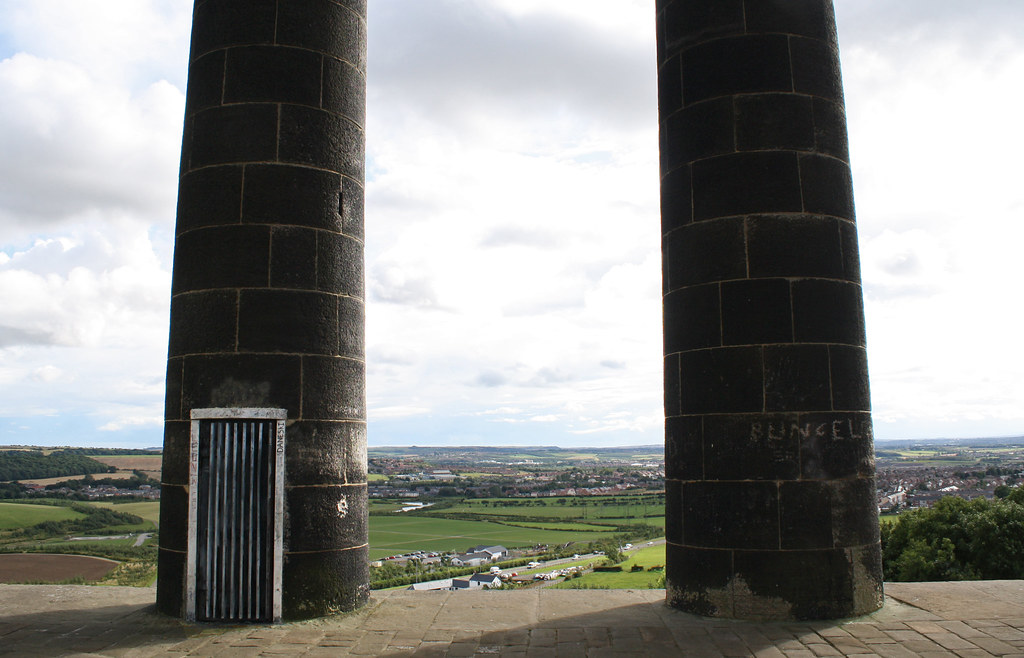
adventure. Anyway they climbed the hill & made their way to a doorway in one of
the pillars, a doorway that leads to steps that climb to the parapet atop the
monument. That pillar & doorway can be seen at left. Just one pillar has
such stairs.
They were not alone.
There were 20 or so others up there also, probably admiring the view & waving to
their friends & relatives below. Remember that the monument was never completed.
Had it been topped with a roof, there surely would not have been a parapet at
all. It ran along both long sides, end to end, edged by a protective wall, & at
each end, a masonry arch arose with a sloping surface some 8? feet across. To a
shallow peak in the centre of the structure. Such structures are called
'pediments'. On those 'pediments' there was no protective wall, no railings or
barriers, & no handholds. I presume that crossing over on those 'pediments' was
the only way to get to the other side of the monument, to be able to see & enjoy the views in the
other direction.
|
You can see the scene quite perfectly
in this most splendid image. 
Temperley Arthur Scott, 15 years
old,
& a friend of his, went around the walkway twice. And they started on a third circuit,
watched by Mitchell & Hind, two of their friends, both sitting on the edge of the peak
- I presume that that means with their feet dangling over the edge. 'Scott was hurrying to reach his companions, when he stumbled and fell, he rolled
over once and then disappeared over the edge of the monument.’ It was 70 ft. or 20 metres to the ground below.
He fell onto rocks, I presume, & was killed.
There was an inquest, held on Apl. 26, 1926, & reported in the
'Sunderland Echo'. It was the first such accident in all of the monument's 82
years, the hearing was advised. Deputy Coroner Boulton returned a verdict of Accidental Death, and said:- 'that
it was a terrible accident to have occurred and they must have the greatest
sympathy with the parents of the boy'. He suggested:- 'that iron railings with
spikes should be put up at the sides to prevent people getting round and if that
could not be done then he could only suggest that the place be locked up and the
public not admitted.’
And the place was locked up. From then to this
very day. With some most rare exceptions (see next para). Or was it always so? Which
brings us back to our site visitor who states that he was running around the top (of the monument)
'in 1948,
1949 or 1950'.
I have read that Temperley Arthur Scott was from Castle
Street in Fatfield. A recent writer
(that link seems no longer to work, alas) says that his late father was one of the
other boys. And that they all lived in Herrington in a street called Old Rows commonly known as
'auld raws'. One writer says that 'a few of my mates went up (to the
parapet) in the late 70's when they were restoring it
... I saw inside the pillar with the staircase and it was just covered in bird
___ (i.e. droppings)'. Another says it is not only locked up but bricked up also.
Another suggests the metal door may be a relatively recent addition.
I have spared the reader a full description of the monument,
its dimensions, its location etc. There are many sites where such data can easily be found, such as the Wikipedia site available here.
But I especially mention two sites. Firstly a fine 'pdf' file, a Fact Sheet
(#14) made available by the Local Studies Centre of the Sunderland City Library
and Arts Centre,
a sheet that few WWW sites seem to have seen or refer to. Available here. It
is a fine publication indeed & contains the brilliant image of the parapets atop the monument that I
have shown above. And the second is a site which records the circumstances of
Temperley A. Scott's death more completely.
There are some nagging questions about the monument
- these words are introduced as the result of one such question e-mailed by a site
visitor.
i) Is the monument as you see it today complete as it was planned? Fact Sheet (#14)
referred to above is clear about the opinion of the Local Studies Centre on the matter - 'About £6,000 was raised by public
subscription, which was used to build the Monument. However funding ran out and
the roof and interior walls were never added.' A great many think that the
opposite is true, i.e. that the monument is in fact complete
- in one writer's words 'As far as I am aware the monument was finished'. I am
surprised that the detail plans of Newcastle architects John & Benjamin
Green are not mentioned re this matter.
ii) Was
the roof omitted because the Earl of Durham had raised rents for his estate tenants
to help pay to finish the Monument & the tenants had rebelled? Author Dawn Cummings
essentially comments that if that were true the Earl of Durham must been a clever fellow indeed. He
died in 1840 & the dedication ceremony was four years later in Aug. 1844. He must
have most cleverly come back from his grave if he indeed tried to raise the estate rents as is suggested.
iii)
A statue of the Earl of Durham, as a rider on horseback, was intended to be on
the top of the monument. But that that statue was given instead to Durham. The
Durham statue is apparently not of the Earl of Durham, rather of the Marquess
of Londonderry. Any statue would surely have destroyed the symmetry of the
structure. And the statue is of the wrong person. The story seems unlikely.
iv) The monument is said to be
based upon the Temple of Hephaestus in ancient Greece. Or is it the Temple of
Diana at Ephesus, Turkey? Did either temple lack a
roof? Both temples still stand to this very day, in Athens & at Ephesus. You
can see hundreds of images of the temples here
& here -
they clearly had roofs, indeed the Temple of Hephaestus still does have its roof!
The monument is today owned by the National
Trust, a gift of the 5th Earl of Durham in 1939.
It would be good to be able to provide through these pages, the
complete texts of the Inquest's decision & of the 'Sunderland Echo' article which reported it. If you have such material, it would be welcomed indeed.
On Aug. 29, 2011, it was possible, for the first time in 85 years, to climb to the top of
the Penshaw Monument. That day, between the hours of 10:00 a.m. & 4:00
p.m., at a fee of
£5 per person, visitors were taken on guided ascents by staff of The National Trust.
In parties of five, leaving every 20 minutes, thru the 6 hour time period. Only
90 visitors in total were able to make the climb, in small parties limited for
safety concerns to 5 visitors per party. Now there were many more than 90 who
wished to ascend the monument but they were all turned away disappointed,
including one person who came especially all the way from Kent & was not able to
buy a ticket. But it
would seem that the day was a great success & there will be many similar opportunities to
ascend the structure in the future. The safety of the climbers was of the
greatest importance. of course, & no tiny children were permitted - you
needed to
be more than a metre tall to be permitted access. A site visitor has kindly provided a newspaper cutting from
the Aug. 30, 2011 edition of 'Northern Echo'.
Visitors were only permitted onto the parapet of just one side of the building.
So the visitors' views over the countryside were therefore limited in
terms of direction. Getting to the 'other side' used to require a scramble over
the arches at either end of the structure - see the image immediately above. I
learn however that wires are now installed (a ManSafe System) that permit maintenance workers to
attach themselves & cross over safely to the other side.
I learn also that there was an unusual eBay item offered by National Trust in
Nov. 2011, the
opportunity for a single adventurous soul to visit both sides of the monument &
cross over both ends. Attached to the wires. At a mid-week future date to be
mutually agreed. As you can read here. The winning bid was
£122, I see.
The weather was fine & the view was splendid.
To prove it, here is site contributor Keith Cockerill atop the monument on Aug. 29, 2011. He
cleverly managed to get a fine picture taken of himself with not another visitor
in sight. Very sneaky! You can see the image in a wider view here.
And do not miss Keith's slideshow
'The River Wear at Washington - its forgotten history' here.

Alan Vickers kindly advises me that the Penshaw Monument was featured in 'A and P News', the employee magazine of Austin & Pickersgill Limited. Two pages were published in Volume 22, of Oct. 1978
& one of those pages contains a fine image of John George Lambton. I provide next thumbnail
images of the two pages. The pages can be viewed in a fully legible size by clicking on the thumbnails.
Alan also advises that a booklet was published in 1978 entitled 'Penshaw Monument - Erected in Memory of the First Earl of
Durham, John George Lambton 1792-1840'. It was written by Albert L. Hind & is of 24
pages - privately published I do believe. I understand, however, that the
booklet almost entirely relates to the life of the Earl of Durham & that its
content about the monument itself is modest.
Now I did try to track down Albert L.
Hind to check his memory of historical details re this section. But I have now
found references to the fact that Albert Hind, who used to live in Fatfield,
died some years ago, that his house was razed (maybe it burned also) & that his
daughter lives in a house on the site today. Should that daughter, who likely
owns the booklet's copyright, wish to consider such a matter, I would gladly
create space on this site to present Albert's 24 page 'Penshaw' booklet so it could be
read, cover to cover, by all who have an interest in the Earl. A way perhaps to acknowledge
& honour his
memory & contribution to local history. The booklet would have to be at hand to do that,
of course, but that is surely possible.

|
|

|
You will be delighted, I am sure, to read the following
little article about Penshaw. Which article was published in 'Son of Coaldust',
a booklet of about 60 pages, by 'Stephenson'. The booklet is undated & contains
no data whatsoever about 'Stephenson'. The booklet, however, was surely published, in the 1980s, by Rev. John Stephenson, former Rector of All Saints', Eppleton. He
retired, in 1996, I read, and in 2010 was living in East Herrington. The church
was clearly his destiny, his purpose in life & his joy. In 1991, he
was described, by the Northern Echo, as the North-East's best known priest. 'A
pacifist, a poet, a campaigner for social justice, a friend to the miners and an
inveterate opponent of the first Gulf War.' And a prolific writer & communicator.
Can anybody put the webmaster in touch with the Reverend
John Stephenson today? Or alternatively I invite him to contact the webmaster. Re
matters of copyright.
The 'tongue-in-cheek' title for the section in which the
following article appears is 'North East Headlines'. A similar section in another of his booklets is entitled 'Believe it or
Not!'.
Can anybody tell me where the coaldust mines that are referred to are today located!
PENSHAW MONUMENT: It has now been confirmed that Penshaw Monument, the
famous East Durham landmark built in the style of a Greek temple in the mid-19th
century, is to be sold to Aristobulus Onassis, boss of the multi-million-pound
Athenian Monastic Enterprises Ltd. for a sum of two million pounds. The monument
will be shipped stone by stone, after dismantling, from Sunderland to Athens,
and re-assembled on the site of the ruined Temple of Theseus which was built in
560 B.C. and which fell into decay because of the high percentage of sodium
chloride (salt) in the atmosphere of the Greek mainland port. A spokesman for
Monastic Enterprises said that the decision to purchase Penshaw Monument had
been taken after a team of experts from Athens University had examined the
monument & had found that the dimensions of the building exactly matched those
of the former Temple of Theseus, and that the stones had been miraculously
preserved by coaldust from the nearby pits. "When we have erected the monument
in Athens", he said, "we will import large quantities of coaldust and regularly
spray it on the stone to ensure that the building will stand for at least 500
years". It is anticipated that the pits closed by Mr. MacGregor on the East
Durham coalfield during & after the 1984-85 pit strike will be re-opened for the
mining of coaldust, leading to the creation of at least 450 new jobs and
allaying the fears of local residents that the pits might be used for the
storing of radio-active nuclear waste.
|
Next, another fun item. A fun image of 'Penshaw'! Of trampolinist
Katherine 'Kat' Driscoll, a 25 year old, of West Rainton,
(between Durham & Houghton-le-Spring), who hopes to represent Britain in the 2012 Olympic Games
to be held in London. Go for it, Kat! As this page was updated in early Jul.
2012, the Olympic Games were just weeks away. I am delighted to tell you that on
Jun. 3, 2012, Kat won the right to represent Great Britain in the Games, at trials
held at the
North West Gala in Liverpool.
The Women's Trampoline Olympic event took place at the London Olympics on Aug. 4, 2012.
Katherine Driscoll ended up in 9th place amongst the 16 athletes who competed in
the qualification round - and did not advance to the finals. Wenna He & Shanshan
Huang, both of China, placed first & second respectively in that qualification
round. But neither won gold in the finals, held about an hour later. Rosannagh
Maclennan of Canada, 4th in the qualification round, beat out both of the
Chinese girls & won gold - Canada's first gold medal of the 2012 Summer Games.
We congratulate Rosannagh Maclennan for her 'come-from-behind' success. And we
congratulate also Katherine Driscoll & the other athletes who earned the right
to represent their respective countries on the world stage.

A
bit of a change of subject. Penshaw?
I read that there were 2 pubs at Penshaw in 1890 - the 'Bird in the Bush' at
Penshaw Staithes. And the 'Bird in the Hand', at Penshaw itself. (There is
an image at that link with Penshaw Monument in the distance.) The following most interesting image,
provided by 'Billy Fish' of Midfield, relates
to one or the other of those pubs it would appear. When the pub was 'a temperance bar'. I
trust that inclusion of the (darkened) image here is in order.

THE 'HAVELOCK HOUSE' FIRE OF 1898
This
page entry came about thanks to the kindness of Craig Hamilton, of Ballarat, Australia.
Who listed a card for sale via eBay which closed on Apl. 19, 2010.
Craig's e-Bay store is here.
Craig kindly provided the image to the webmaster for inclusion here. A most interesting card, which follows:-

Late on Jul. 18, 1898, a Saturday, fire broke out at
'Havelock House', the name by which George H. (Henry) Havelock's (that's George
Havelock at left below) drapery store in
Sunderland, was known. A noted store indeed, located at the major business
intersection known as MacKie's Corners - where Fawcett & Bridge Streets
cross High Street.
|

|
The fire may well have been caused by the
simplest of matters - a cigarette end, carelessly probably nonchalantly dropped
down a grating at street level. Below ground, in the 'well' if you will, the stub is
believed to have fallen amongst other debris - paper included - & smouldered & ignited -
& the fire was under way.
And this was not just any fire. It was the worst fire in the history of
the City of Sunderland. It devastated a truly vast section of the city centre.
Thousands of citizens, & visitors who flocked to the City, thronged the streets
to gawk at the conflagration & the ongoing fire-fighting activities. It was not
hours but rather weeks before the fire was finally extinguished. Not before it
had destroyed business after business in the area - I have read '12 business
premises in High Street West, 11 premises in Fawcett Street, 22 shops, offices &
a Weslyan
Chapel in John Street, & 3 shops in Bridge Street.' A very long list of businesses
(& residences also above those premises), went up in flames or were
extensively damaged. You can read the long
list of premises affected via the first link below. |
The main cause
of the great extent of the disaster was the fire-fighting facilities of the City at the time.
Perhaps I should rather state the lack of such facilities. Fire engines
existed in 1893, i.e. steam driven engines that could pump water from hydrants or the river & play
it at force upon burning premises. But Sunderland did not have any such
engines. Its Fire Brigade was clearly ill-equipped for such a gigantic task. The
City had 'barrows', it is true, i.e. carts that were used to carry hoses & other
firefighting apparatus to the scene of a fire. And apparently lots of
fire hose full of punctures, which hose would be hooked up to the available
hydrants. The firemen & the policemen did valiant duty
over many days. Also, when
the tide was in, Fire Queen, the 2nd steam fire-float of the name owned by the River Wear Commissioners, did
valiant service also, only then able to successfully pump sea-water at pressure
to
the distance & to the height that was required.
The value of the damages was said to have been £400,000, an
astounding value in those days. A tiny contemporary 'New York Times' article equated it then to
U.S. $2,000,000. What a giant sum! And how the currency values (GBP v US$) have changed in the
interval! It was damage from which the businesses & the City recovered only over
the succeeding years.
It would seem that, on the opposite corner from Havelock House, the
store of 'Drury & Son' haberdashers, but previously that of 'MacKie' a
silk top hat maker, was badly damaged but was not totally destroyed. Buildings
far away in the City, however, were damaged by sparks & flying embers.
The authority of the whole subject is James T. Bryce. Whose web page (here) covers
the subject more completely than I can possibly do so in these short pages &
lists the many stores that were affected. He has written, indeed, a book on the subject, entitled
'Sunderland Fire Brigade'. The book includes, I believe, extensive coverage of the 1898 fire. The next
image, indeed, is from imagery kindly provided by Jim - a composite image which
shows, at left, the remains of Havelock House after the fire was extinguished, & at right an animated scene,
near to 'Havelock House'. I do not think that I personally, could ever have
climbed such amazingly long ladders, especially when dressed in protective gear &
dragging a heavy hose. Purposeful fellows those firefighters must have been! A 2007 'Sarah
Stoner' Sunderland Echo article is
most worthy of your attention also.
'Sunderland Fire Brigade', the book, is available from Jim as per
the bottom of this page.

A portion of a splendid image of the site thanks to
Sunderland City Library's Local
Study Centre. Do click the image below for the full image.

Havelock House? It was rebuilt over the next 18 months &
emerged as a prestigious department store, advertised as 'the largest in
Northern England', though in the image which next is featured, the store claims
to be 'The Largest Drapery Establishment in the County of Durham'.
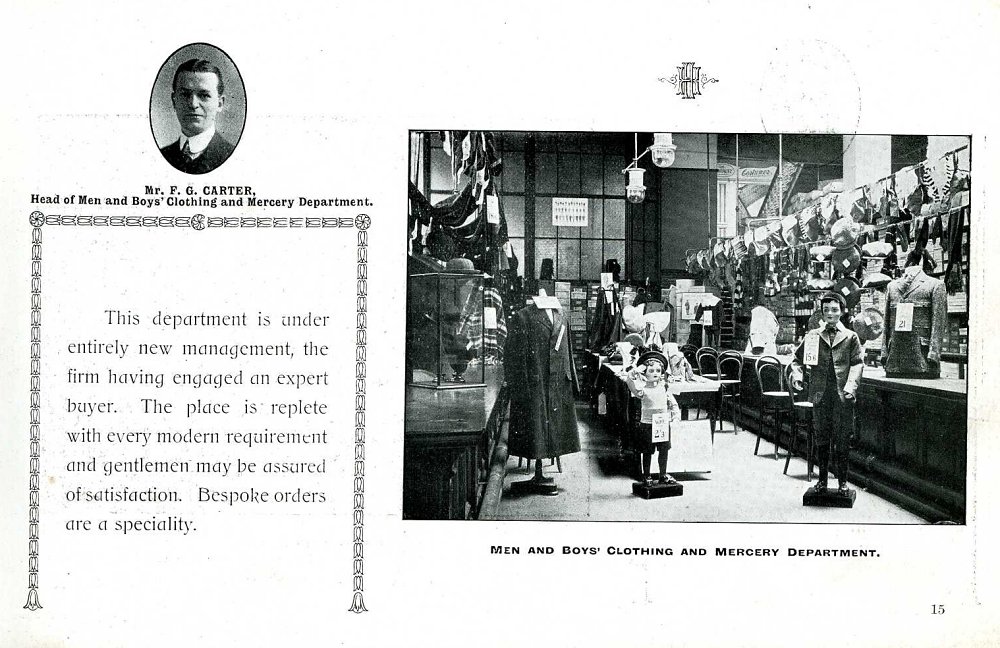
A long term friend & supporter of the site, who prefers
not to be
either identified or even thanked, (but we thank him
regardless), has provided to the webmaster images from a
'Havelock House' booklet. A 'Reorganisation Souvenir' booklet that would seem to have been published when
the new & rebuilt store was opened in 1900. Or was it 1901? A booklet of 32 pages.
All of those pages can be viewed lower on this page, specifically here.
Its very first page is next.
But it would seem that the last two paragraphs above are quite wrong! And the
booklet must be from a much earlier date than 1900 or 1901. Why do I say that?
Jim Bryce has kindly been in touch to advise as follows:- 'You are not
sure of the year that the booklet was produced and assume that it was published
after the store was rebuilt. The store was not rebuilt and the Havelock Cinema,
which opened in 1915, later occupied the site. There was an earlier store,
operated by George Henry Robinson, further down High Street East, but the new
store at Havelock House housed the expanding and thriving business'.
It would be good to know when
Havelock House did first open.


|
What later happened to the store?
It would seem that it did not survive for many more years. (Wrong see Jim
Bryce's words above!)
The 'Provincial Cinematograph Company', of London, acquired
the property in 1914, for between £60,000 & £70,000. The 'Havelock', a very high class cinema,
opened on the site on Dec. 16, 1915. It became the 'Gaumont'
in 1960. And closed in 1963.
A modest shop is at the spot today, I am
told, & the name
'Havelock House' is long gone. |
Is it possible that you have data & particularly images available about this devastating fire. If so, do consider being
in touch with the webmaster, for the inclusion of such
material in this page.
JOPLINGS DEPARTMENT STORE
In the words of Len Charlton (who witnessed the 1954 'Joplings'
fire) ....
'As a youngster I knew of 'Joplings' as one of the largest of Sunderland's big
department stores but little of its history - which goes back to 1804
when James Jopling opened a small drapers shop at the bottom of High Street East
(image at left next below).
With business expanding, he was joined by Joseph Tuer to form 'Jopling & Tuer'.
In 1868, out-growing their premises, the firm moved up to a fine building at 176-177 High Street
East,
(image at right next below), which over the years became ever more popular.

In 1891, it was bought out by 'Hedley, Swan & Co.', (Robert Hedley & Stephen
M. (Moriarty) Swan) who, within a further three years, doubled its size by buying
the adjacent property of 173-175 High Street East. In a big publicity campaign in 1900, a café was added to the
big building & the very latest, i.e. electric lighting, was installed. It had
changed from a drapery store to a department store with over 200 employees.

It even
issued its own coinage for customers!

|
At left (clickable) is a 1 penny coin. There
were other denominations also. Certainly a 1/2 penny. A 6 penny coin. & a 1 shilling coin. Including one, at right, for 2 shillings - which coin would
buy a 4 course meal, elegantly served in the 'Joplings' restaurant.
The name 'Jopling and Tuer' was so well
known that the name was retained so people were still 'going to Joplings'. |
|

|

|
|
In 1921 Joplings moved again, this time
'upmarket' to
126-129 High Street West, where Hedley, Swan & Co. had bought J. T. Calvert
& Co. Ltd.'s
big store on the corner of Lambton Street. The 4 storey store was then renamed 'Hedley, Swan & Co. known as Joplings'.
(An 1890s poster is at left & an
image of the No. 126-129 High Street West store, is below)

These
were the great days of the store. It survived the bombs of WW2 & the subsequent
depression but ...
... disaster struck on Dec. 14, 1954, when the
entire building was destroyed in another of Sunderland's big fires.
|
|
On that cold winter night, I happened to be returning home from a late party.
Driving towards MacKie's corner at about 1.30 a.m., I was
surprised to find the town centre very
busy. I parked my old car to join everyone who seemed to be rushing on foot &
cycle down High Street West and I discovered that Joplings was in
flames. The fire, which had been spotted
at 1 a.m., had spread rapidly & though the structure looked undamaged, the red
flickers through any windows remaining left no doubt that the fire was
already out of control. The firemen had left the inside & were now hastily
moving their equipment & their vehicles away from the front of the building. No
doubt similar scenes were being repeated both
beyond & behind the store which took up a complete block. There was a lot of
noise both from the crowd's excitement & from the many pumps & vehicle
engines. Within a remarkably short time, all of the windows had gone with flame curving
up the front of the building which soon turned into one massive furnace, the glow apparently visible for 20
miles. Periodically, the noise increased as the roof collapsed or masonry fell
into the cleared areas with accompanying oohs & aahs from the onlookers. Pumps
& hoses were working desperately to try to save adjoining buildings, although I
could see little of this. On the opposite side of High Street, Ridings, a large
furniture store, had lost its windows while being hosed down & was now in
serious danger, the manager having to be woken up at 2 a.m. for the keys to be
rushed to the scene. At the height of the conflagration, the heat was
forcing onlookers back still more & I could feel a cold wind blowing from
behind as the air fed the furnace - which surely, I thought, would be the final page
in 'Joplings' history. By 3 a.m. there was
little left to burn in the ruined red hot skeleton. For my part I was feeling very tired
& saddened indeed, &
leaving the scene which was becoming more active as firemen & equipment were
repositioned, I made my way home to bed.

The fire
brigade at one point being surrounded by fires on both sides of High Street &
in adjacent buildings. Business continued in temporary buildings until 1956 when Joplings
reopened in a fine new store on John Street.
In a guestbook message you can read here, Jean Elliott tells
us that after the fire, Joplings opened a very small temporary store, on John
Street.
|
Fast forward almost 50 years. In 2005, with closure imminent, the store was bought out by 'Owen Owen Ltd.'
of Liverpool, but they themselves collapsed 2 years later & the store is now
owned
by 'Vergo Retail Limited'.
Until recently,
walking along John Street, you will find a large busy modern store very
different from the small drapers shop which opened in the East End over 200
years ago. |
|

|


Now, in July 2010, the Joplings story
seems to have ended at last. 'Vergo Retail Limited', who rescued the store from bankrupt
'Owen, Owen Ltd.' in 2007, has itself become a casualty of the declining markets.
Administrators MCR, called in to try to sell Vergo's 19
shops, did not find a buyer for the old Sunderland store & time has run
out. It's very last trading day was June 19, 2010.
 |
To the
older people of Sunderland it is a tragedy - but many of the new
generation regarded Joplings as
outdated in today's world. The store had become an icon loved
by long-time customers & run by staff who took personal pride in serving
them. But whereas Joplings could claim 50,000 customer accounts in its heyday, at the
last count the figure was less than 10,000.
Looking back, Marie Neilson,
the operations manager, said 'There's never been a morning I didn't smile
(as I walked round), but when I was told we only had four weeks I broke down in
front of the staff'.
It is difficult to foresee what will become of the
now locked up premises. |
Located away from the
main shopping centre & with many retail stores struggling to
survive, conversion to flats,
offices or perhaps to a hotel must be the main options - but a sorry period
of dilapidation seems likely. A sad end to a story of over 200 years of service
& survival
for Sunderland's beloved old store.
Does anybody know what caused the Joplings 1954 fire? Len Charlton advises the webmaster that he recalls no word as to how
& why it happened. Was there an inquiry into the fire? If so, surely such a matter would have been addressed.
In Oct. 2020, Barry Moon tells me (thanks Barry!) that he read in the
'Sunderland Echo' that the fire was the result of an electrical fault - in the
basement where the fire began.
I am advised that a poster that read 'Santa Claus is Here
Today', located on the exterior of the building at the corner, was left standing.
As you can see in the next pair of images, believed to have been 'Sunderland
Echo' images. The poster was completely unscathed, while the rest
of the building was devastated. Who says there isn't a Santa Claus!

We hope to add
more 'Jopling' related images soon. If
you have any 'Jopling' images in your own collections, particularly a good
sized image of the 1954 fire, do consider being
in touch with the webmaster.
The sources of the
'Jopling' images used above?
I will
identify them as the sources are located. But ... Should 'Sunderland Antiquarian Society' prefer that I do not use the left
black & white image of the fire above, (#10), I will remove it, of course. With regret since
good images of the fire are scarce indeed. Such applies also to 'New Writing North' whose
colour image at bottom right (#7) was featured in a 'Flickr' Factory Nights archive.
1, 2, 3
(a long gone 'Delcampe' auction item), 4, 5, 6,
7, 8,
9, 10, 11, 12, 13,
14 & 15,
16,
17.
A few 'Joplings' related images. Hover your mouse over each thumbnail to read the subject matter.
THE 'WEAR GLASS WORKS' OF
JAMES HARTLEY & CO.
This section starts with very little data about 'Hartley's Glass Works',
rather with an
image. Kindly provided by Clive Ketley. So this section is initially added as somewhere that
I can place that image & add additional material that is later located. What I show below is a portion only of the whole image, with
additional contrast added with the help of 'Picasa'.
I read that Wear
Glass Works was on Trimdon Street. And that it was in existence from 1837 to
1896 producing patent rolled plate, sheet & stained glass. In 1863 they are
said to have produced one third of all of the sheet glass consumed in England. The
works covered a large area & employed 700 men.
With the expanding amount of material on this page about
'Hartley's', it is becoming clear that we need in this space a tidy history of the company - including
both its amazing success & its gradual decline. For the webmaster, a project for another day
- though
if you feel like summarising that history for inclusion here, your effort would be most welcome.

But now ... eBay has provided more about Hartley's in the form of a wonderful print, published originally, it would seem,
on Nov. 24, 1877. The print, which is 6 1/4 x 5 1/4 in. in size, was offered
by 'periodpaper' of Whitewater, Wisconsin, U.S.A. &
it sold on Apl. 12, 2011 for U.S. $40.00. We
have chosen not to bother 'periodpaper', a giant dealer indeed, re the use of
this 'so appropriate to this page' item on site. But we sincerely thank them
none the less.
The above eBay listing did not indicate the name of the 1877 publication. I now see,
however,
that it was the Nov. 24, 1877 Supplement #99 edition of 'Scientific American', &
that the print was accompanied
by what looks to be an extensive article that extends over 2 pages. As you can see here.

There is a fine additional image of Hartley's Glass Works available via the 'Pictures in Print' site, most similar to that shown above.
Available here.
And there is a second image, of the blast furnaces at night, which can be viewed here.
But ... it is not absolutely sure that that print was re 'Hartley's'. There were
many such blast furnaces throughout the city.
Where exactly was Trimdon Street & therefore the Hartley's plant site?
I learn that the plant was located at the NW corner of the intersection of Trimdon Street (a short north-south street) & Keelmen's Lane (an east-west
street). Neither are in the city's east end, as I initially assumed when I saw
the image which follows, but rather are on the high ground, west of the bridges
& behind Hetton Staiths, or where Hetton Staiths used to be.
The river is therefore behind you in the birds' eye view above. The splendid image that follows, comes from this site, made available by
'Durham County Council, Arts, Libraries and Museums Dept.', now located, it would seem in the Clayport Library, in Durham City.
Its date of creation is not known, but it was published, I read, in 1872. But
likely published elsewhere too.

So now if I spot any data about 'Wear Glass Works' in the future, I can add it in here. Or your data can be added also, should you be able to provide
any.
A history of the company can, I see, be found at this
'National Archives' site.
FLEET VISITS TO SUNDERLAND
There have been many fleet visits to Sunderland over the
years. Certainly I have seen via eBay images of medals that were struck to
commemorate the events. And soon, hopefully, we can include here images of
such medals. One such medal is already shown below, the front & back of a medal issued
to commemorate the visit of 'Devastation' in 1874. Another copy of a somewhat
similar medal can be seen here. Ex a long expired eBay
listing. In Oct. 2013, another copy of the medal is available via Delcampe. 
But next an interesting little story ex a book
entitled 'Wearside Wedges' - written by J. H. Meek & published in 1912.
We thank Keith Cockerill for item. Keith advises that the book is full of short humorous stories about Sunderland
folk, all written in the vernacular Sunderland dialect - which may be a little
difficult to understand.
A 'Wearside Wedge' was a nickname for a Sunderland shipwright or carpenter
in the days of wooden ships. The word 'wedge' probably because a significant part of
a shipwright's duties was to split timbers.

LIME KILNS AT FULWELL
This tiny section is not yet indexed above, since its content
is so very limited. It is added to simply show an eBay
item of
late Oct. 2012 that caught
my eye - a label for
a 1954 shipment of kibbled lime that originated from the lime kilns of 'Sir Hedworth
Williamson's Lime Works, Ltd.', of Sunderland.
I read that 'kibbled' lime was
a course grade with lumps the size of your fist.
 |
The kilns are worthy of coverage in these pages as and when time
permits. I quickly read that there were a number of lime kilns located at Fulwell, just
north of the Fulwell Mill. The kilns burnt magnesium limestone extracted from
the now-landfilled Fulwell Quarry. The quarry & kilns
were the property of the Williamson family, possibly from as early as 1714.
Such kilns, which operated for
centuries
until closure in 1957, were formerly linked by three waggonways to the River Wear.
At the North Dock area most probably. But the label at left is, of course, for
lime that was rather shipped by railway.
The lime was shipped all over the north
east. Remains of two of the kilns still exist. |
A most extensive 'pdf' archaeological report re the Fulwell Lime Kilns can be read here.
May I suggest that you navigate the site via the
index on page 001. PRIOR PAGE / NEXT PAGE PRIOR PAGE / NEXT PAGE
Thomas M. M. Hemy Data Pages
01,
02
&
03 are now on site. Plus all
of the other image pages, accessible though the index on page
05.
To MV Danmark
Slider Puzzle
page
&
to the
Special Pages Index.
| A SITE SEARCH FACILITY
THE GUEST BOOK - GO
HERE
|
|
A 'HAVELOCK HOUSE' BOOKLET

|
The webmaster
had assumed that the 'Havelock House' booklet that follows, was published when the new & rebuilt store was opened in 1900/1901.
But Jim Bryce tells me that the store never re-opened. So the booklet
must date from much earlier. Of 32
pages, all of which are available below for viewing in a larger size with a
mouse click.
The images look & indeed are 'repetitive' in both style
& content, but each
features a department or function of a department store of over a century ago. A
store where many functions were performed 'in house', including I read, making furniture for sale on the premises, 'from the rough
wood to the finished article'.
The webmaster was particularly pleased to see that it contains an image of George H. (Henry) Havelock,
the proprietor. And pleased also, since the webmaster
is an accountant, to see the image (at left) of a portion of the accounting
department (counting house). Not a computer in sight! Not even a telephone. |
|